
⚡ Quick Summary (TL;DR):
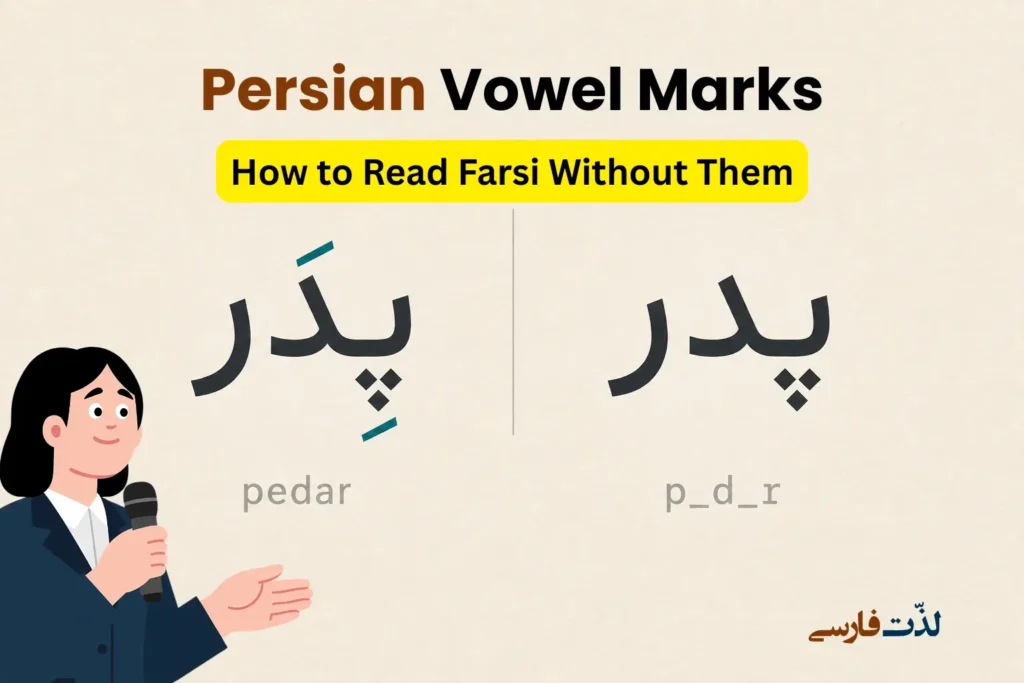
- Persian writes consonants and long vowels. The short vowels are optional. The Persian short vowel marks exist — فتحه، کسره، ضمّه — and then almost nobody prints them.
- The three long vowels aren’t marks at all. ā, i and u are written with the letters ا، و، ی. They are on the page, in full view, and they are the reason unvoweled Persian is readable.
- Three short marks to recognise: fathe ـَ (above), kasre ـِ (below), zamme ـُ (above). You’ll meet them in dictionaries, children’s books, textbooks and poetry. Rarely anywhere else.
- Leaving the Persian vowel marks off is a design decision, not a defect. One written form of پرسیدن serves both porsidan and pursidan. Persian has kept a single spelling across dialects and centuries by refusing to commit to a vowel.
- The real skill is section four. Reading a line that gives you consonants and expects you to supply the rest — and why it’s far less ambiguous than it looks.
- Ezāfe is the one you’ll genuinely need. A small -e that links a noun to whatever describes it, carries a large share of Persian grammar, and is almost never printed.
You learned the letters. Then you opened a real Persian page.
You can pick ب out of a line. You know ش has three dots and س has none. You’ve been through the chart and the four sounds that actually need work. So you find something real — a news headline, a shop sign, the caption under a photo — and you start at the right-hand edge, and you get three letters in, and stop.
The vowels aren’t there.
Not hidden, not small, not in some font you don’t have. Simply absent. The page has handed you a row of consonants and moved on, as though you were expected to know the rest already.
You were. That’s the system, and this article is about how to live inside it.
What the page actually gives you
The three long vowels are letters, not marks
Start here, because it’s the good news and almost every beginner misses it.
Persian has six vowels: three long, three short. The three long ones — ā, i, u — are not diacritics at all. They’re written with letters you already know: ا (and آ at the start of a word), ی, and و. مادر carries its ā openly. میز carries its i. دوست carries its u.
These never disappear. A long vowel is spelled out with a full letter, exactly as b or m is, and no writer can leave it off without misspelling the word.
The complication is that ا، و، ی also do consonant duty. From our own lesson notes: و can be /v/ in وام, /u/ in روز, /o/ in دو, /ow/ in دولت. ی can be /y/ in یک, /i/ in میز, /ey/ in نِی. And ه at the end of a word is usually the vowel e, as in خانه (khāne). So the letter tells you a vowel is present — it doesn’t always tell you which one. That’s still an enormous head start.
The three short vowel marks
The short vowels a, e, o have no letters of their own. They have marks, placed on the consonant that comes before them. Here is the full set of six, long and short together, with native audio:
Long vowels — written with letters, never omitted
Short vowels — diacritics, almost always omitted
Look at the three short-vowel examples: دست، گرفت، شد. Not one of them shows its vowel. That is the normal state of written Persian.
Transliteration throughout this article follows the Iranian Studies Transliteration System, the standard used by the Cambridge-published journal Iranian Studies, alongside IPA. The two answer different questions: IPA tells you what the sound is, ISTS gives you a consistent way to write Persian in Latin letters.
That’s all there is. A bare ب with no mark is simply b, with no vowel after it. So a single Persian letter carries four possible readings, and the diacritic is what decides between them — which would be fine, except that the diacritic is almost never printed.
For how each of these vowels actually sounds, and for the mouth positions behind them, go to Persian alphabet pronunciation. This article is about what’s on the page, not what comes out of your mouth.
Why Persian leaves the short vowels off
The usual explanation is that it’s a leftover from Arabic and everyone puts up with it. That’s not quite right. The omission does real work.
Take پرسیدن. In the standard dialect of Iran it’s porsidan. In the standard dialect of Afghanistan, and in a number of regional dialects inside Iran, it’s pursidan. The written form is identical. Or کردن: kardan in all three standard varieties, but kerdan around Kerman, Yazd and Shiraz, and kordan elsewhere. One spelling, no argument. Or رسیدن, normally residan in Iranian Persian and rasidan in literary or classical delivery — again, same letters.
A writing system that spelled out every short vowel would have had to pick a side. Persian didn’t, and as a result a text written a thousand years ago is still spelled the way you’d spell it today, and a reader in Kabul, Dushanbe and Shiraz can each read it in their own mouth.
The cost lands on you, the learner, and it’s a real one: you have to know the word before you can read it. Persian readers aren’t decoding these words. They’re recognising them.
How to read Persian without vowel marks
This is the actual skill, and it’s more learnable than it feels at three letters in.
Read the skeleton, then count the gaps
Look at مادر. The letters give you: m — ā — d — r. Three consonants and one long vowel, already spelled out. There is exactly one unmarked slot, between د and ر, and it can hold only a, e or o.
Three candidates. In practice, one: mādar.
That’s the pattern for most Persian words. Because long vowels are written, the ambiguity is rarely spread across the whole word — it sits in one or two short slots, with three options each, inside a language where only one combination is usually a real word. Unvoweled Persian looks like a code. It behaves more like a crossword clue you’ve already solved before.
Let the long vowels anchor you
Train your eye to find ا، و، ی first, before you work through the consonants. They are where a word’s vowels live. دوست gives you its u in the middle — the skeleton is d‑u‑s‑t, and once you know the word there is nothing left to supply. میز gives you its i the same way. نان gives you its ā, leaving one consonant on each side and no short slot at all.
But these letters are helpers, not guarantees. A medial و is usually u — and sometimes o, as in دو (do), sometimes the diphthong ow, and in a few Persian words it is not pronounced at all. ی is the same: usually i, but a consonant at the end of چای (chāy) and in the middle of سایه (sāye). So finding ا، و، ی tells you where a word’s vowels are likely to be; it does not always tell you which. That is still a large head start over a word that offers nothing: پدر, pedar; بد, bad — every vowel supplied from memory.
Persian has two words for each parent, and they fall on opposite sides of this line:
Every vowel on the page
No vowel on the page
Play all four. The vowels are equally audible in every one — but only two of these words put them on the page. Reading research calls the first pair transparent and the second pair opaque.
بابا and مامان spell themselves out. You could read them cold, having never met them. پدر and مادر can’t be read cold by anyone. Same meanings, same language, same page — and only one pair is doing you a favour.
Learn the vowels with the word
This is the part most self-teaching learners get wrong, and it’s the reason people stall at this exact stage.
Do not learn پدر as “p-d-r, and I’ll work out the vowels later.” Learn it as pedar, with its vowels, the first time you meet it — the way you learned that English colonel is “kernel”. The written form is a reminder of a word you already hold, not a set of instructions for building one.
This is also why serious Persian teaching materials print the diacritics on a word’s first appearance and drop them afterwards. Our courses work that way: full marks when a word is introduced, then bare script once the spelling is expected to be known. The marks are scaffolding. They come down.
Use grammar and context as a filter
When a skeleton genuinely allows two words, the sentence usually rules one out. Reading researchers have a name for the two kinds of Persian word you have been meeting: transparent words, where the vowels are letters and there is only one way to say them, and opaque words, where the short vowels are missing and the same letters could be read several ways. سرد is the standard example, the letters allow sard, serd and sord, and only one of the three is a Persian word. Studies of Persian readers find that transparent words are read faster and more accurately than opaque ones, by children and skilled adults alike, and that experienced readers handle opaque words by recognising them whole rather than sounding them out. That is the skill you are building, and it comes from vocabulary and reading volume rather than from studying the marks.
If you’re wondering how long this stage takes, we’ve written a realistic timeline for the alphabet as a whole.
Try it
Six words, no marks. Find the long vowels first, then work out how many short slots are left. Say each one aloud before you open the answers.
کتاب مادر خانه بزرگ ایران نان
Show the answers
Notice that ایران and نان didn’t change when the marks went on. Everything they needed was already written.
Where to build this into a habit
Reading unvoweled Persian is drill work. You need words introduced in an order that never asks you to guess, with a native voice confirming or correcting each attempt, dozens of times.
That’s what The Persian Alphabet, Decoded is built for. It works through the 32 letters in a staged sequence where every example word uses only letters you’ve already met — no filler, no words you can’t yet parse — with 120+ interactive exercises that tell you whether you got it right, native audio dictation, and worksheets that guide you rather than sitting blank. That staging is exactly the discipline an unvoweled reader needs: you never face a skeleton you haven’t been prepared for. Price: €70 €49 (30% Off Launch Tier), self-paced.
If you’d rather meet the script inside real Persian than in drills, Listen to the Reed teaches the same letters through Rumi’s opening lines.
The alphabet is the entry point; when the script stops slowing you down, Let’s Learn Persian A1 is where you start building the vocabulary that makes unvoweled reading automatic.
Ezāfe: the mark you’ll actually need
Everything above is about marks you won’t see. This one you’ll need constantly, and you still won’t see it.
Ezāfe (اضافه) is a short unstressed -e that links a noun to whatever follows and describes it — an adjective, a possessor, a name:
- کتاب فارسی — ketāb-e fārsi, “the Persian book”
- کتاب من — ketāb-e man, “my book”
- آب سرد — āb-e sard, “cold water”
In writing, ezāfe is a kasre on the last letter of the first word: کتابِ من. In practice that kasre is left off, exactly like every other short vowel. So the page gives you two nouns sitting next to each other and expects you to hear a linking -e that was never printed.
When the first word ends in a vowel, the ezāfe becomes -ye, and that form usually does get written, because it needs a letter: خانهٔ من — khāne-ye man, “my house”. The hyphenated -e and -ye you see in transliteration here are the ISTS convention for exactly this.
Why this matters more than the rest of this article: you cannot parse a Persian noun phrase without it. Miss the ezāfe and a two-word phrase falls apart into two unrelated words. It is the single most frequent thing Persian writing leaves off the page, and the first invisible feature worth training your ear to expect.
Sukun, tashdid, tanvin — borrowed, and mostly resting
Three more marks exist. Persian inherited them from Arabic and uses two of them rarely.
Sukun (سکون), a small circle above a letter, marks the absence of a vowel — this consonant is bare. It does serious work in fully vocalised Arabic texts such as the Quran. In Persian, including in teaching materials, it’s uncommon.
Tashdid (تشدید), a small w-shape above a letter, doubles that consonant. You’ll see it in dictionaries and careful typesetting, and usually not otherwise. Transliteration handles it by simply writing the letter twice: معلّم becomes moʿallem, “teacher”.
Tanvin (تنوین) is the exception — the one Arabic mark you’ll meet in ordinary Persian text. Written as a double fathe over a final ا, it turns certain Arabic loanwords into adverbs ending in -an: لطفاً (lotfan, “please”), مثلاً (masalan, “for example”), تقریباً (taqriban, “approximately”). These are everyday words and the mark is normally printed, because without it the reading changes.
If a mark in this group appears in something you’re reading, treat it as a gift. Someone has decided you need help.
Where this goes next
The Persian vowel marks are the last thing standing between recognising letters and writing them, because you can’t sensibly form a Persian word until you know what the script leaves out. The next step is putting pen to paper — the letterforms, the connections, and why handwriting still matters even for adult learners who’ll mostly type. We’ll cover the how of it in the writing guide.
Everything in this cluster lives on the Persian alphabet posts hub.
FAQ
Why doesn’t Persian write short vowels?
Because not writing them lets one spelling serve every dialect and every century. پرسیدن is read porsidan in Iran and pursidan in Afghanistan and parts of Iran, from an identical written form. The marks exist and can be added when a reader needs help — dictionaries, children’s books and textbooks use them — but standard writing assumes you know the word.
How do you read Persian without vowels?
Find the long vowels first: ā, i and u are written with the letters ا، و، ی and are always on the page. What’s left is a small number of short slots, each with three possible values, inside a language where usually only one combination is a real word. مادر gives you m-ā-d-?-r, and mādar is the only answer. The skill is vocabulary-driven: you learn each word with its vowels, then recognise it on sight.
What are the Persian vowel marks called?
فَتحه (Fathe) for a, placed above the letter; کَسره (Kasre) for e, placed below; ضَمّه (Zamme) for o, placed above. Collectively these are the harakat, borrowed along with the script from Arabic.
Does Persian use the same diacritics as Arabic?
The same set, much less often. Persian has fathe, kasre, zamme, sukun, tashdid and tanvin, but uses far fewer of them in ordinary text than fully vocalised Arabic does. Persian also adds one Arabic doesn’t: ezāfe, an unstressed -e linking a noun to its modifier, written as a kasre when it’s written at all.
Do I need to learn the vowel marks if the text never shows them?
Yes, for two reasons. Learning materials and dictionaries use them, so you’ll need to read the marked forms to learn new words correctly. And knowing that exactly three short vowels exist is what makes an unmarked word solvable rather than infinite.
 Add as a preferred source on Google
(Click the link and check the box next to our name)