
⚡ Quick Summary (TL;DR):
- Typing feels faster, but handwriting builds a different, deeper kind of memory — one grounded in motor learning, not just visual recognition.
- Persian’s cursive, position-changing letterforms and right-to-left flow make it a script where the hand genuinely teaches the eye.
- Research on Dual Coding and embodied cognition suggests that pairing a physical action with a visual symbol creates a stronger, more retrievable memory trace than sight alone.
- This isn’t a “kids only” concern. Adult learners who skip handwriting often plateau at passive recognition — they can read a letter but can’t reconstruct it from memory.
- You don’t need calligraphy skills. A few minutes of deliberate handwriting per lesson is enough to lock in the shapes for good.
Introduction
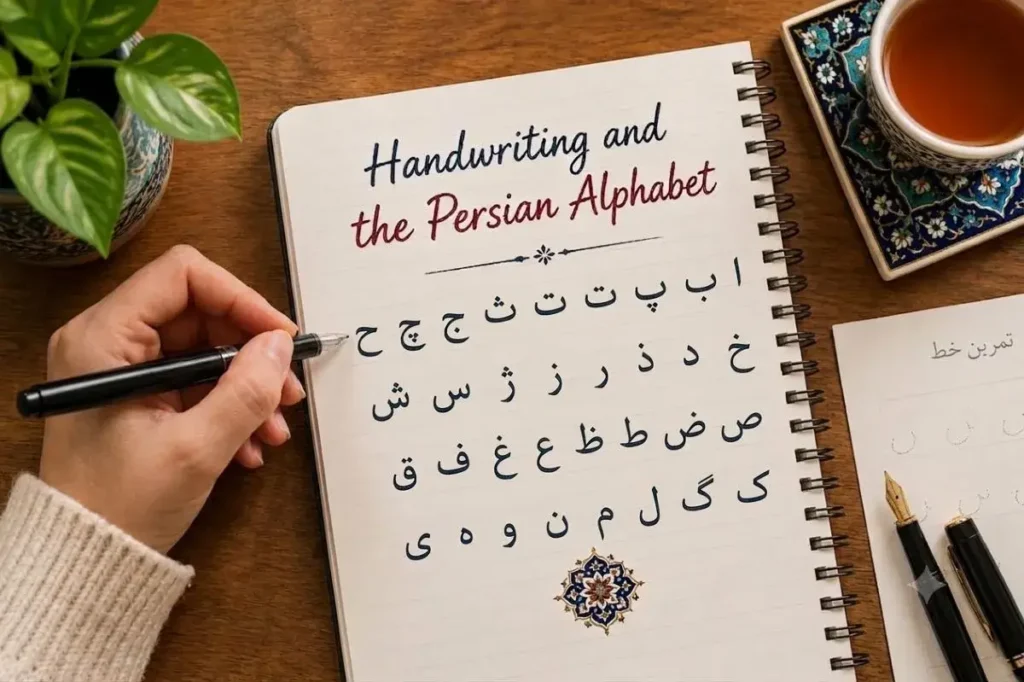
If you’ve read our earlier piece on why learning the Persian alphabet matters, you already know that literacy — not just conversation — is what turns a language learner into a genuinely independent reader. But there’s a follow-up question that trips up almost everyone once they commit to learning the script: do I actually need to write these letters by hand, or can I just learn to recognize them on a screen?
It’s a fair question. Most adult learners haven’t picked up a pen for sustained handwriting since school, and typing feels like the obviously efficient choice. But when it comes to an unfamiliar, cursive, right-to-left script like Persian, skipping the handwriting step quietly caps how far your recognition skills can go. Below are the five main reasons fine motor practice is doing real cognitive work — not just tradition for tradition’s sake — followed by a few ways to build it into a busy adult schedule.
1. Letter Shape Recognition
Persian script is cursive by design: most of its 32 letters change shape depending on whether they sit at the start, middle, or end of a word, or stand alone. That means a single letter can have up to four visually distinct forms, and a beginner effectively has to learn several alphabets layered on top of one another.
Writing each form by hand forces you to notice the details that separate them — where a tooth appears, where a tail curls, where a dot sits — because your hand has to physically reproduce that difference, not just glance past it. Passive reading lets the brain get away with “close enough” pattern matching. Writing doesn’t allow that shortcut, and the payoff is a visual recognition system that’s linked to a physical action, not just a vague impression.
In my own beginner classes, this shows up constantly with confusable pairs — students mix up ل (lām) and ا (alef) for weeks because the two look almost identical on the page. The distinction only sticks once they’ve written both, side by side, enough times to feel the difference in their hand: ل connects on both sides, ا only on the right. And Persian schoolchildren aren’t immune either — even native speakers in first grade routinely confuse letters that sound identical but are spelled differently, which is simply a normal part of learning any script, not a sign that something’s wrong with an adult learner who struggles with the same thing.
2. Right-to-Left Orientation
For learners coming from Latin-script backgrounds, right-to-left writing isn’t just a rule to memorize intellectually — it’s a spatial habit your hand has practiced in the opposite direction thousands of times. Reading right-to-left is relatively easy to adapt to. Writing right-to-left is where the retraining actually happens, because it requires new, deliberate motor planning every time you start a line.
Repeated handwriting practice retrains that directional flow at a motor level, so the orientation eventually stops requiring conscious effort — the same way you no longer think about which direction to move your eyes when reading English.
A word like نیستان (neyestān) is one I like to assign early precisely because it mixes connecting and non-connecting letters — the hand has to shift its rhythm mid-word, right to left, rather than settling into one continuous motion.
3. Fluency Through Repetition
Cognitive scientists distinguish between controlled processing (slow, effortful, one step at a time) and automatic processing (fast, effortless, parallel). Early on, every Persian letter you encounter requires controlled processing: you consciously recall its shape, its position-based variants, and its sound.
Repeated handwriting is what shifts letter recognition from controlled to automatic. Once your hand — and by extension your brain — has traced a letter enough times, you stop consciously recalling its form. That automaticity is what frees up working memory for the things that actually matter at more advanced stages: pronunciation, meaning, and grammar. Skipping this step doesn’t eliminate the cognitive load; it just defers it to later, when you have less patience for it.
4. Multi-Sensory Learning
Handwriting engages three channels at once: the hand (motor), the eye (visual), and — if you say the letter aloud as you write it — the ear (auditory). This isn’t a minor bonus. Paivio’s Dual Coding Theory proposes that information encoded through both a verbal and a non-verbal (in this case, motor and visual) channel is easier to retrieve later than information encoded through only one channel, because there are effectively two independent retrieval paths to the same memory.
In practice, that means a letter you’ve written by hand while saying its sound out loud tends to be far stickier in memory than a letter you’ve only tapped on a keyboard or scrolled past on a flashcard.
One of my favorite exercises is having students write their own name in Persian script while saying it aloud, letter by letter. It’s a small task, but I’ve watched it visibly boost a student’s confidence more than almost any other exercise — there’s something different about producing your own name with your own hand, in a script that felt completely foreign an hour earlier.
5. Confidence and Engagement
There’s also a less measurable but very real effect: learners who can produce the script by hand tend to feel a stronger sense of ownership over the language. Typing a Persian word uses a system — autocomplete, transliteration keyboards, copy-paste — that does a lot of the work for you. Writing a word from memory, with your own hand, is unambiguous proof that you know it. That small, repeated proof of competence is what builds the confidence to keep going, especially through the early weeks when the alphabet still feels unfamiliar.
How to Build This Into Practice (Without Overdoing It)
You don’t need formal calligraphy training, and you don’t need hours a day. A few practical guidelines:
- Write before you type. In each lesson, trace and copy new letters by hand at least once before you rely on a keyboard or app for practice.
- Say it as you write it. Speaking the letter’s sound aloud while forming it stacks the auditory channel on top of the motor and visual ones.
- Start with the non-connecting letters. Seven Persian letters never join to the letter that follows them, so words made entirely of these letters behave like simple, separated block printing — a gentle entry point before you tackle full cursive joins.
- Ten focused minutes beats sixty distracted ones. Short, daily handwriting practice builds automaticity faster than infrequent long sessions.
- Write big first, shrink later. Larger letterforms are easier for your hand to control while the motor pattern is still new; let the size shrink naturally as the movement becomes automatic.
- Group letters by family. ج، چ، ح، خ share the same base shape and differ only by the number and position of their dots. Learning them together, rather than in isolation, fixes the shared motor pattern faster.
FAQ
Do I really need to handwrite Persian if I’ll mostly type it later?
Yes, at least during the learning phase. Typing is a fine long-term habit once the letterforms are secure, but the initial memory encoding is measurably stronger when it’s paired with the motor action of handwriting. This isn’t just true for children — a study that trained adults on unfamiliar characters found that recognition accuracy for hand-copied characters stayed stable over the following weeks, while accuracy for typed characters gradually declined. Skipping straight to typing tends to produce learners who can recognize letters passively but struggle to recall or reproduce them without a reference.
Is handwriting practice only useful for children?
No. Fine motor practice supports letter-shape memory at any age. Adult learners actually have an advantage here: they can be far more deliberate and metacognitive about why they’re practicing a particular stroke, which speeds up the transition from controlled to automatic recall.
How much handwriting practice is enough?
For most adult learners, a few minutes of focused, deliberate writing per new letter — repeated across a handful of lessons — is enough to move a shape from short-term recognition into durable memory. More matters less than consistency.
Does this apply the same way to typing on a Persian keyboard?
Typing helps with speed and digital fluency, but it doesn’t engage the same fine motor pathways as handwriting, and the visual-motor link it builds is weaker. The two skills are complementary, not interchangeable — which is why we recommend handwriting first, typing second.
How do I stop confusing similar-looking Persian letters?
In my experience teaching the alphabet, the fastest fix isn’t more reading — it’s writing confusable pairs (like ص/س) side by side in the same practice session, so your hand learns the contrast directly instead of trying to memorize it visually.
Conclusion
Reading Persian script, as we’ve argued before, is what separates learners who can genuinely navigate the language from those who stay dependent on translation. Handwriting is what makes that reading skill stick. It’s a small, low-tech habit with an outsized cognitive payoff — one that adult learners can build in minutes a day, without any special materials beyond a pen and paper.
If you haven’t started yet, the easiest place to begin is Lesson 1 of “Listen to the Reed: Learn the Persian Alphabet with Rumi,” where handwriting practice is built directly into the exercises. Thanks to the generous support of the DhunAnand Foundation, the course is completely free until September 30, 2026, using the discount code RUMIDAF1.
Pick up the pen. The letters will follow.
 Add as a preferred source on Google
(Click the link and check the box next to our name)