
At twenty minutes a day, six days a week, most adults can name all thirty-two Persian letters in three to four weeks.
That is the number you came for. It is also the number that misleads more learners than any other, because naming the letters and reading Persian are not the same achievement, and nobody tells you there is a gap between them until you are standing in it.
So here is the fuller answer, with the gap marked.
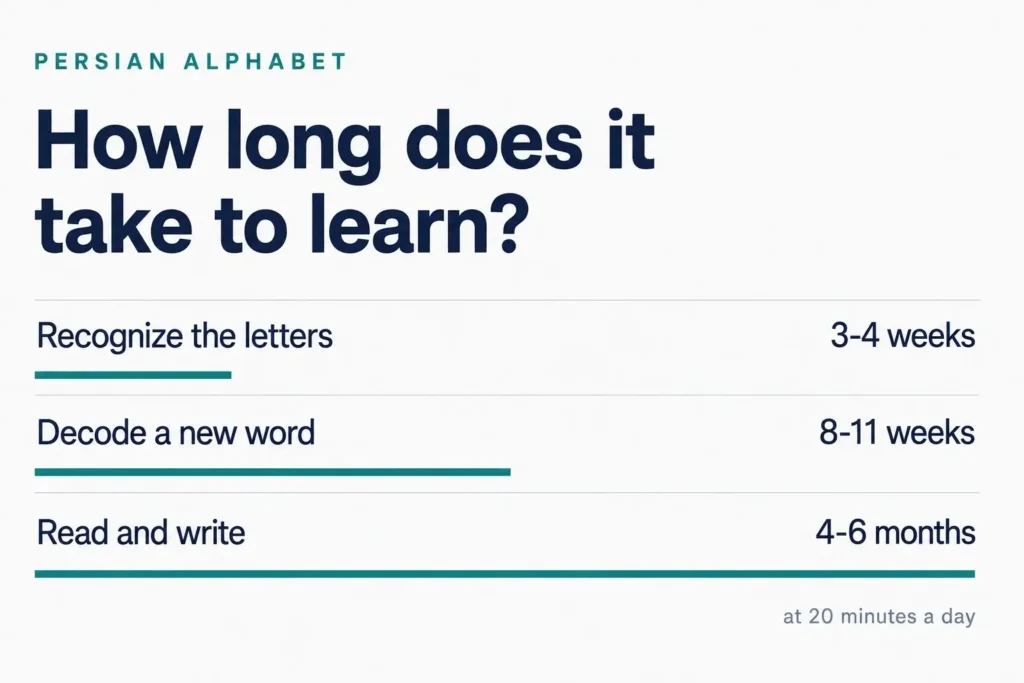
“Learning the alphabet” is three finish lines, not one
Ask ten people how long the Persian alphabet takes and you will get ten different answers, mostly because they are quietly answering different questions.
Recognition
3–4 weeksYou see a letter on its own and you know its name and its sound.
The fast one — and the one every timeline on the internet is quietly quoting.
Almost nobody quits during stage one. Almost everybody who quits does it here: they reach recognition in three weeks, feel genuinely capable, open a real page of Persian, and conclude the three weeks were wasted. They were not. They were the first third.
In a 2021 training study, adults learned Arabic letters either by writing them or by watching them. Both groups reached the same recognition score. Then they were asked to write the letters from memory:
Decoding
8–11 weeksYou meet a word you have never seen, in a real sentence, and you can work it out aloud — including the letters that change shape depending on where they sit, and the vowels that were never written down.
Roughly three times as long as recognition.
Reading and writing
4–6 monthsFamiliar words arrive whole instead of letter by letter. You can write a shopping list by hand and an Iranian can read it.
This is the one that turns into an actual skill.
Timings are for twenty minutes a day, six days a week, with no previous experience of a right-to-left script. Change any of those and the three dates move independently — the calculator below works out your own.
Here is the judgement I would offer after years of watching adults move through this: almost nobody quits at finish line one, and almost everybody who quits does it just after. They hit recognition in three weeks, feel genuinely capable, open a real page of Persian, and conclude that the three weeks were wasted. They were not. They were the first third.
If you know the middle stage exists before you get there, it stops being evidence of failure and becomes what it actually is — the part where the learning happens.
The realistic timeline
Six days a week, learning the letters alongside simple words built only from letters you have already met, practicing actively with some handwriting, and starting with no previous experience of a right-to-left script.
| Time per day | Recognize every letter | Decode unfamiliar words | Read and write comfortably |
|---|---|---|---|
| 10 minutes | 5–7 weeks | 4–5 months | 9–12 months |
| 20 minutes | 3–4 weeks | 8–11 weeks | 4–6 months |
| 30 minutes | 2–3 weeks | 5–7 weeks | 3–4 months |
| 45 minutes | 8–11 days | 3–5 weeks | 9–12 weeks |
Read down a column rather than across a row. Doubling your daily time roughly halves the calendar, but it does not compress the middle column the way people expect, because decoding is limited by how many separate days your brain gets to consolidate on — not by how many minutes you stack into one sitting.
The honest answer is that you will know within a week whether this is for you. Listen to the Reed is twelve sessions, taught through Rumi’s verses. Start Session 1 — a demo lesson, no signup required — and see how the first four letters feel in your mouth and under your pen. A week of honest evidence beats a month of deciding.
Run your own numbers
Work out your own number
How long will the Persian alphabet take you?
Three answers, because “learning the alphabet” has three finish lines. Move the controls to match your real life, not your ideal one.
A planning estimate, not a promise.
Where these numbers come from — and where they don’t
Stage 1 is anchored in a 2021 training study of adults learning Arabic letterforms, scaled up for Persian’s larger set of positional shapes.
Stage 2 has no published research behind it. Nobody has measured time-to-criterion for decoding unfamiliar words in a right-to-left script. Eighteen hours is an informed estimate, not a measurement.
Stage 3 comes from Dr. Leila Seyedghasem’s classroom. Her fastest student — no Arabic, no Urdu, no Persian family, starting from zero — got there in five weeks of one weekly hour plus home practice. Her slowest took three months, same format. We don’t know how many hours either of them put in at home, so the figure here is reasoned outward from that, with an allowance for studying without a teacher.
We would rather tell you that than dress a guess up as a fact.
If you have learned the Persian alphabet — with us or anywhere else — leave your real numbers in the comments: minutes a day, days a week, and how long it actually took before you could read a familiar word without sounding it out. Every real figure makes this less of an estimate.
The table above holds four things fixed. The calculator lets you move all of them: your real minutes, your real number of days, how you practise, and where you are starting from. It gives you three dates instead of one. Arabic and Urdu readers in particular should run it — your head start on letter shapes is enormous and your head start on reading Persian at speed is much smaller, and the calculator shows you both.
The variable the timelines leave out
Every timeline you will find quotes minutes. None of them asks what happens inside the minutes. That turns out to be the larger factor.
The closest thing to direct evidence comes from a training study run at Johns Hopkins in 2021, and it tested almost exactly our situation. Forty-two adults with no knowledge of Arabic learned twenty letters of the Arabic script — cursive, right-to-left, letters that change shape by position, the same structural problems Persian poses. They were split into three groups: one copied each letter by hand, one found it on a keyboard, one watched it and responded on screen. Same letters, same audio, same time on task.
Same finish line, different destination
Adults learning Arabic letters by handwriting, by typing, or by watching. All three groups trained until they hit the same recognition standard — then were tested on something nobody had drilled them on.
The watching group trained for more sessions than the writing group — and still finished furthest behind.
Wiley, R. W., & Rapp, B. (2021). The Effects of Handwriting Experience on Literacy Learning. Psychological Science, 32(7), 1086–1103. Full text. Twelve participants per group.
First finding: everyone reached recognition, and the method barely mattered. The handwriting group needed 3.67 sessions on average, the typing group 3.92, the watching group 4.25. A gap of about fifteen percent. If naming the letters is all you want, how you practice is close to irrelevant.
Second finding: after all three groups had reached the same recognition standard, they were tested on things nobody had drilled them on. Asked to write the letters from memory, the writing group scored 91 percent, the typing group 78.5, the watching group 64.5. Asked to read words, the writing group scored 66.6 percent against 59.2 for watchers and 50.8 for typers.
And here is the part that should change how you plan. The watching group had trained for more sessions than the writing group and still finished behind on every single measure. Extra time did not close the gap. Whatever the writing group had built, the watching group was not building a slower version of it — they were building something else, and more hours of the same would not have got them there.
Which means practice method is not a speed dial. Below finish line one it hardly registers. Above it, it decides where you stop.
Be honest about the limits: twelve people per group after dropout, Arabic rather than Persian, four sessions rather than four months. It is one study, not a settled literature. But it points the same way as the broader evidence on active versus passive learning — a meta-analysis of 225 studies found students in lecture-only courses failed at roughly one and a half times the rate of students in courses built around doing things — and the same way as what we see in class every term.
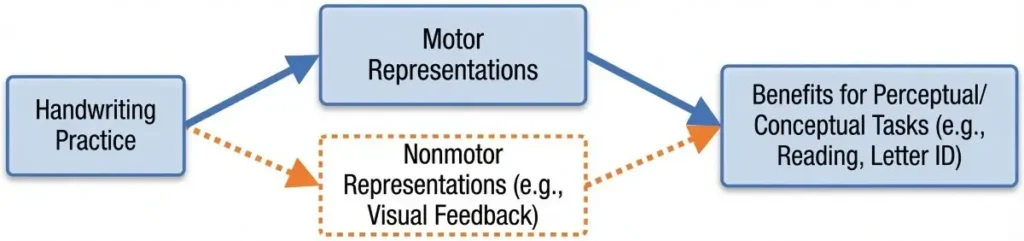
The practical version, and the reason handwriting is worth the minutes, is that the pen is what stops recognition from staying passive. It is also why both Joy of Persian paths build writing into the exercises rather than leaving it as optional homework. Watching is the thing that does not work. Which of our two paths you choose matters much less than that.
Source: Wiley, R. W., & Rapp, B. (2021). The Effects of Handwriting Experience on Literacy Learning. Psychological Science, 32(7), 1086–1103. Full text.
What actually slows people down
Four things, in the order they tend to bite. None of them is intelligence.
Grouping look-alike letters without writing them.
Persian has families of letters that share one skeleton and differ only in the number and position of their dots. Teaching them as a family is the right call — the shared shape is a single motor pattern, and learning that pattern once is far cheaper than learning it four times over. But the grouping only pays off if you are producing the letters. Group them and merely look at them, and the family fuses into one blurry thing with a decoration problem, and you spend a fortnight untangling what you should have separated with your hand in an afternoon. Group them, and write them.
Treating positional forms as four times the work.
Most letters have several shapes depending on whether they start a word, sit inside it, end it, or stand alone. Learners who try to memorize every shape as a separate item are memorizing well over a hundred things, and they stall around week two. In practice, most letters keep a recognizable core and gain or lose a tail. Once you see the core, the count collapses.
Short vowels that are not written.
This is the real plateau, and it arrives almost exactly when recognition is complete. English trains you to expect letters to map onto sounds. Persian writes the long vowels and leaves most short ones for you to supply from knowing the word. There is no trick for this. There is only vocabulary — which is why decoding speeds up dramatically once you are learning words rather than letters, and why any alphabet course worth taking introduces words from the first lesson.
Linguists call this orthographic depth — how directly a script maps onto sound. Persian is regular but not shallow, and it is opaque in both directions: unwritten short vowels mean you cannot pronounce an unfamiliar written word with certainty, and several letters share a single sound, so hearing a word does not tell you how to spell it. One study of Iranian primary-school textbooks put the average gap between what is written and what is said at about 1.4 phonemes per word. That is why the difficulty feels unfamiliar rather than merely harder.
Stopping and restarting.
Two weeks on, one week off, two weeks on is not five weeks of progress. It is closer to three, because the gap eats the letters you had only just stabilised. Of everything on this list, this is the one that decides outcomes. Ten minutes daily beats an hour on Sunday, and it is not close.
The learning material
Those four are things that happen to you. There is a fifth category that is not your fault at all: the material itself. We have cataloged the five failures that recur across existing alphabet books and courses — from example words built out of letters you have not met yet, to the complete absence of any feedback on whether what you just wrote or said was right — on the Persian alphabet courses hub page. It is worth reading before you buy anything, ours included.
The Persian Alphabet, Decoded: A Complete Course was built as the answer to that list: twenty-two hours of structured study, 120+ interactive exercises and guided handwriting worksheets, at €70, with a tiered launch discount that shrinks as places fill. Letters arrive in a deliberate order, every practice word is built only from letters already introduced, and the writing is part of the lesson rather than a suggestion at the end of it.
So is the Persian alphabet hard?
It is front-loaded, not deep. That distinction matters more than the word "hard".
The set is closed and small: thirty-two letters, four of them Persian additions that Arabic does not have. There are no tones, no thousands of characters, no grammatical gender waiting inside the script. Whatever difficulty exists is concentrated in weeks two to five, and then it drops off sharply — the opposite shape to Chinese, where the character load keeps growing for years.
Against other scripts an English speaker might meet: the Cyrillic alphabet is easier, mainly because its letters do not change shape according to position. Hangul is easier still. Chinese and Japanese are in a different category entirely. Persian sits in the middle, and its one genuinely unusual demand — reading words whose vowels are not fully spelled out — is a skill that transfers to nothing else you have done.
Some perspective on the cost. The US Foreign Service Institute, which has been training American diplomats for decades, files Persian (Farsi) among its "hard languages" and puts the classroom time at roughly 44 weeks — about 1,000 hours — to reach professional working proficiency, on top of substantial self-study. The alphabet, on the numbers in the table above, is somewhere between six and forty-five of those hours. Under five percent of the journey, and at the fast end well under one.
And that target is measured in speaking and listening, so the script is not even counted inside it. The alphabet is not a slice of the journey. It is a small, unavoidable thing you do beside it.
The script is the cheapest part of Persian. It is also, for reasons that have nothing to do with difficulty, the part people use to decide whether to start at all.
What week four actually looks like
Concretely, at twenty minutes a day, by the end of week four you can expect to: read shop signs and menu headings, write your own name, spot the four Persian-only letters in a line of text, and pick your way through a short line of poetry with the transliteration beside you.
You will not be reading a newspaper. Nobody is, at week four, in any language with a new script.
What you will have is the thing the alphabet is for: text stops being decoration and starts being something addressed to you. Everything after that — the A1 course, conversation, poetry — is built on top of a skill you can acquire in under a month of small, unglamorous sessions.
FAQ
Can I learn the Persian alphabet in a week?
You can learn to Recognize most of the letters in a week at forty-five minutes a day. You will not be able to read with them. Recognition in a week is realistic; decoding in a week is not, for anyone.
Can I learn the Persian alphabet from YouTube videos?
You can reach letter recognition that way, and it will take you only modestly longer than any other method. What watching does not build is the ability to write the letters from memory or to decode words you have not seen — and the evidence suggests that gap does not close simply by watching more. Use videos, but write alongside them.
Is the Persian alphabet harder than the Arabic alphabet?
Slightly easier for an English speaker. Persian has four more letters, but drops several Arabic sounds that English speakers find hard to produce, and Persian spelling has fewer surprises for a beginner. If you already read Arabic or Urdu, the shapes will cost you days rather than weeks.
How long does it take to learn Farsi script if I already speak some Persian?
Faster in the second and third stages, not the first. The letter shapes take you about as long as anyone else. Decoding is where you pull ahead, because the words you sound out are words you already know — which is the whole difficulty for everyone else.
Do I need to learn the alphabet before learning to speak Persian?
No, but delaying it costs you. Transliteration works for a few weeks and then quietly caps your vocabulary, because most Persian material worth reading is not transliterated. Most learners who put the script off end up doing it later at a worse time. There is a longer case for why the script is worth it at all, if you are still weighing that up.
 Add as a preferred source on Google
(Click the link and check the box next to our name)