
⚡ Quick Summary (TL;DR):
- Most of the alphabet isn’t the problem. Persian alphabet pronunciation is usually taught as 32 separate lessons, but around 25 of those letters map onto sounds your English-speaking mouth already produces. You don’t need a tutorial for those — you need the chart.
- Four sounds genuinely need work: خ (a throaty /x/), ق and غ (one uvular sound written two ways), ع and ء/ئ (a glottal stop — a real consonant), and ر (a quick tongue tap, not the English “r”).
- The honest scope is the point. Guides that promise “the mouth position for every letter” pad out 25 easy letters to look thorough. This one covers the handful that will actually change how you sound.
- ح vs ه is not on the list. In Persian these two letters are pronounced identically. The difference is a spelling difference, not a pronunciation one.
- Plus: the exact technique I used to teach my nine-year-old son to say ر after years of substituting “y” for it — and why it works just as well for adults.
You already know most of these letters
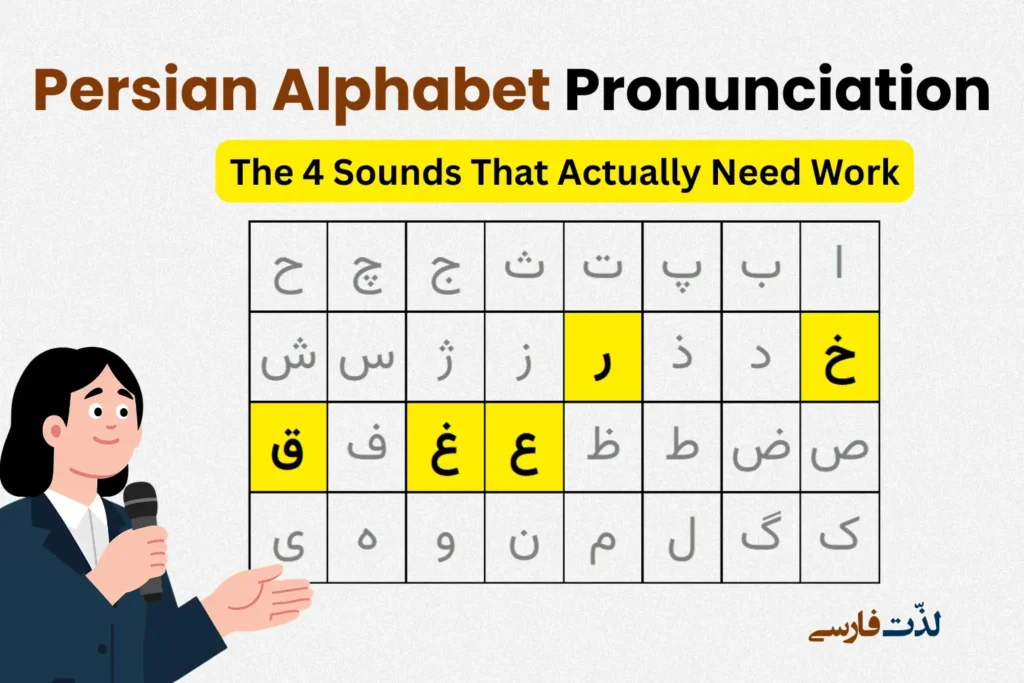
If you speak English, most of this alphabet is already in your mouth — you just haven’t been told which parts.
Persian has 32 letters. Six of them — خ، ق، غ، ع، ء، ر — carry sounds that need real work from an English-speaking mouth. That leaves roughly 25 that don’t.
Some of those 25 are easy for a reason that surprises people: Persian inherited letters from Arabic that mark distinctions Persian itself doesn’t make. Four different letters (ذ، ز، ض، ظ) are all pronounced /z/. Three (ث، س، ص) are all /s/. ت and ط are both /t/. ح and ه are both /h/. You learn one sound and get several letters for free — the work there is spelling, not pronunciation.
We’ve already mapped all of this, with native audio for every letter and every positional form, in the Persian alphabet chart. If you haven’t been through it, start there and come back. Nothing below repeats it.
Transliteration below uses ā for the long “a” in father, gh for both ق and غ, and an apostrophe ‘ for the glottal stop.
خ (khe) — the sound English lost
IPA: /x/ — voiceless velar fricative
English used to have this sound. It’s the gh in night and thought, which stopped being pronounced centuries ago and left the spelling behind. Scottish English kept it in loch; German has it in Bach.
How to make it: Start to say “k”. Notice where the back of your tongue rises to touch the soft palate. Now do exactly that — but don’t let the tongue quite make contact. Leave a narrow gap and push air through it. You should hear a rough, continuous hiss, not a clean pop. Your vocal cords stay off: this is a whispered sound, like an angry cat.
Where it goes wrong: English speakers reduce خ in one of two directions. Either they close the gap and it becomes /k/ — خوب (khub, “good”) turns into “kub” — or they abandon the tongue position entirely and settle for /h/, giving “hub”. Both are immediately audible to a Persian ear.
Practice words: خوب (khub, good) · خانه (khāne, house) · تلخ (talkh, bitter) · تاریخ (tārikh, history)
ق and غ — one sound, two spellings
IPA: /ɢ ~ ɣ/ — uvular
Here’s the piece that most guides get tangled up in. In the Persian spoken in Iran today, ق and غ are the same sound. They are two different letters representing one pronunciation. The letters were distinct in Classical Persian and remain distinct in Dari and Tajik, and in some southern Iranian dialects — but for a learner aiming at standard Iranian Persian, treat them as one sound with two spellings, the same way English writes one /f/ sound as both f and ph.
How to make it: Say “g” as in good and hold the contact point in mind — the back of the tongue against the soft palate. Now slide that contact backwards, toward the uvula, the small flap hanging at the very back of your throat. It feels uncomfortably far back at first. That’s the right feeling.
The sound has two natural variants depending on position, and you don’t need to think about them — they happen on their own once your tongue is in the right place. At the start or end of a word, it comes out as a full stop, a hard catch at the uvula: قند (ghand), باغ (bāgh). Between two vowels it softens into a continuous, gargling fricative: آقا (āghā), چاقو (chāghu).
Where it goes wrong: English has no uvular consonant at all, so learners default to /g/, the nearest thing they own. آقا becomes “ah-gah”. This is the single most common giveaway in a foreign Persian accent, and it’s the contrast we drill below.
Practice words: قند (ghand, sugar cube) · آقا (āghā, sir/mister) · چاقو (chāghu, knife) · باغ (bāgh, garden) · دروغ (dorugh, lie)
Note on transliteration:
this site broadly follows the ISTS system, which writes these as two different letters — q for ق and gh for غ — because it preserves the historical distinction. In the Persian spoken in Iran today, they are one sound.
ع and ء / ئ — the consonant you can’t see
IPA: /ʔ/ — glottal stop
You make this sound every day. It’s the catch in the middle of uh-oh. Some English speakers use it in button and kitten. What English never does is treat it as a letter — so learners meet ع on the page, hear nothing obvious in the audio, and conclude it’s silent.
It isn’t. It’s a consonant, produced by snapping the vocal folds shut and releasing them. Persian writes it two ways: as ع, and as hamze ء / ئ. Same sound, two written forms — exactly as the chart describes it.
How to make it: Say “uh-oh” slowly and freeze at the moment between the two syllables. That closure at the throat is the sound. Now say “ah”, then cut it off sharply mid-vowel — the cut-off itself is a glottal stop.
Where it goes wrong: Learners drop it and glide straight through. جمعه (jom’eh, Friday) becomes “jomeh“; معلم (mo’allem, teacher) becomes “moallem” with a smooth vowel slide instead of a clean break.
One honest caveat about position. At the start of a word, ع is hard to notice — because English also inserts a small glottal stop before any word beginning with a vowel. Say “apple” and you’ve made the sound already. The place where ع genuinely does work in Persian is in the middle and at the end of words, and that’s where the drills below focus.
Practice words: جمعه (jom’e, Friday) · معلم (mo’allem, teacher) · سؤال (so’āl, question) · مسئله (mas’ale, problem/issue)
ر (re) — the tap, not the roll
IPA: /ɾ/ — alveolar tap (flap)
Persian ر is not the English “r”. They aren’t close. English /ɹ/ is an approximant: the tongue bunches or curls near the roof of the mouth and never touches it. Persian ر is a tap: the tip of the tongue makes one quick, light contact with the ridge behind your upper front teeth and immediately leaves.
You already produce this sound if you speak American English — it’s the tt in butter and the dd in ladder. Say “butter” at normal speed and pay attention to what your tongue does on the tt. That flick is Persian ر.
One refinement: at the start of a word, Persian ر is often produced with a short trill — two or three rapid contacts instead of one, like a Spanish rr. Elsewhere it’s a single tap. If you can only manage the single tap, use it everywhere; you’ll be understood perfectly.
Where it goes wrong: English speakers import the English /ɹ/ wholesale. It’s intelligible, but it’s the most persistent marker of a foreign accent in Persian, because ر is everywhere.
The month my son learned to say ر
Rāstin, my son, was about nine and still couldn’t produce this sound. He replaced it with ی — a “y”. Which meant that his own name came out as something close to “Yāstin”. When people asked him his name, he’d look at Leila or me and let us answer for him.
Leila had been worried about it for months and was ready to book sessions with a speech therapist in Iran. I told her I’d handle it.
What I found while researching was that this pattern has a name. Speech-language pathologists call it gliding: children substitute a glide (/w/ or /j/, roughly “w” or “y”) for a liquid consonant (/r/ or /l/) before the liquid is fully acquired — the classic English example being “wabbit” for “rabbit” (overview from Speech Therapy PD). Liquids are among the last consonants children master. In Shriberg’s widely used grouping, /ɹ/ and /l/ sit in the “Late 8” — the eight English consonants acquired last (Shriberg, 1993, as summarised in this JSLHR paper) — and a large 2020 review of U.S. studies put the average age of acquisition for /ɹ/ at the 90% criterion somewhere in the 5;0–5;11 range (Crowe & McLeod, 2020).
An important honesty note: that research is English-language child phonology, and English /ɹ/ is a different sound from Persian /ɾ/. I could not find a Persian-specific study of this. So I’m not claiming research proves anything about Rāstin. What I found was a well-documented, named, cross-linguistic pattern — liquids come late, and glide substitution is a normal step on the way — and a nine-year-old at my kitchen table who fit it exactly.
While gathering material for our Listen to the Reed course, I came across videos and articles by speech therapists describing techniques for teaching exactly this sound. I assembled them into the sequence below, and we worked on it in a handful of sessions over about a month.
Then one afternoon he said it. Properly. He jumped straight up in the air. And, as promised, we went out for döner kebab.
The technique, step by step
1. Silent Practice
Train the tongue with no voice at all. Place the tip of your tongue about 2–3 millimetres behind your upper front teeth, just behind the bumpy ridge (the alveolar ridge).
Then drop your tongue quickly to the floor of your mouth. Repeat: up, tap, drop. Treat it as a warm-up, not a sound.
2. Find the Spot
Use sounds you already have:
– Say “d” and notice where it touches. – Move slightly back for “n”. – A little further back for “l”. – Just beyond is Persian ر.
Move between these four points slowly until the last one stops feeling like a guess.
3. Add Voice
From that position, practise saying:
Let the tongue make one quick, light tap each time. Don’t push — a tap is a flick, not a press.
4. Keep Going
This takes repetition, not talent. The tongue is learning a motor pattern. A few minutes a day beats one long session a week.
A supplementary reference: the Glossika Phonics channel has a one-minute clip demonstrating the sound — “[r] voiced apical alveolar trill”. It’s not our video; credit goes entirely to Glossika. Two honest caveats: the title says trill, meaning multiple rapid contacts, while Persian ر in most positions is a tap, a single contact. It’s a useful reference for the tongue position and the general quality of the sound, not an exact model of the Persian consonant.
And the closing point, which is really why I’ve told you all this: if this sequence got a self-conscious nine-year-old from “Yāstin” to “Rāstin” in about a month, an adult who can read an articulatory description and check their own tongue placement in a mirror has every advantage.
Minimal pair drills
Producing a sound in isolation is one thing. Keeping it distinct from its nearest neighbour under the pressure of real words is another. English collapses several distinctions that Persian keeps, and these three pairs are where that costs you.
Read each pair aloud, alternating, until the two words feel like different words rather than the same word said twice.
خ vs ه — /x/ vs /h/
English has /h/ but not /x/, so learners flatten خ down to it and lose the contrast entirely.
Listen for it: /h/ is just breath. /x/ has friction — you should hear the air scraping.
ق / غ vs گ — uvular vs velar
Different place of articulation and different manner. English speakers who only have /g/ often can’t hear the difference at first, which is exactly why these pairs are worth drilling before you can produce the sound cleanly.
If both words in a pair sound identical to you, the fix is your tongue position, not your ears — go back to the ق/غ section and slide the contact point further back.
ع vs nothing — glottal stop or no glottal stop
The hardest contrast to hear, because the “other” member of the pair is silence. But it’s a real, meaning-bearing difference:
The vowel is the same in each pair. The only difference is the catch in your throat before the final consonant. Exaggerate it while practising — you can dial it back later.
FAQ
How many Persian letters are actually hard to pronounce for English speakers?
Four sounds, spread across six letters. خ, the ق/غ pair (one sound, two spellings), the ع/hamze pair (one sound, two written forms), and ر. Around 25 of the 32 letters map directly onto sounds English speakers already produce, so those need no articulatory instruction at all — just the alphabet chart and its audio.
Is Farsi pronunciation the same as Persian pronunciation?
Yes. “Farsi” is the Persian name for the language and “Persian” is the English name, so a guide to Farsi pronunciation and a guide to Persian pronunciation are describing the same thing. What does vary is the variety: this article describes standard Iranian Persian. Dari (Afghanistan) and Tajik keep a few distinctions Iranian Persian has merged — most notably ق and غ, which remain separate sounds there.
What’s the difference between ح and ه in Persian?
In pronunciation, none. Both are /h/. The two letters come from Arabic, where they represent different sounds, but Persian collapsed them. The difference matters for spelling only, and we cover which words take which letter in the alphabet chart.
Do I have to roll my r’s to speak Persian?
No. Persian ر is a single quick tap of the tongue tip, not a sustained roll. If you speak American English you already make this sound in the middle of butter and ladder. A short trill does appear at the start of some words, but a clean tap everywhere will sound completely natural.
How long does it take to get these sounds right?
The positions can be learned in an afternoon; making them automatic in connected speech takes weeks. But it needs less practice time than you’d think. My son and I worked on ر in short sessions of about twenty minutes, two or three times a week — and after a month, he could produce the sound. What mattered was the correct tongue position and consistency, not long drilling sessions. For the broader question of alphabet timelines, see how long it takes to learn the Persian alphabet.
Where to practise next
Reading about tongue positions gets you maybe a third of the way. The rest is hearing a native speaker produce the sound, producing it back, and finding out whether you got it — repeatedly, on real words, in the order that builds.
That’s what The Persian Alphabet, Decoded is built for. It works through all 32 letters in five staged groups with native audio at every step, plus structured pronunciation drills on exactly the contrasts above — so خ and ه, ق and گ don’t stay theoretical distinctions on a page. Around 22 hours of active study, 120+ guides and exercises, 160+ flashcards, fully self-paced.
If you’d rather meet these sounds inside real Persian rather than in drills, Listen to the Reed: Learn the Persian Alphabet with Rumi teaches the same 32 letters through Rumi’s opening lines, live-recorded. It’s free until September 30, 2026 with the code RUMIDAF1, thanks to the DhunAnand Foundation.
Four sounds. That’s the whole hill. Everything else you already knew how to say.
 Add as a preferred source on Google
(Click the link and check the box next to our name)