
Persian Alphabet
Why You Should Learn to Read and Write in Persian?

Many learners focus on conversational Persian, and that’s fantastic! But have you considered unlocking a whole new level of understanding? Imagine accessing authentic resources, connecting with native speakers, and boosting your fluency – all through the power of reading and writing.
But picture this: the true joy of swimming doesn’t come solely from dipping your toes. To experience the exhilarating plunge, the refreshing coolness, and the freedom of movement, you need to get fully immersed. Similarly, unlocking the true depth and appreciation for the Persian language requires mastering its written form.

Speaking Persian is great — but reading and writing unlock a completely different world.
When you know the Persian alphabet, you gain access to authentic resources, connect with Persian-speaking communities on social media, and multiply your learning speed. Just like swimming: the real joy comes when you fully immerse yourself, not just when you dip your toes in.
Curious what exactly awaits you? Read the 6 compelling reasons to learn reading and writing here — then come back to this page to start your journey.
Two Paths, One Destination
Fall in love with Persian through Rumi’s poetry, or master the script fast with an engineered method. Both paths teach you to read and write — and both lead to your next step: Let’s Learn Persian (A1).
Listen to the Reed: Learn the Persian Alphabet with Rumi
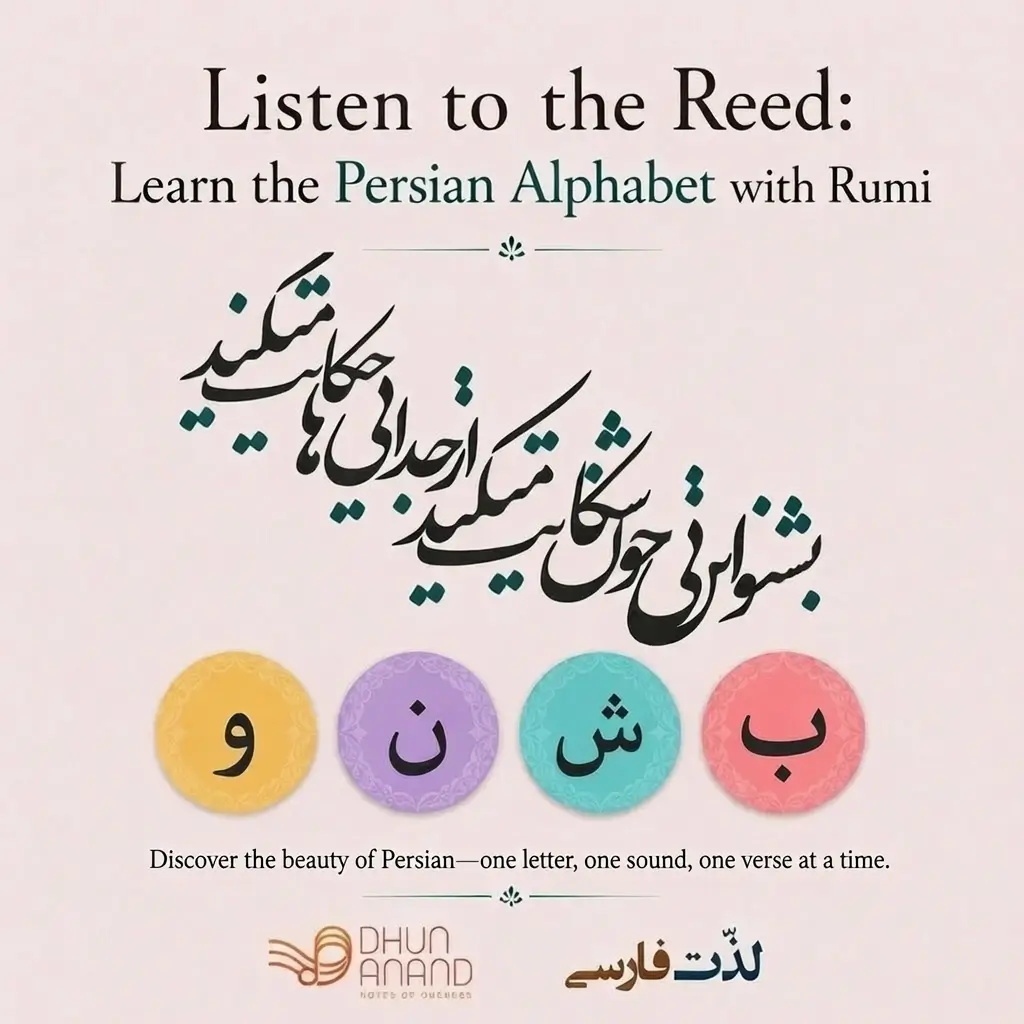
🎁 FREE until Sep, 30 2026 🎥 Live Class Recordings 🔍 Word-by-Word Analysis 📆 1-Year Access
Join a 12-session journey to learn the Persian alphabet through the soul-stirring verses of the Neynameh, where poetry brings every letter to life.
For the poetry lover
The Persian Alphabet, Decoded: A Complete Course
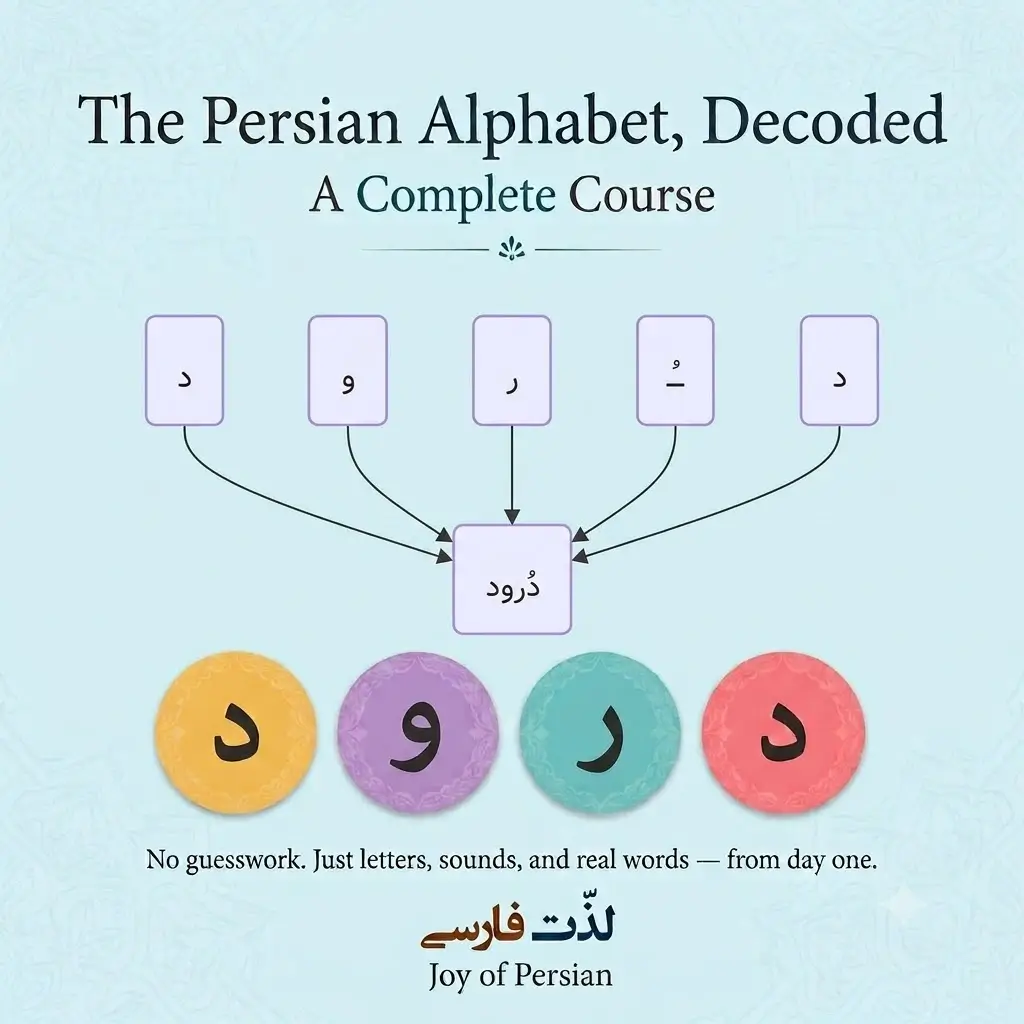
🚀 €49 Launch Price 🧩 120+ Interactive Exercises ✍️ Guided Handwriting Worksheets 📆 1-Year Access
The fastest, most structured path — 22 hrs of active study, 120+ interactive exercises, native audio, handwriting worksheets. Master it once, for good.
For the structured learner who values their time
Decoding the Challenge:
Why Mastering the Persian Alphabet Can Feel Tricky
While the Persian alphabet boasts fewer characters than its Chinese and Japanese counterparts, many students and aspiring learners still find it challenging to master. To understand this perceived difficulty, we analyzed readily available books and online courses aimed at teaching the Persian alphabet and identified the following recurring issues:
- Introducing complexities too soon: Grouping similar letters is a proven strategy for teaching the Persian alphabet. However, a common pitfall in many resources is starting with joining letters like “ب.” These letters can have up to four forms: (isolated, initial, medial and final), creating hurdles for beginners who haven’t yet grasped the basic letter forms.
- Examples that do not match the flow: Another frequent misstep is using examples containing unintroduced letters. Imagine stumbling upon “کتاب” (book) while just learning “ب” and “ت”. This throws in the unknown “ک” causing confusion and stalling understanding. Just like learning “book” before the “k” sound creates a disconnect, so do such mismatched examples in Persian.
- Focus on memorization: Many resources prioritize rote memorization of isolated letters, neglecting their pronunciation variations and contextual forms. This approach fails to engage learners and build practical reading and writing skills.
- Inadequate feedback mechanisms: Learners often lack opportunities to receive personalized feedback on their pronunciation and writing, hindering their progress and leaving them unsure of their accuracy. Interactive exercises and assessments can address this gap.
- Lack of cultural context: The alphabet often stands alone, devoid of cultural grounding. Integrating basic vocabulary, common greetings, and everyday expressions can inject motivation and demonstrate the alphabet’s real-world application.
Many resources prioritize rote memorization, neglecting to build practical reading and writing skills.
Our Solution
While grouping similar letters establishes a solid foundation, mastering the Persian alphabet requires overcoming several challenges.
For optimal learning, materials should provide examples that strictly follow the introduced letter sequence. This allows learners to solidify their understanding of each letter before encountering new complexities. Instead of words like “کتاب” (book), opt for examples like “بابا” (dad) or “توپ” (ball) that reinforce previously learned sounds and build upon existing knowledge.
Start with disjoining letters: …
Addressing these challenges, we built The Persian Alphabet, Decoded — a course with more effective and engaging methods for teaching the Persian alphabet, making it more accessible and enjoyable for learners of all backgrounds.
Our pedagogical approach is built on a foundation of structured progression and contextual learning:
- Staged Introduction of Letters: We begin by teaching the isolated forms of letters that do not join to the left (like “د” or “ر”), allowing learners to build immediate confidence. We then systematically introduce joining letters in small, logical groups, focusing first on their distinct isolated and final forms before progressing to the more complex initial and medial forms. This “crawl, walk, run” method prevents cognitive overload.
- Controlled, Predictable Examples: Every single practice word and example in our early lessons is constructed only from letters the learner has already mastered. This ensures 100% comprehension, reinforces previous learning, and builds a powerful sense of progression. You will never see a word like “کتاب” until after “ک” has been thoroughly introduced.
- Contextual and Sound-Based Learning: We move beyond rote memorization by teaching each letter within the context of its sounds and common words. Learners don’t just see ‘ب’—they practice its different forms through audio examples, minimal pairs, and interactive listening exercises from the very beginning.
- Cultural Immersion from Day One: The alphabet is the key to a rich culture, not an abstract exercise. We integrate simple, high-frequency vocabulary, greetings, and essential phrases into the lessons. This demonstrates immediate utility, boosts motivation, and connects the script to the living, breathing Persian language and the people who speak it.
By combining this thoughtful structure with interactive technology and cultural relevance, we transform the learning journey from a frustrating hurdle into an engaging and successful first step toward fluency.
Ready to start? The Persian Alphabet, Decoded puts this exact method into practice — with interactive exercises, native audio, and handwriting worksheets. Get the course
Once you’ve mastered the Persian alphabet, you can dive into the Let’s Learn Persian (A1) course or participate in a related workshop.
FAQ
Do I need to learn the alphabet before speaking Persian?
No, but delaying it caps your vocabulary sooner than you expect, because most Persian worth reading is not transliterated. Six reasons to learn the script →
How long does it take to learn the Persian alphabet?
Most adults recognize all 32 letters within three to four weeks at twenty minutes a day. Reading unfamiliar words takes two to three months, and comfortable reading with legible handwriting takes longer still. Full timeline and calculator →
Which path should I choose — Rumi or Decoded?
Choose Listen to the Reed if poetry is what drew you to Persian and you like learning inside a story. Choose Decoded if you want the shortest structured route and value your time. Both teach the same letters and both lead to Let’s Learn Persian (A1) →.