
Last year, I was teaching Session 2 of our “Listen to the Reed: Learn the Persian Alphabet with Rumi” course, and right around the 51-minute mark, the class took a beautiful detour — the kind I could never have planned, but that I’ve come to treasure most in live teaching.
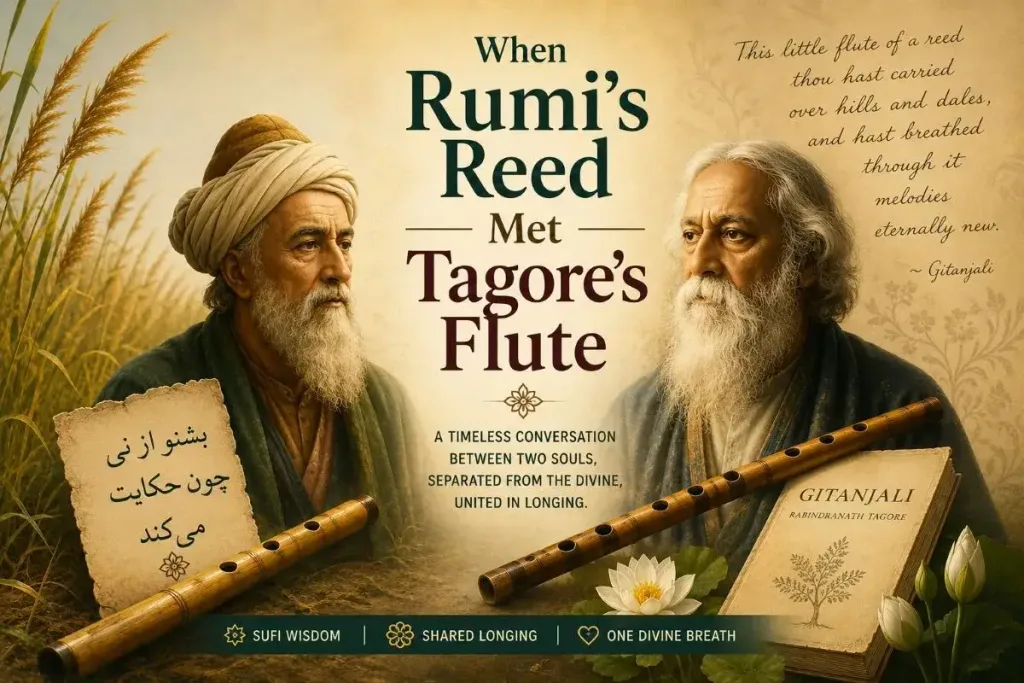
I had just finished walking students through the Persian letters of the word neyestān (نیستان) — the reed bed — explaining that it represents the soul’s original home, the place of unity with the Divine before separation. That’s when Shivpreet Singh, founder of the DhunAnand Foundation and a participant in the course, asked if he could share something. What followed has stayed with me ever since: he laid Rumi’s reed alongside Rabindranath Tagore’s flute, and the parallel was striking enough that I knew I wanted to share it with you.
Why This Parallel Matters
The connection between Rumi and Tagore isn’t new to scholarship — the influence of Sufi mysticism, particularly Rumi and Hafez, on Tagore’s worldview and poetry has been written about before. What made this moment special for me wasn’t the comparison itself, but where it came from: a musician steeped in Indian spiritual music and kirtan, recognizing a Sufi image in real time, during a Persian class centered on Rumi.
At the center of it was one shared image: the reed as the soul, cut off from its divine source.
Rumi’s Neyestān
Rumi opens the Masnavi with the famous Ney-nāme (Song of the Reed):
Listen to the reed as it tells its tale,
Complaining of separation.
Ever since they cut me from the reed bed,
Men and women have moaned with my wailing.
Here, the reed (nay) is the human soul, severed from its origin — the neyestān (reed bed) — and left to lament that separation for the rest of its life. The neyestān is the soul’s original home, the state of oneness with the Divine it has been cut away from. It’s this image I try to sit with slowly whenever I teach these opening verses.
Tagore’s Flute in Gitanjali
Shivpreet’s detour started with a question he put to the class: what other poets had written about the flute? He pointed straight to Rabindranath Tagore — the first non-Western writer ever awarded the Nobel Prize in Literature, and specifically for the collection that opens with this very image: Gitanjali (“Song Offerings”). He also shared something I hadn’t known myself: Tagore translated Gitanjali into English on his own, from his own Bengali, and it was that English translation — not the Bengali original — that won the Nobel Prize.
The opening poem of Gitanjali reads, in Tagore’s own English:
Thou hast made me endless, such is thy pleasure.
This frail vessel thou emptiest again and again, and fillest it ever with fresh life.
This little flute of a reed thou hast carried over hills and dales, and hast breathed through it melodies eternally new.
A Flute That Isn’t Named — Until It’s Translated
This is the part of Shivpreet’s explanation I found most fascinating, and it’s one I’ve thought about often since. He said he’d gone back and checked Tagore’s original Bengali — and the word “flute” isn’t actually there. Where the English says “reed” and “flute,” the Bengali simply says something close to bane — “of the forest,” or living in the forest. There’s no bãshi or bãnshi (the Bengali words for flute) anywhere in the original stanza.
Tagore didn’t need to name it. To a Bengali reader, “something from the forest” was already, unmistakably, a flute — the reference was obvious inside the culture. But writing for a Western audience in his own translation, he made the image explicit and spelled out “flute.” Shivpreet’s point, and I found it exactly right, was that this is the same relationship as nay and neyestān in Persian: the instrument and the place it comes from, so tied together linguistically and culturally that naming one implies the other.
“Neyestān Is God. Nay Is Us.”
Shivpreet then drew the line explicitly, and I still think it’s worth quoting because it’s the clearest summary of the whole parallel: the neyestān is God — the source we all come from. The nay is us — the small instruments cut from that source, our “necks” severed, left crying, while the Divine listens to our cries. I picked up the thread from there, adding that the reed’s sound reflects the soul’s yearning to return to that state of divine connection — which is precisely why Rumi chooses the nay to narrate the Masnavi‘s opening story.
Four Shared Layers Between Rumi’s Reed and Tagore’s Flute
Laid side by side, I see at least four layers connecting the two images:
- Emptiness and the Dissolution of Ego
The reed must be hollowed out before it can produce sound. In the same way, the soul must be emptied of ego before it can hold the Divine. This mirrors the Sufi concept of fanā (annihilation of the self), an idea Tagore also circles in his own poetry.
- Divine Breath as the True Source of Music
Neither the reed nor the flute makes its own sound — the music comes from the breath passing through it. For Rumi, that breath is the divine spirit. Tagore says almost the same thing: the melodies are “eternally new” because they come from the Divine, not from the instrument or the musician playing it.
- Separation and the Longing for Return
Torn from the neyestān, the reed laments its separation — just as the soul longs to return to the Divine in Rumi’s thought. Tagore’s flute carries the same ache: a cry of separation folded into every note, and a yearning to return to its source.
- The Human Being as Instrument, Not the Player
In both traditions, the beauty belongs to the breath, not to the instrument. Rumi and Tagore both set the poet’s own ego aside, presenting the human being as a channel the divine message simply passes through.
Why Moments Like This Matter to Me
What made this moment work was exactly where it happened. Shivpreet didn’t bring this insight to a lecture on comparative mysticism — he brought it to a live Persian class built around learning to read Rumi’s own words, letter by letter. It’s exactly why I designed Listen to the Reed: Learn the Persian Alphabet with Rumi to be more than a Persian Alphabet course. I wanted it to create room for this kind of living, cross-cultural exchange to happen organically, between students who bring their own traditions into the room.
Why This Matters for Persian Literature Lovers
Studying Persian through Rumi opens a door onto universal, timeless human experience. When parallels like this surface in class, my students aren’t just picking up vocabulary and grammar — they’re engaging with layers of thought and spirituality that reach far beyond Persian itself.
If you’d like to experience this kind of depth yourself, I’d love to have you join me:
→ “Listen to the Reed: Learn the Persian Alphabet with Rumi” Course
A Course That Teaches Both Language and Meaning
This course is designed for beginners. I teach the Persian alphabet while guiding students, verse by verse, through the first 18 verses of Rumi’s Masnavi — known as the Ney-nāme, or Song of the Reed. These opening verses aren’t just poetic; they’re the spiritual overture to the entire six-volume Masnavi. In them, Rumi lays out the themes that run through the whole work: separation from the Divine, longing, love, suffering, and the soul’s journey back to its source.
By learning these verses, students aren’t just practicing reading Persian poetry — they’re engaging, from day one, with one of the most cherished texts in the entire Persian literary tradition.
And if you’re the kind of learner who wants to sit with Persian literature alongside others — comparing notes, testing readings, thinking out loud together — my Online Group Persian Workshops are built exactly for that. They’re a rare chance to explore Persian literature in community, with me guiding the discussion and helping the group go deeper together.
For Further Reading
If you’d like to explore the broader connections between Rumi and Tagore, these resources may be helpful:
- Mystic Poets: Rumi and Tagore by Jawhar Sircar
- Rumi and Tagore: Mystics Across Time and Tradition
- مولوی و تاگور (تأثیر عرفان اسلامی بر تاگور) (Persian)
- Tagore and Sufism for a Better World
 Add as a preferred source on Google
(Click the link and check the box next to our name)