
⚡ Quick Summary (TL;DR):
- Persian has two registers: ketābi (written, formal) and goftāri (spoken, colloquial). Neither is slang and neither is wrong: they are two standard forms of the same language.
- The difference is systematic, not random. A small set of sound and ending changes converts almost any written sentence into its spoken form.
- About a dozen rules cover most of it: ā raises to u before n and m, verb endings collapse, ast becomes -e, rā becomes -o, -hā becomes -ā.
- Written Persian runs the news, textbooks, official documents and literature. Spoken Persian runs conversation, film, song, and every message you will ever receive on WhatsApp.
- Learn only ketābi and you will not follow a family dinner. Learn only goftāri and you cannot read a sign, a menu, or a dictionary entry.
- The fix is to learn both together, on the same sentences, from the first lesson, because the conversion rules make each pair reinforce the other rather than doubling the workload.
- Across our A1 and A2 courses, every one of the thirty core dialogues is recorded twice by native speakers, formal and spoken, starting at lesson one. A2 then goes further: nine exercises make you convert between the registers yourself.
- Practice the difference: At the end of the post, you’ll find short exercises for converting between formal and spoken Persian and identifying the register of each form.
You have done a year of lessons. You can conjugate. You know several hundred words. Then you sit down at a Persian dinner table, your host’s mother asks if you would like tea, and you answer: بله، من چای میخواهم (bale, man chāy mikhāham).
Nobody misunderstands you. That is the cruel part. Everyone smiles, you get your tea, and something in the room shifts very slightly, because what she actually said was chāy mikhori?, and what everyone else at that table would have answered is not what you said:
🔵 Formal • نوشتاری
بله، من چای میخواهم.
bale, man chāy mikhāham
🔴 Spoken • گفتاری
آره، چای میخوام.
āre, chāy mikhām
“Yes, I’d like tea.”
Then the conversation resumes at full speed and you catch almost none of it, because the word you were taught, nemidānam, never arrives. What arrives is nemidunam. Your vocabulary is fine. Your ears have simply been trained on a register that these people are not speaking.
Almost no app addresses this directly. Below is the whole system, including the conversion rules we teach, with a native recording of both registers on every example.
What are the two registers of Persian?
Persian is conventionally described as operating in two registers. Ketābi (کتابی, literally “bookish”) is the written and formal register: newspapers, textbooks, official documents, literature, prepared speeches. Goftāri (گفتاری, “spoken”) is the conversational register: what people actually say to each other, and what you hear in film, podcasts and voice notes. How clean that two-way division really is turns out to be a live question, and we come back to it below.
The critical point, and the one most learners get wrong: goftāri is not slang and not “broken” Persian. It is not the equivalent of dropping your g’s in English. It is a full, rule-governed register that educated Iranians use with each other constantly, including professors, judges and newsreaders, the moment they stop reading and start talking. Using ketābi in a casual conversation does not make you sound educated. It makes you sound like you are reading a form aloud.
Throughout this article, “spoken Persian” means the Tehran-based colloquial standard used across Iranian media and understood nationwide. Regional varieties within Iran, and the spoken standards of Afghanistan and Tajikistan, differ from it in ways this post does not cover.
Why does Persian have two registers at all?
Short answer: the written language stayed still and the spoken language kept moving.
Written Persian has been unusually stable. The survival of the classical written norm is what Jeremíás (1984) treats as the heart of the Persian case: a literate Persian speaker today can read poetry written a thousand years ago with far less difficulty than an English speaker faces reading Chaucer. That stability has a payoff, in that classical poetry still gets quoted in ordinary conversation rather than staying inside literature classes. It also has a cost. The written standard stayed anchored to its literary models while ordinary speech did what speech always does: contracted, simplified, and drifted.
The gap you are hearing at that dinner table is that accumulated drift, made visible. The boundary was never sealed, though. Orsatti (2015) identifies features characteristic of speech inside classical Persian texts. The two registers have been leaking into each other for a long time, rather than running on separate tracks until recently.
The split is not only a historical accident. The two registers now do different jobs. Ketābi carries formality, distance, officialdom and respect. Goftāri carries intimacy, speed and ordinary life. Native speakers move between them deliberately, and a speaker who shifts up into ketābi mid-conversation is signalling something: seriousness, sarcasm, mock-officialdom, or the fact that the other person has just become a stranger. That capacity is unavailable to a learner who knows only one register.
Is Persian actually diglossic?
You will see this split labelled diglossia, and the label is worth knowing, including the fact that it is contested.
The term comes from Ferguson (1959), who used it for a stable arrangement in which a prestige “high” variety and an everyday “low” variety divide a language’s work between them. His original four cases were Arabic, Modern Greek, Swiss German and Haitian Creole; Persian was not among them. Jeremiás (1984) applied the framework to Persian directly. The objection to the label is that Persian’s two varieties are not mutually unintelligible enough to clear Ferguson’s bar; “pseudo-diglossia” is the term that circulates for arrangements like this one. Rossi (2015) offers something more useful than a yes-or-no verdict: treat the difference as a gradient rather than a binary.
That last point does real work for a learner, because Persian sentences do not sort themselves into two clean boxes. A speaker can produce one sentence with a written verb ending and a spoken vowel. A televised interview sits somewhere in the middle of the scale. A message to your manager lands in a different place from a message to your brother. So read the twelve rules below not as a single switch you flip, but as twelve dials you can turn independently. That is closer to what native speakers are actually doing.
How does written Persian turn into spoken Persian? The 12 rules
Written Persian converts to spoken Persian through a compact set of recurring changes affecting vowels, verb endings, the copula, the object marker and the plural suffix. Once you know them, you are not learning two languages: you are learning one language plus a conversion system.
This is how we present the system in our own teaching, with two caveats. First, these are strong tendencies rather than exceptionless laws. The University of Texas at Austin’s Persian Online grammar describes them as inconsistent and only partly implemented, with some observed by nearly all speakers and others varying by who is talking. Second, several rules stack on the same word, which is why a form like mitavānam → mitunam looks more drastic than any single rule would produce.
The twelve rules, in short
- ā becomes u before n or m. nān → nun, tehrān → tehrun, tamām → tamum
- Third-person singular -ad becomes -e. mikhorad → mikhore
- Third-person plural -and becomes -an. miravand → miran
- Second-person plural -id becomes -in. mikonid → mikonin
- High-frequency present stems contract. mishavad → mishe, mikhāham → mikhām, mitavānam → mitunam
- The copula ast attaches to the word before it. khub ast → khube
- Full “to be” forms give way to enclitics. man khaste hastam → khastam
- The object marker rā becomes -o or -ro. ketāb rā → ketābo
- The plural -hā loses its h. ketābhā → ketābā
- Written u and ān both become un. ān mard → un mard
- Certain function words are swapped outright. dar → tu, ammā → vali, bale → āre
- Pronouns attach as endings, to verbs and to prepositions. u rā didam → didamesh, barāye u → barāsh
Now hear them. Every example below is recorded twice by native speakers, formal on the left and spoken on the right, so you can hear what each rule does to a real sentence.
Where can I learn?Rules 1 + 5
🔵 Formal • نوشتاری
کجا میتوانم فارسی یاد بگیرم؟
kojā mitavānam fārsi yād begiram?
🔴 Spoken • گفتاری
کجا میتونم فارسی یاد بگیرم؟
kojā mitunam fārsi yād begiram?
“Where can I learn Persian?”
mitavānam compresses to mitunam, a shortcut that runs through dozens of everyday verbs.
Buying a giftRules 2 + 5 + 12
🔵 Formal • نوشتاری
سارا میخواهد برای او یک جفت کفش بخرد.
sārā mikhāhad barāye u yek joft kafsh bekharad
🔴 Spoken • گفتاری
سارا میخواد براش یه جفت کفش بخره.
sārā mikhād barāsh ye joft kafsh bekhare
“Sara wants to buy her a pair of shoes.”
Preposition and pronoun fuse into one word: barāye u becomes barāsh. Nothing in the written form prepares you for that.
That’s expensive!Rules 1 + 6
🔵 Formal • نوشتاری
این ماشین چقدر گران است!
in māshin cheqadr gerān ast!
🔴 Spoken • گفتاری
این ماشین چهقدر گرونه!
in māshin cheqadr gerune!
“This car is so expensive!”
Two changes at once: gerān shifts to gerun, and the verb ast shrinks to a single sound glued onto the end of the word. The /ān/ → [un] shift is treated in detail by Miller (2011).
Making plansRule 3
🔵 Formal • نوشتاری
مریم و خانوادهاش میخواهند به آمریکا بروند.
maryam va khānevāde-ash mikhāhand be āmrikā beravand
🔴 Spoken • گفتاری
مریم و خانوادهش میخوان برن آمریکا.
maryam va khānevādash mikhān beran āmrikā
“Maryam and her family want to go to America.”
The plural ending -and drops to -an on both verbs, and in speech the word order relaxes too.
A daily habitRule 2
🔵 Formal • نوشتاری
پدرم هر روز چای میخورد.
pedaram har ruz chāy mikhorad
🔴 Spoken • گفتاری
پدرم هر روز چای میخوره.
pedaram har ruz chāy mikhore
“My father drinks tea every day.”
The cleanest case of the commonest rule: -ad loses its d and becomes -e. Apply it to any third-person verb you meet.
Asking where someone livesRule 4
🔵 Formal • نوشتاری
شما کجا زندگی میکنید؟
shomā kojā zendegi mikonid?
🔴 Spoken • گفتاری
شما کجا زندگی میکنین؟
shomā kojā zendegi mikonin?
“Where do you live?”
This is the polite “you”, so it turns up in almost every conversation with someone you have just met: -id becomes -in.
Finishing a bookRules 8 + 1
🔵 Formal • نوشتاری
من این کتاب را خواندم.
man in ketāb rā khāndam
🔴 Spoken • گفتاری
من این کتابو خوندم.
man in ketābo khundam
“I read this book.”
The object marker rā stops being a separate word and becomes -o on the end of the noun, and the verb raises too: khāndam to khundam.
Whose books are these?Rules 9 + 7
🔵 Formal • نوشتاری
این کتابها مال من هستند.
in ketābhā māl-e man hastand
🔴 Spoken • گفتاری
این کتابا مال منن.
in ketābā māl-e manan
“These books are mine.”
The plural -hā loses its h to become -ā, and the whole verb hastand collapses into a single sound on the end of man.
Where he livesRules 10 + 11 + 1 + 2
🔵 Formal • نوشتاری
آن مرد در تهران زندگی میکند.
ān mard dar tehrān zendegi mikonad
🔴 Spoken • گفتاری
اون مرد تو تهرون زندگی میکنه.
un mard tu tehrun zendegi mikone
“That man lives in Tehran.”
Four rules in one short sentence: ān → un, the preposition dar is swapped for tu, tehrān raises to tehrun, and the verb ending drops to -e. This is why spoken Persian sounds like a different language when you have only studied the written form.
Yes, but…Rule 11
🔵 Formal • نوشتاری
بله، امّا من وقت ندارم.
bale, ammā man vaqt nadāram
🔴 Spoken • گفتاری
آره، ولی من وقت ندارم.
āre, vali man vaqt nadāram
“Yes, but I don’t have time.”
This is not a sound change but a different word. bale becomes āre and ammā becomes vali. This is the one group you have to memorise rather than derive.
I saw himRule 12
🔵 Formal • نوشتاری
من او را دیدم.
man u rā didam
🔴 Spoken • گفتاری
دیدمش.
didamesh
“I saw him.”
Four written words become one spoken one. The pronoun clips onto the end of the verb as -esh, the same ending that turned barāye u into barāsh above.
All doneRule 1, before m
🔵 Formal • نوشتاری
کار تمام شد.
kār tamām shod
🔴 Spoken • گفتاری
کار تموم شد.
kār tamum shod
“The work is finished.”
The same raising works before m as before n, but on a much shorter list of words (Persian Online, UT Austin). Do not generalise this one as freely as rule 1 before n.
Hearing the difference is stage one; producing it is stage two. Our A1 course puts both registers in your ear from lesson one, and A2 then asks you to convert between them yourself. Start with the A1 course
Four rules stacked in one sentence (Rules 5, 8, 10, 12)
Here is what happens when the rules stack. Same sentence, both registers. Listen to them back to back and you will hear why an ear trained only on the first one fails on the second.
🔵 Formal • نوشتاری
من آن کتاب را به او میدهم.
man ān ketāb rā be u midaham
🔴 Spoken • گفتاری
من اون کتابو بهش میدم.
man un ketābo behesh midam
“I’m giving him that book.”
Six words changed shape. Not one word changed meaning. That is the whole problem, and also the whole solution.
Where is each register actually used?
Roughly: ketābi for anything written down or delivered formally, goftāri for anything said spontaneously. The boundary is not the medium but the degree of preparation and distance.
| Ketābi (written, formal) | Goftāri (spoken, colloquial) |
|---|---|
| Newspapers and news bulletins | Everyday conversation, in person and by phone |
| Textbooks and academic writing | Family life, including with in-laws once past the first meeting |
| Official, legal and administrative documents | Contemporary film and TV dialogue |
| Classical and most modern poetry | Most modern pop lyrics |
| Prepared speeches and formal presentations | WhatsApp, Telegram and Instagram messages |
| Signage, forms, job applications, formal email | Podcasts, vlogs, interviews, stand-up comedy |
| Narration in novels | Dialogue inside those same novels |
The interesting cases are the ones that cross the line inside a single artefact. A news programme opens in ketābi, then the anchor turns to a guest and the interview runs in goftāri. A novelist narrates in ketābi and writes every line of dialogue in goftāri, because a character speaking ketābi to a friend would read as a joke. A learner with only one register loses the ability to hear the switch, which is often where the meaning sits.
Which register should you learn first?
Both, together, from the first lesson, not one and then the other.
That answer sounds like a dodge, so here is the reasoning. Take either register alone and you get a specific, predictable failure:
- Ketābi only. You can read. You cannot follow a conversation at natural speed, because the forms arriving in your ear are not the forms in your head. And when you speak, you are intelligible but tonally off, permanently slightly formal with people who are trying to be warm to you.
- Goftāri only. You can chat. You cannot read a street sign, a menu, a contract, a news article, or a single line of the poetry that half of Persian conversation quotes. Worse, you cannot use a dictionary, because dictionaries list mikhorad, not mikhore. You have locked yourself out of your own study tools.
The argument for doing both at once is not that you should work twice as hard. It is that the twelve rules above make the second register mostly derivable from the first. Learn mikhorad and mikhore as a pair and you have not learned two words: you have learned one word and reinforced rule 2, which then does its work on every other verb you ever meet. Learn them years apart and you get none of that leverage; you get a painful re-learning project instead.
One thing genuinely does come first, though, and it is not a register: the alphabet. Both registers are written in the same script, and until you can read it, every example above is just a picture. If you are not there yet, start with The Persian Alphabet Decoded (€49 launch price), or with the free option below.
What this looks like inside a lesson
Everything above is the theory. Here is how it is actually built into our two core courses. The paired recordings run through both of them: thirty core dialogues, every one recorded formal and spoken. What changes between the levels is what you are asked to do with them. A1 trains your ear; A2 trains your mouth and hand.
A1: both registers in your ear, every single lesson
A1 runs to fifteen lessons and 171 interactive exercises. Each lesson is built around a core dialogue, and every one of those fifteen dialogues is recorded twice by native speakers, once formal and once spoken. Fifteen lessons, fifteen dialogues, thirty recordings. There is no lesson where this is skipped, nothing to unlock, and no point at which you are asked to pick a side.
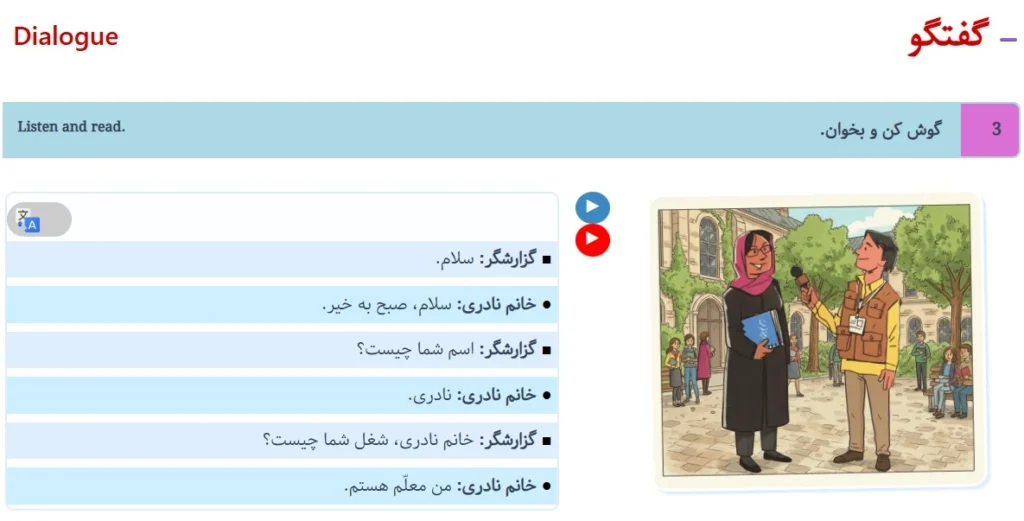
By Lesson 8 you are producing the spoken forms yourself, not just recognizing them. One exercise gives you half of each pair, written or spoken, and asks you to supply the other half:
- A1 · Lesson 8 جدول زیر را کامل کنید. Complete the table below.

A2: now you produce them
A2 runs to a further fifteen lessons and 213 interactive exercises. The dual recordings continue exactly as before: fifteen more dialogues, thirty more recordings, formal and spoken on every one. What reverses is the direction of the work. Nine exercises, spread across Lessons 17, 20, 22, 26, 27, 28 and 29, stop asking you to recognise the difference between the registers and start asking you to generate it. Lesson 17 has you hold a conversation and then write back what you said in the written register:
- مانند گفتگوی زیر با معلّمت صحبت کن. سپس متن را به صورت نوشتاری بنویس. Talk to your teacher like the conversation below. Then write the text in formal form.
- این جملهها را یکبار به گونه گفتاری و یکبار به صورت نوشتاری کامل کن. Complete these sentences once in spoken form and once in written form.
- جملههای بالا را به صورت گفتاری بگو. Say the above sentences colloquially.
- جملههای بالا را به صورت گفتاری بگو و بنویس. Say and write the above sentences in a spoken format.

Learning both registers with Joy of Persian
To be precise about the scope, because this matters more than the marketing: every core dialogue in A1 and A2 carries both recordings: thirty dialogues, sixty tracks, no exceptions and nothing to unlock. They do not extend to B1, and they do not extend to the literature courses, where the material is written and a spoken register would not be meaningful. If dual audio is the reason you are considering us, A1 is where it starts.
Not ready to buy, or not able to read the script yet? Learn the Persian Alphabet with Rumi is free until 30 September 2026 with the code RUMIDAF1, thanks to the DhunAnand Foundation. It teaches you to read using Rumi’s opening lines, which means your first Persian text is one worth having.
One last reason this matters
A2 Lesson 16 carries a section titled simply:
- تعارُف Taarof
Taʿārof is the ritual of offering, declining, and insisting again. No vocabulary list can hand it to you, and it runs on register. The same offer lands as warmth or as distance depending on whether it arrives in ketābi or goftāri, and choosing correctly is not a grammar skill sitting next to a politeness skill. It is one skill. Which is the real argument for learning both registers together, and learning them early: not so you can pass a test on verb endings, but so that when someone offers you tea, you can hear what they actually mean.
What puts both registers in front of you at once
Most good Persian courses make a deliberate choice about which part of the language to lead with, and that choice is usually not “both registers, together, in Persian script.” Ours is. Five things travel together in every core lesson, and it is the combination that is hard to find elsewhere:
- Both registers side by side, in Persian script, not romanised.
- Paired native audio on the dialogues, formal and spoken, inside the same lesson: thirty core dialogues across A1 and A2, every one recorded twice.
- Keyboard-free dictation, so you practise Persian spelling without owning or installing a Persian keyboard.
- Click-to-reveal English, so you read the Persian first and check yourself after, rather than reading the translation and skipping the Persian.
- +380 interactive exercises across the two courses (+170 in A1, +210 in A2), so you apply what you learn rather than only reading about it.
The keyboard-free dictation is worth singling out. Getting a learner to produce correct Persian spelling normally means either a Persian keyboard layout or a romanised workaround. Doing it with no keyboard, directly in the script, is the piece a course cannot easily copy without giving up on Persian script altogether.
None of this means the well-known alternatives are doing something wrong. They are doing something different, and the honest way to see the gap is to look at what each one leads with.
Chai and Conversation
Chai and Conversation is well established and good at the approach it chose, which is conversation first. In their own words the focus is “purely conversational Persian” from lesson one, with grammar and the formal register deliberately held back early. They do teach the formal register and grammar later, once you are ready, so this is a question of sequencing and emphasis, not of leaving anything out. Their Speak course presents Persian in English phonetic script, and reading and writing Persian script is a separate course. The delivery is a podcast plus a web course on a membership and free-trial model, split into three pathways: Speak, Read/Write, and Poetry.
The contrast is clean and not a criticism. They teach the spoken register first, in Latin transliteration, with Persian script on a separate track. We put both registers side by side, in Persian script, with paired native audio inside the same lesson.
Pimsleur
Pimsleur is audio-first by design. Its Farsi page frames grammar drills and verb conjugation as things that slow learning down, and centres the method on listening and speaking. Reading is included but secondary, described on the page as lessons you can use to pick up the alphabet and script. The course runs two levels of thirty lessons each, sixty in total, and it has a mobile app on both the App Store and Google Play. The page makes no mention of the formal and spoken split, of ketābi versus goftāri, or of diglossia.
The difference here is not formal versus spoken. It is that the two-register framework is central to what we do and absent from how Pimsleur presents itself, with the script kept secondary there and primary here.
One honest limit on all of this: we read the public marketing and FAQ pages of these courses, not the inside of their paid lessons. Everything above describes how each course positions itself, which is the fair thing to compare against our own positioning.
Practices
Practice 1: Converting Between Registers
Convert each sentence in the direction shown. Fill in the empty cell. All examples are taken from the pairs used in this post.
| Direction | Formal (Written) | Spoken |
|---|---|---|
| Formal → Spoken | تو به موسیقی گوش میدهی؟ | … |
| Formal → Spoken | او رنگ قرمز را دوست دارد. | … |
| Formal → Spoken | قابل ندارد! | … |
| Formal → Spoken | متولّد کجایی؟ | … |
| Formal → Spoken | چه روزهایی مدرسه میروی؟ | … |
| Spoken → Formal | … | چقدر میشه؟ |
| Spoken → Formal | … | بچّهها، بیدار شید. |
| Spoken → Formal | … | کدوم لباس رو دوست داری؟ |
| Spoken → Formal | … | دستتون درد نکنه! |
Practice 2: Confirm the Register
Look at each pair and decide which version is more formal / more spoken. Then say both versions out loud.
- من نمیدانم.
نمیدونم. - میخواهم بروم.
میخوام برم. - او را دیدم.
اونو دیدم.
FAQ
Is goftāri Persian just slang?
No. Goftāri is a full standard register with consistent grammar, used by every level of society including highly educated speakers in professional settings. Persian does have slang, and it sits inside goftāri the way English slang sits inside spoken English, but the register itself is not slang, and treating it as sloppy or optional is the mistake that leaves learners unable to hold a conversation.
Can I get by in Iran speaking only formal Persian?
You will be understood: everyone can read and comprehend ketābi. The problem is the other direction. People will answer you in goftāri, at speed, and if you have never trained on those forms you will not understand the replies. Speaking is only half a conversation.
Do Iranians ever write in spoken Persian?
Constantly. Text messages, social media captions, comments and informal notes are typically written in goftāri, spelled to match how the words sound: میرم rather than میروم. This catches out learners who studied only ketābi and then find they cannot read a message from a friend, despite reading a newspaper without difficulty.
Is spoken Persian in Iran the same as Dari or Tajik?
They are varieties of the same language and are broadly mutually intelligible, but the spoken forms differ in pronunciation, some vocabulary, and some of the specific contractions described above. The rules in this post describe the Tehran-based colloquial standard of Iran. Written formal Persian is much closer across all three, which is one more argument for not skipping ketābi.
Does Duolingo teach spoken Persian?
Duolingo does not currently offer a Persian course at all, so the question of register does not arise there. It does arise with almost every alternative you will consider instead, and it is worth asking of each of them: are these recordings the way people actually talk, or the way the textbook writes? We go through the options in our guide to Duolingo and Persian.
Should I worry about registers before I can read the alphabet?
No, read first. The script is the prerequisite for everything else, and it takes far less time than most people expect. Decoded is the systematic route; the Rumi course is free until 30 September 2026 with code RUMIDAF1. Once you can read, come back to this page and the twelve rules will be usable rather than decorative. Then start on the paired dialogues in A1.
References
- Ferguson, C. A. (1959). “Diglossia.” Word 15, 325–340.
- Jeremiás, É. M. (1984). “Diglossia in Persian.” Acta Linguistica Academiae Scientiarum Hungaricae 34(3–4), 271–287.
- Miller, C. (2011). “A Holistic Treatment of /ān/ to [un] in Persian.” ICPhS 2011 Proceedings.
- Orsatti, P. (2015). “Spoken features in classical Persian texts: subordinate conditional clauses without a conjunction,” in Szántó, I. (ed.), From Aṣl to Zā’id: Essays in Honour of Éva M. Jeremiás. Piliscsaba: Avicenna Institute of Middle Eastern Studies.
- Rossi, A. V. (2015). “Diglossia in Persian,” in Szántó, I. (ed.), From Aṣl to Zā’id: Essays in Honour of Éva M. Jeremiás. Piliscsaba: Avicenna Institute of Middle Eastern Studies, 211–219.
- Persian Online – Grammar & Resources, University of Texas at Austin.
 Add as a preferred source on Google
(Click the link and check the box next to our name)