
⚡ Quick Summary (TL;DR):
- 32 letters, but 114 shapes. Persian has no capitals. Instead each letter changes form depending on where it sits in a word — up to four forms apiece.
- Those 114 forms come from just 17 skeletons. ب پ ت ث are one shape wearing four different sets of dots, and they behave identically in every position. Ten such families cover twenty-five of the letters.
- Seven letters never join forwards: آ (ا) · د · ذ · ر · ز · ژ · و. They have two forms instead of four, and they are why a Persian word can look broken in the middle.
- Letters and sounds are not one-to-one. Four letters spell /z/ and three spell /s/, so hearing a Persian word will not tell you how to spell it. In the other direction, و, ه and ی each stand for several different sounds.
- Persian is an abjad. Most short vowels go unwritten — پدر is written ⟨pdr⟩ and read pedar. Reading Persian is recognising words, not decoding them letter by letter.
In a hurry? Jump straight to the chart ↓ — all 32 letters, every positional form, native audio and an example word for each. The Persian digits ۹–۰ are at the foot of the page. Bookmark it, print it, keep it open while you practice. The two sections before it explain why the chart is easier to learn than it looks; skip them if you only came to look something up.
32 letters. 114 forms. 17 shapes.
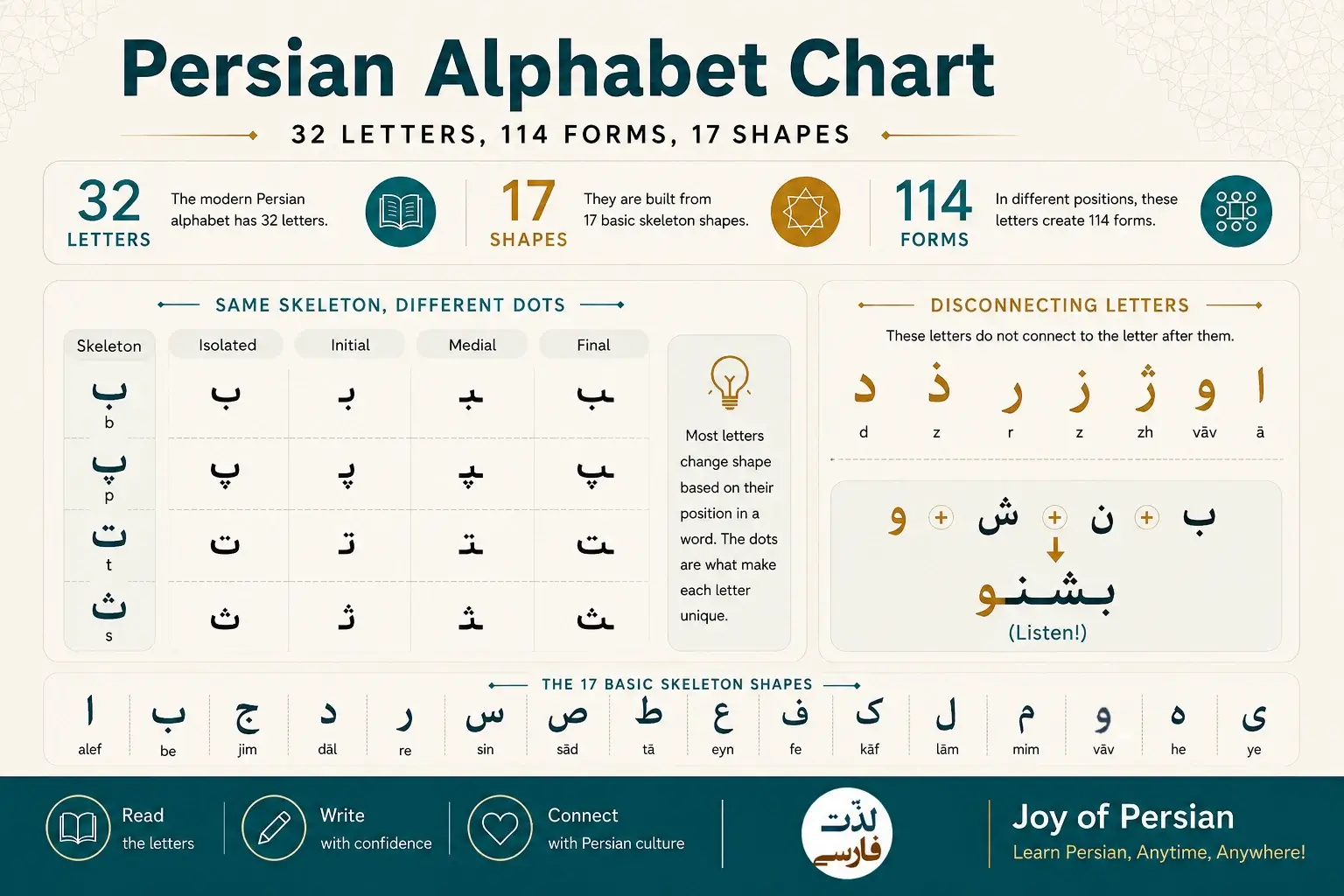
Every Persian alphabet chart opens the same way: there are 32 letters. That is true, and it is also the least useful number on this page.
The number that should worry you is 114. Persian letters have no capitals; instead each one changes shape depending on where it sits in a word — up to four forms apiece. Twenty-five letters take all four. Seven take only two. That is 114 shapes on the page in front of you, not 32.
The number that should reassure you is 17.
Look at ب پ ت ث. That is one skeleton — a shallow bowl with a tail — wearing four different sets of dots. One below, two below, two above, three above. The underlying stroke is identical, and so is every one of its four positional forms. Learn to draw that bowl once and you can write all four letters, in all four positions.
The same trick runs through most of the alphabet. ج چ ح خ are one skeleton. د ذ are one. So are ر ز ژ, س ش, ص ض, ط ظ, ع غ, ف ق, and ک گ. Ten families cover twenty-five letters. Only seven letters — آ (ا), ل, م, ن, و, ه, ی — have a shape belonging to nothing else.
All 32 letters, sorted into their 17 skeletons. The ten coloured cells are shapes shared by two or more letters; the seven grey ones belong to a single letter each. † marks a letter that will not join to the letter after it. These colours reappear in the chart further down.
Two things are worth noticing before you read on. The seven non-connecting letters are scattered across four different skeletons — how a letter connects and what shape it has are two independent facts, and the chart below tracks them separately. And these seventeen are shapes, not a study order: letters that look alike are not always the easiest to learn together, which is why our Decoded course groups them differently.
Ten families plus seven one-offs is seventeen skeletons. Run the same arithmetic on those and 114 forms collapses to 60. Learn seventeen shapes and a single rule about connection, and the chart below stops being a memorisation problem.
That rule is next, because a chart you can read is worth ten charts you can only stare at.
The rule that decides how words look
Persian is written right to left, and it is cursive: letters join to their neighbours inside a word, the way English cursive does. Each letter can take up to four positional forms:
- Isolated — attached to nothing.
- Initial — attached to the letter after it, but not before.
- Medial — attached on both sides.
- Final — attached to the letter before it, but not after.
Take ب through all four and you can see the skeleton surviving intact: بله (bale, yes) has it initial; کبوتر (kabutar, pigeon) has it medial; سیب (sib, apple) has it final; and on its own it is simply ب.
Here is where the families pay off a second time. Letters in one family share identical positional forms. Work out how ب behaves in the middle of a word and you have simultaneously solved پ, ت and ث — four letters, one lesson. The saving is actually larger than the count of seventeen suggests. In شبنم (shabnam, dew), the ـبـ and the ـنـ are the same single tooth, distinguished only by whether the dot sits below or above; ی behaves the same way. Their isolated and final forms diverge, which is why they are counted separately here, but through the middle of a word they are one shape. That is why our Decoded course teaches them together as the B Nāzanin family.
Then comes the exception, and it is a small, closed, learnable one. Seven letters refuse to join forwards. They accept a connection from the letter before them but will not pass it on to the letter after:
آ (ا) · د · ذ · ر · ز · ژ · و
These are the disjoining letters, and they are why a Persian word can appear to have gaps inside it. ندارد (nadārad, does not have) looks broken because د will not connect forwards — that gap is not a space between words, it is the script obeying the rule. For these seven, isolated and initial forms are identical, and so are medial and final. Two shapes each instead of four.
That is the whole system: seventeen skeletons, four positions, seven letters that break the chain. Now the chart is readable.
The Persian alphabet chart
All 32 letters in alphabetical order, with the letter name, transliteration in the Iranian Studies Transliteration System (ISTS) used by Cambridge’s Iranian Studies, IPA, an English pronunciation guide, native audio, and an example word.
Tap any letter to hear it pronounced by a native speaker. The coloured bar marks the skeleton. Same colour and number = same underlying shape, differing only in dots. Grey means the shape belongs to that letter alone. 17 skeletons cover all 32 letters. † = non-connecting letter: isolated and initial are the same shape, and so are medial and final — two forms, not four.
| Letter | Name & Sound | Forms | Example |
|---|---|---|---|
| skeleton 1 · unique | āالف Alef not, thought /ɒ/ | اisol. · init.اmed. · final† two forms, not four | آینه āyene mirror |
| skeleton 2 · shared | bب Be book /b/ | بisol.بinit.بmed.بfinal | کبوتر kabutar pigeon |
| skeleton 2 · shared | pپ Pe pen /p/ | پisol.پinit.پmed.پfinal | پنجره panjare window |
| skeleton 2 · shared | tت Te ten /t/ | تisol.تinit.تmed.تfinal | توت tut mulberry |
| skeleton 2 · shared | sث Se rice, sad /s/ | ثisol.ثinit.ثmed.ثfinal | ثانیه sāniye second |
| skeleton 3 · shared | jجیم Jim job, age /d͡ʒ/ | جisol.جinit.جmed.جfinal | جشن jashn celebration |
| skeleton 3 · shared | chچ Che cheese /t͡ʃ/ | چisol.چinit.چmed.چfinal | چشم cheshm eye |
| skeleton 3 · shared | hح جیمی He Jimi hit /h/ | حisol.حinit.حmed.حfinal | حرف harf letter, word |
| skeleton 3 · shared | khخ Khe Spanish ojo; Scottish loch /x/ | خisol.خinit.خmed.خfinal | خورشید khorshid sun |
| skeleton 4 · shared | dدال Dāl do /d/ | دisol. · init.دmed. · final† two forms, not four | دریا daryā sea |
| skeleton 4 · shared | zذال Zāl zoo /z/ | ذisol. · init.ذmed. · final† two forms, not four | کاغذ kāghaz paper |
| skeleton 5 · shared | rر Re red (tapped) /ɾ/ | رisol. · init.رmed. · final† two forms, not four | باران bārān rain |
| skeleton 5 · shared | zز Ze zoo /z/ | زisol. · init.زmed. · final† two forms, not four | زمستان zemestān winter |
| skeleton 5 · shared | zhژ Zhe television /ʒ/ | ژisol. · init.ژmed. · final† two forms, not four | مژه mozhe eyelash |
| skeleton 6 · shared | sسین Sin rice, sad /s/ | سisol.سinit.سmed.سfinal | ستاره setāre star |
| skeleton 6 · shared | shشین Shin she /ʃ/ | شisol.شinit.شmed.شfinal | شبنم shabnam dew |
| skeleton 7 · shared | sصاد Sād rice, sad /s/ | صisol.صinit.صmed.صfinal | صدا sedā sound, voice |
| skeleton 7 · shared | zضاد Zād zoo /z/ | ضisol.ضinit.ضmed.ضfinal | عضو ʿozv member |
| skeleton 8 · shared | tطا Tā ten /t/ | طisol.طinit.طmed.طfinal | طوطی tuti parrot |
| skeleton 8 · shared | zظا Zā zoo /z/ | ظisol.ظinit.ظmed.ظfinal | نظر nazar view, opinion |
| skeleton 9 · shared | ʿعین ʿEyn as in “uh-oh” — the pause in the middle /ʔ/ | عisol.عinit.عmed.عfinal | شمع shamʿ candle |
| skeleton 9 · shared | ghغین Gheyn Spanish amigo — further back than English g /ɣ/ · /ɢ/ | غisol.غinit.غmed.غfinal | باغ bāgh garden |
| skeleton 10 · shared | fف Fe food /f/ | فisol.فinit.فmed.فfinal | برف barf snow |
| skeleton 10 · shared | qقاف Qāf Spanish amigo — further back than English g; identical to غ /ɣ/ · /ɢ/ | قisol.قinit.قmed.قfinal | قاشق qāshoq spoon |
| skeleton 11 · shared | kکاف Kāf cat, ask /k/ | کisol.کinit.کmed.کfinal | کوه kuh mountain |
| skeleton 11 · shared | gگاف Gāf get /ɡ/ | گisol.گinit.گmed.گfinal | گل gol flower |
| skeleton 12 · unique | lلام Lām ball, let /l/ | لisol.لinit.لmed.لfinal | بلبل bolbol nightingale |
| skeleton 13 · unique | mمیم Mim milk /m/ | مisol.مinit.مmed.مfinal | ماه māh moon |
| skeleton 14 · unique | nنون Nun pen /n/ | نisol.نinit.نmed.نfinal | نمک namak salt |
| skeleton 15 · unique | vواو Vāv very — also /u/, /o/, /ow/ /v/ | وisol. · init.وmed. · final† two forms, not four | وام vām loan |
| skeleton 16 · unique | hه He hit — also /e/ at word end /h/ | هisol.هinit.هmed.هfinal | ماهی māhi fish |
| skeleton 17 · unique | yی Ye yes, yet — also /i/, /ey/ /j/ | یisol.یinit.یmed.یfinal | یخ yakh ice |
You will also meet همزه (Hamze), written ئ and transliterated ʾ. It is not counted among the 32 core letters, but it belongs here for orthographic completeness: it marks a glottal stop — the same sound as ع, and you can hear it here.
Every audio file above is a native recording from our free Persian alphabet lesson, where you can also hear the six vowels and test yourself on them.
Two things this chart cannot show you
Read down the Name & Sound and you will notice something a chart of this kind usually hides. The letter-to-sound relationship in Persian is not one-to-one, and it breaks in two opposite directions. These are the two facts that separate people who have memorised a chart from people who can actually read.
Sound duplicates: several letters, one sound
Four different letters spell the sound /z/. Three spell /s/. The chart above gives them away — ث, س and ص all point to the same audio file, because they are the same sound.
- /s/ — ث · س · ص
- /z/ — ذ · ز · ض · ظ
- /t/ — ت · ط
- /h/ — ح · ه
- /gh/ — ق · غ
That last pair catches people out, because the two letters are transliterated differently — ق as q, غ as gh — which suggests a distinction your ear should be able to catch. It cannot. In modern Iranian Persian, ق and غ are pronounced identically. The transliteration preserves the spelling difference, not a sound difference.
These letters mostly arrived with Arabic loanwords, which kept distinctions Persian does not make. The practical consequence is one you should hear now rather than discover later: hearing a Persian word does not tell you how to spell it. If someone says sedā, you cannot know from the sound alone whether it starts with ث, س or ص. Spelling in Persian is learned word by word, exactly as with English through, threw and thru.
Multitasking letters: one letter, several sounds
The reverse is also true. Three letters are read differently depending on the word:
- و — /ow/ in دولت · /o/ in دو · /u/ in روز · /v/ in وام
- ه — /e/ in خانه · /h/ in هوا
- ی — /ey/ in نِی · /i/ in میز · /y/ in یک
This is where a chart alone stops being enough, and it connects to something structural about the writing system: Persian is an abjad, a script that records consonants and leaves most short vowels unwritten. پدر is written ⟨pdr⟩ and read pedar. The vowels are supplied by the reader, from knowledge of the word.
That sounds alarming. In practice it is why Persian spelling has stayed stable for over a thousand years across dialects that pronounce vowels quite differently — کردن is written identically whether a speaker says kardan or kerdan. But it does mean that reading Persian is not decoding letter by letter. It is recognising words.
A chart can tell you which letters share a sound. It cannot tell you how to make a sound your mouth has never made. Four of these — خ, ق/غ, ع and ر — have no English equivalent, and we cover the mouth positions and minimal-pair drills for each in Persian alphabet pronunciation.
Persian Numbers: The Digits ۰–۹
Persian uses its own set of digits, and you will meet them everywhere the letters appear — page numbers, prices, dates, phone numbers, licence plates. They are not part of the 32 letters, but no alphabet chart is much use without them.
Numbers run left to right. This is the one place Persian reverses its own direction. The year ۱۴۰۴ is read exactly as you would read 1404 — most significant digit first, on the left — even though the words around it run the other way. Multi-digit numbers are built the same way as in English: ۲۵ is twenty-five, not fifty-two.
Three digits differ from the Arabic set. Persian writes four, five and six as ۴ ۵ ۶; Arabic writes them ٤ ٥ ٦. The other seven digits are identical in both. If a page shows ۵ rather than ٥, you are looking at Persian.
A footnote for the curious: before these digits, letters did the counting. Each letter carried a numeric value in a system called abjad, and the values follow the older Semitic letter order rather than the alphabetical order of the chart above. You will still meet abjad on old manuscripts, gravestones and building inscriptions, where a phrase doubles as a date. It is a curiosity rather than something a learner needs. It is also where the word abjad comes from — the first four values, ا ب ج د, read as one word, exactly as alphabet comes from alpha and beta. When linguists call Persian an abjad, they are borrowing that name for the whole class of scripts that leave short vowels unwritten.
Twenty-eight values: nine units, nine tens, ten hundreds. The four Persian-only letters (پ چ ژ گ) have no value of their own.
Where to go from the chart
A chart shows you the letters. It cannot show you a letter behaving differently in the middle of a word, or teach your hand the stroke order, or give you the repetitions that turn recognition into reading. If you are still weighing whether the alphabet is worth the effort at all, we’ve made that case in full — the short version is that transliteration quietly caps how far you can go.
The Persian Alphabet, Decoded is built for exactly that gap. The letters arrive in five staged groups that follow the shape families above — the disjoining seven first, because they are the easiest win, then the joining families one at a time. Around 22 hours of active study, 120+ guides and interactive exercises, and 160+ interactive flashcards, with native audio for every letter and word, animated stroke-by-stroke handwriting guides, a printable worksheet in every lesson, and a fully decodable path: you will never meet a practice word containing a letter you haven’t been taught. Most learners finish in about 1.5–2 months at one lesson a week, with a full year of access and a 14-day guarantee. A launch discount is currently active.
If you would rather meet the letters inside poetry than inside drills, Listen to the Reed teaches the same alphabet through 12 live-recorded sessions with Dr. Leila — around 12 hours of video built around the 18 verses of the Neynameh, the opening of Rumi’s Masnavi — with word-by-word analysis, 100+ interactive exercises and 166 visual flashcards. It is free with the code RUMIDAF1 through 30 September 2026, thanks to the DhunAnand Foundation.
Either route leads to the same next rung: Let’s Learn Persian! (A1), where the letters you now recognise start becoming sentences you can say.
Curious how long the alphabet stage actually takes? We’ve broken the numbers down in how long it takes to learn the Persian alphabet. And if you plan to write by hand as well as read — which we’d recommend — handwriting and the Persian alphabet explains why.
More in the series is collected on our Persian alphabet resources page.
FAQ
How many letters are in the Persian alphabet?
Thirty-two — but they take up to four shapes each depending on position, which is 114 forms in total. The good news is that those forms are built from only seventeen underlying skeletons, because letters like ب پ ت ث share one shape and differ only in their dots. Hamze (ئ) appears in Persian writing but is not counted among the 32.
Is the Persian alphabet the same as the Arabic alphabet?
They share a script but are not identical. Persian uses the Arabic script with four added letters for sounds Arabic lacks — پ, چ, ژ and گ — and pronounces several inherited letters differently. ض, for example, is a distinct sound in Arabic but is simply /z/ in Persian.
Can I print this Persian alphabet chart?
Yes. The table above is designed to print cleanly on a single sheet for a desk or wall. Note the seven daggered letters as you go — those are the ones that will not join to the letter after them.
How long does it take to learn the Persian alphabet?
At 20 minutes a day, most adults can recognise and name all 32 letters in 3–4 weeks. However, recognising letters and actually reading are different stages: decoding unfamiliar words takes roughly 8–11 weeks, and comfortable reading/writing takes 4–6 months.
For a full breakdown by your own daily time and practice method, see How Long Does It Take to Learn the Persian Alphabet? A Real Timeline.
Which Persian letters are hardest to pronounce?
Only four sounds are genuinely new to an English-speaking mouth: خ, the ق/غ pair, ع (and hamze), and ر. The rest of the alphabet maps onto sounds you already make. See Persian alphabet pronunciation for mouth positions and minimal-pair drills.
 Add as a preferred source on Google
(Click the link and check the box next to our name)