
Proceed with extreme caution. While it is tempting to use these apps because they look like Duolingo, they often suffer from the exact technical issues we described above.
For example, we recently analyzed the promotional material for the Ling App, which markets itself as a top Farsi alternative. In their own demonstration video, the Persian text is displayed with Left-to-Right (LTR) alignment, effectively spelling the sentences backward.
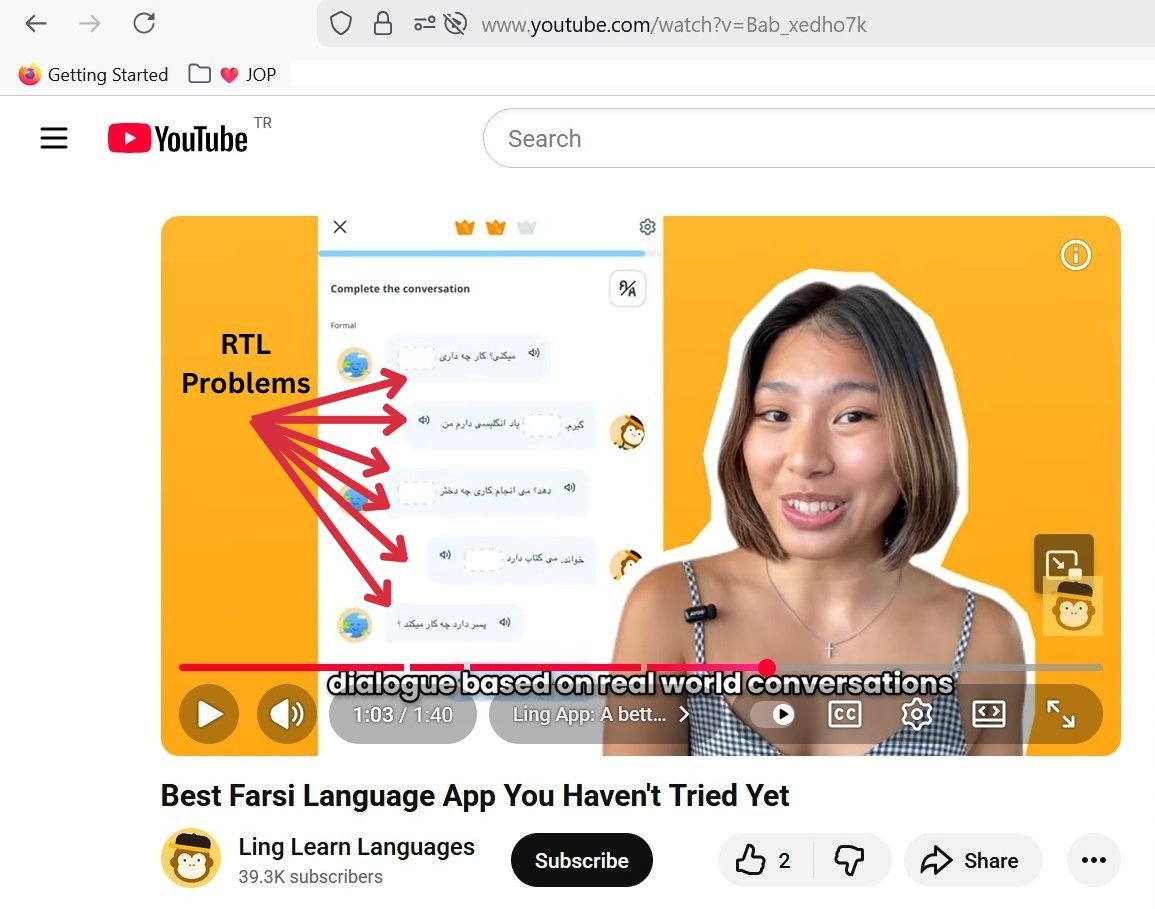
The Evidence: In the video, the Persian sentence “What is the girl doing?” (دختر چه کاری انجام میدهد؟) is displayed incorrectly as:
دهد؟می انجام کاری چه دختر
Notice the critical errors:
- Reversed Word Order: The subject (Girl) is on the far left instead of the right.
- Broken Prefix Form: The Zero-Width Non-Joiner in «میدهد» fails, causing the prefix «می» to detach and appear as «می» and «دهد».
- Displaced Punctuation: The question mark appears in the middle of the sentence rather than at the end.
The English Equivalent: To understand how confusing this is, imagine taking the English sentence “What is the girl doing?” and forcing it into the same broken structure. It would look like this:
ing? do girl the is What
The Result: If you try to read this as a Persian speaker, it is nonsense. You would have to force your brain to read Persian “backwards” to make sense of it.
This is a classic “cookie-cutter” app problem: developers take a code template built for English or Spanish and simply paste Persian words into it without adjusting the underlying engineering for Right-to-Left scripts.
For the fuller picture, we tested Ling and Mondly side-by-side with 12 other options — podcasts, tutors, university-style courses — in our 2026 comparison of the best online Persian courses, including what each platform actually teaches (and what it skips).