
Learning Persian in 2026 has become a familiar New Year’s aspiration. As the new year approaches, many learners promise themselves: “This is the year I finally master Persian.” not for exams or apps, but for love, family, and a deeper sense of belonging. But statistics are cruel—approximately 80% to 90% of these resolutions will crumble by February. The reason isn’t a lack of talent or a “missing gene” for languages; it is a fundamental failure of Mindset.
Most people approach Persian the way they were taught to approach school: through force, repetition, and sheer willpower. They try to memorize a living language, as if fluency were a test you could cram for.

But language doesn’t work like a textbook. It works like a system.
If your mental setup is wrong—if your strategy fights the way the brain actually acquires language—no amount of motivation will save you. You can work harder, study longer, and push yourself every day… and still stall.
That’s why success in 2026 won’t come from grinding more hours or downloading yet another app. It will come from a reset. A reconfiguration. A fundamentally new way of thinking about what it means to learn a language.
You don’t need more discipline. You need a better operating system.
Time to read:
Table of Contents
Learning from the Architects: Luke’s English Podcast
To find this new mindset, we must look at the “Architects of Learning.” One of the most unexpected sources of insight is Luke’s English Podcast, a long-running, award-winning podcast created and hosted by Luke Thompson, a British English teacher with millions of listeners worldwide. Unlike most language-learning podcasts, Luke’s show isn’t just about grammar rules or vocabulary lists.
While many episodes do teach English, some of the most valuable ones go much deeper. In these rare but powerful conversations, Luke interviews elite polyglots and highly successful language learners—not about English, but about how the human mind actually acquires language.
These episodes are gold. They transcend any single language and reveal the underlying psychology, strategies, and mental frameworks that work whether you’re learning English, Persian, or your fifth foreign language.
I’ve been a loyal listener of Luke’s English Podcast for many years, and two episodes in particular stopped me in my tracks—not because they were about English, but because they exposed how language learning actually works at a deeper level.

One was an interview with Steve Kaufmann, a legendary polyglot who speaks 20 languages and describes language learning as “a voyage of discovery.” The other featured Bahar from Iran, a self-made learner whose immersive, input-driven approach earned her recognition as a WISBOLEP runner-up.
What struck me wasn’t just their success, but how closely their real-world experiences aligned with Stephen Krashen’s theories of language acquisition, particularly the Input Hypothesis.
Taken together, these conversations point to a set of principles that directly challenge what most of us were taught about learning languages.
5 Counter-Intuitive Truths About Language Learning
If you’ve ever tried to learn a language, you know the pattern: early enthusiasm, followed by a sudden wall. Progress slows, confidence drops, and the rules you’ve memorized refuse to turn into real speech.
This frustration isn’t a personal failure—it’s the result of deeply ingrained misconceptions about how language learning actually works.
1. Stop “Practicing” Speaking—Focus on Input First
The most common piece of advice given to new language learners is to “start speaking from day one.” While well-intentioned, this is often counterproductive. It puts immense pressure on beginners, creates anxiety, and can reinforce mistakes before a solid foundation is built.
The core concept, supported by Stephen Krashen’s renowned “Input Hypothesis,” is that we acquire language in one primary way: through comprehensible input. We learn by understanding messages, through massive amounts of listening and reading, not by forcing ourselves to speak before we’re ready.

Polyglot Steve Kaufmann, put this into practice when learning Mandarin Chinese. He spent months focused almost exclusively on intensive reading and listening. Rather than drilling speech, he bombarded his brain with the language, allowing it to absorb the patterns naturally. His advice is to start speaking only when you have acquired enough vocabulary and comprehension to have meaningful conversations. Until then, your focus should be on input.
In other words, your brain is a pattern-recognition machine. Your primary job is not to force it to create language, but to feed it enough high-quality, understandable data so it can discover the patterns for itself. This idea is powerfully summarized by one of the corollaries of Stephen Krashen’s theory:
“Talking (output) is not practicing… comprehensible output is the effect of language acquisition.”
The strategic takeaway here is liberating: It removes the fear and pressure of speaking perfectly from the beginning. It gives you permission to spend your time building a deep, intuitive understanding of the language through listening and reading. This transforms speaking from a high-stakes performance into a natural milestone you arrive at when you’re ready.
2. Your Feelings Dictate Your Success
We tend to think of learning as a purely intellectual activity, but our emotions are the gatekeepers of our minds. According to Stephen Krashen’s “Affective Filter Hypothesis,” negative emotions like anxiety, self-doubt, and even boredom create a mental block. This “filter” prevents your brain from acquiring language, even if the input you’re receiving is perfectly comprehensible.
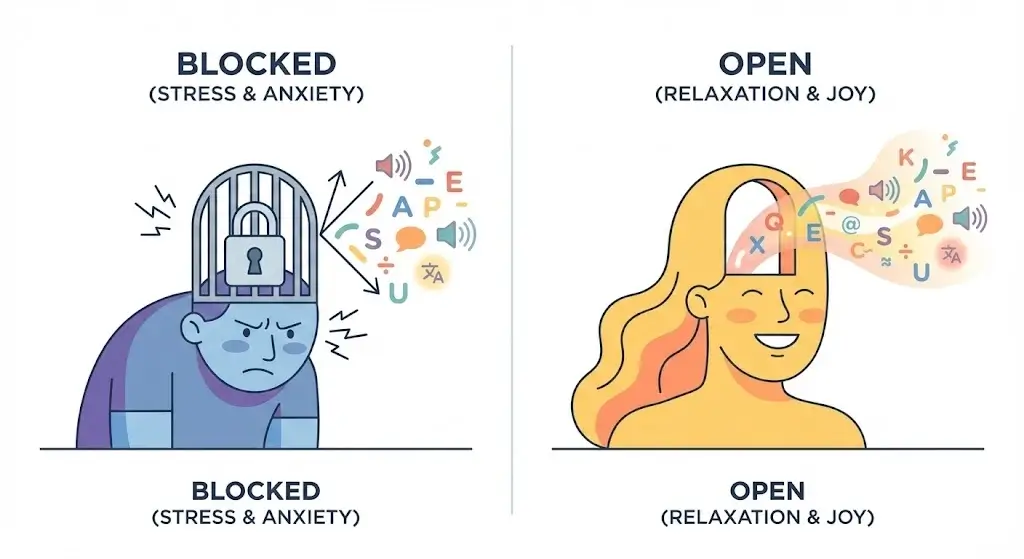
Bahar’s story is a powerful case study. Her first English class was a traumatic experience. Placed in a class with older, more advanced students, she was overwhelmed and embarrassed. She recalls being unable to understand even the simplest questions. This negative association grew until she hated the language, culminating in a final exam where she simply wrote her name on the paper and handed it in blank. Her negative association with the language, and that school, was complete.
Her breakthrough came not from more discipline, but from joy. At a local book fair, she discovered graded readers that came with audio CDs. Listening to The Gift of the Magi read in a warm British accent, she was shocked to find she could understand. “I was so excited that I could understand the story that I shouted, I went to my mom: I can understand English,” she recalls.
Bahar’s breakthrough demonstrates Krashen’s theory in action, but it also validates Kaufmann’s input-first approach. She didn’t force herself to speak; she found compelling, comprehensible input (The Gift of the Magi) that she genuinely loved, which in turn lowered her affective filter and allowed acquisition to happen naturally. This principle is not a luxury; it’s a non-negotiable prerequisite for effective learning. If you are not enjoying the process, your brain is not in a state to learn. Find the books, podcasts, movies, or music that you genuinely love, and your mind will open. In a testament to her transformation, she eventually returned to that same language school, where the teacher who saw her hand in a blank exam paper became one of her greatest encouragers.
3. Embrace “Good Enough” and Ditch Perfectionism
The traditional classroom model teaches us to master Chapter 1 before we can move to Chapter 2. This perfectionist mindset is a primary cause of burnout and slow progress in language learning. You get stuck trying to understand a single grammar point perfectly, and your momentum grinds to a halt.

Steve Kaufmann offers a powerful metaphor to break this cycle: think of language learning like mowing a lawn that has grown too long. If you set the lawnmower blades to their lowest setting and try to cut the overgrown grass perfectly in one pass, the machine will clog and stall. Instead, the smart approach is to set the blades high for the first pass and just skim the top. Then, you lower the blades a little and make a second pass. And then a third, until the lawn is neat and short.
Language learning works the same way. It is far more effective to read an article or listen to a podcast and understand 60-70% of it, then move on to something new. You don’t need 100% mastery on the first pass. As Kaufmann advises, you must develop a “high tolerance for fuzziness.” It’s not only okay to feel uncertain; it is an essential part of an effective process. This iterative process isn’t just efficient; it’s sustainable. It replaces the paralysis of perfectionism with the momentum of steady, layered progress.
4. Train Your Mouth in Silence
Anxiety about pronunciation is a major hurdle for many learners. We try to speak, hear our imperfect accent, and immediately feel discouraged. The judgment we place on ourselves raises our affective filter and makes us afraid to practice.
Bahar developed a surprising and effective technique to overcome this: training her mouth in silence. As a key step in her learning method, she would “lip-sync” to audio. The process is simple:
- Listen to a short segment of audio from a native speaker.
- Without making any sound, silently mouth the words along with the speaker.
- Repeat this process, focusing on the physical sensations: the shape of your mouth, the position of your tongue, and the movement of your lips. The goal is to build muscle memory, not to produce sound.
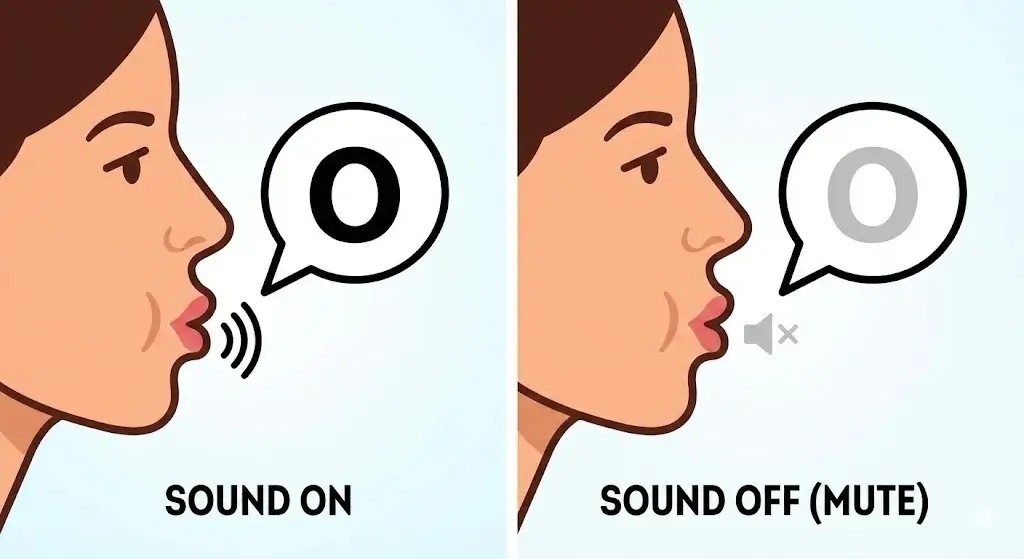
The benefit of this method is twofold. First, it is psychological. By removing the sound, you remove the self-judgment. You are free to practice the physical act of speaking without the pressure of performance or the disappointment of not sounding “right.” This technique is a brilliant practical hack for lowering the affective filter. By separating the physical practice from the act of performance, it bypasses the anxiety and self-judgment that often block pronunciation progress.
Second, it is physical. Pronunciation is not just knowledge; it’s muscle memory. The sounds of a new language require your mouth to move in ways it isn’t used to. Silent lip-syncing isolates this physical component, allowing you to build the necessary coordination before adding the complexity of vocalization. This low-stakes technique is a practical tool for building the confidence and physical skill needed for clear pronunciation.
5. Treat It Like a Voyage, Not a Subject
Why are you learning a language? If your answer is because you “have to” or because it feels like a school subject you must pass, your motivation will eventually run out. The learners who succeed in the long run are those who reframe the entire process.
When asked why he learned 20 languages, Steve Kaufmann’s answer was simple and profound:

“For me it’s just a voyage of Discovery.”
For him, learning Persian wasn’t about memorizing vocabulary lists; it was about unlocking thousands of years of history, culture, and a new way of seeing the world. This framing is critical, because as he implies, viewing language as a mere subject keeps you trapped in your own cultural “box.” Viewing it as a voyage is what truly unlocks connection with the wider world.
This aligns perfectly with Bahar’s journey. She didn’t just learn English words; she fell in love with English culture through the stories of Sherlock Holmes, Harry Potter, and the works of J.R.R. Tolkien. For her, the language became a key to a world of meaning and imagination she desperately wanted to enter.
This final truth is the engine that powers all the others. A “voyage” mindset is what makes massive input feel like exploration, keeps the affective filter low, and provides the patience needed for the “lawnmower” approach. When learning becomes a voyage of discovery, you will never want to stop.
Bonus Tips
Troubleshooting the “Intermediate Plateau”
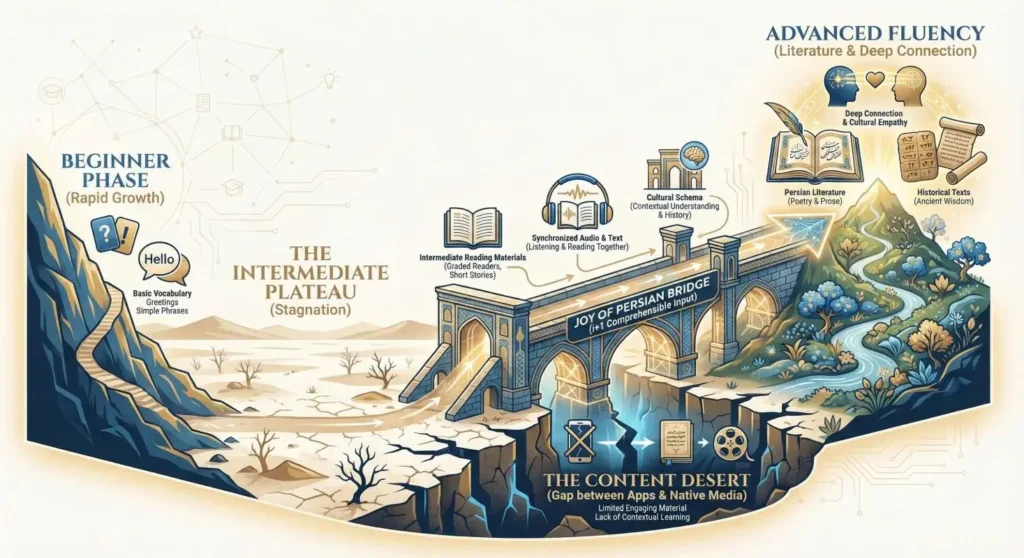
If you find that your progress feels stagnant after the initial honeymoon phase of January, you have likely hit a common system bottleneck. This is known as the Intermediate Plateau—a stage where the low-hanging fruit has been picked, and progress requires a more nuanced approach to acquisition.
Don’t let this plateau lead to a “System Crash.” We have developed a comprehensive guide to help you navigate this transition using advanced input strategies. Explore the mechanics of finding high-interest, comprehensible content to maintain your momentum: Breaking the Persian Intermediate Plateau: A Guide to Persian Language Acquisition.
Conclusion: The Real Secret to Fluency
The core strategy that emerges from these expert truths is this: Treat language acquisition not as an act of force, but as an act of cultivation. It is an organic process fueled by curiosity, joy, and a high tolerance for imperfection. It’s about creating a rich environment of compelling input, keeping your anxiety low, and trusting your brain to do what it’s naturally designed to do.
The next time you feel stuck, take a step back and look at your approach. The path to fluency isn’t about working harder; it’s about learning smarter and more humanely. It leaves us with a final question to consider: What if the biggest obstacle to learning a language wasn’t its difficulty, but the way you’ve been told to approach it?
FAQs
Why is my emotional state considered a “gatekeeper” for learning?
Is “Silent Lip-syncing” really as effective as practicing out loud?
Yes, especially in the early stages. Speaking out loud often triggers self-judgment and anxiety, which blocks learning. Silent lip-syncing isolates the physical aspect of language—training your facial muscles and tongue to form Persian sounds—without the pressure of performance. It builds the necessary muscle memory so that when you do speak, your mouth is already “calibrated” for the language.
How much of a podcast or story should I understand before moving to the next one?
Follow the “Lawnmower Metaphor”: aim for a “high tolerance for fuzziness.” If you understand about 60-70% of a resource, you’ve gathered the most valuable “i+1” data. You don’t need 100% mastery to move on. In fact, moving on to new, compelling content keeps your brain engaged and prevents the boredom that raises your “Affective Filter.”
If I focus exclusively on input, won’t I struggle to speak when I finally need to?
Actually, the opposite is true. According to the “Input Hypothesis,” speaking is the result of acquisition, not the cause of it. By bombarding your brain with high-quality, comprehensible input, you are building the “mental library” of patterns you need. When you have enough input stored, speaking emerges naturally and with far more accuracy than if you had forced it from day one.
 Add as a preferred source on Google
(Click the link and check the box next to our name)
Wow, this really hits home. I’ve totally experienced that ‘force and willpower’ burnout. Focusing on input first and finding real joy in the process—like through music or stories—is a total game-changer. Thanks for sharing Bahar’s story; it’s incredibly inspiring. Time to start thinking of this as a ‘voyage,’ not a homework assignment! 🙌
Spot on, Alex! Moving from “force” to “flow” is the secret. It’s amazing how much faster we learn when we’re actually enjoying the process. If you’re looking for your next piece of ‘compelling input,’ definitely check out our post on the Intermediate Persian Plateau—it complements this mindset perfectly. Looking forward to hearing more about your progress!