
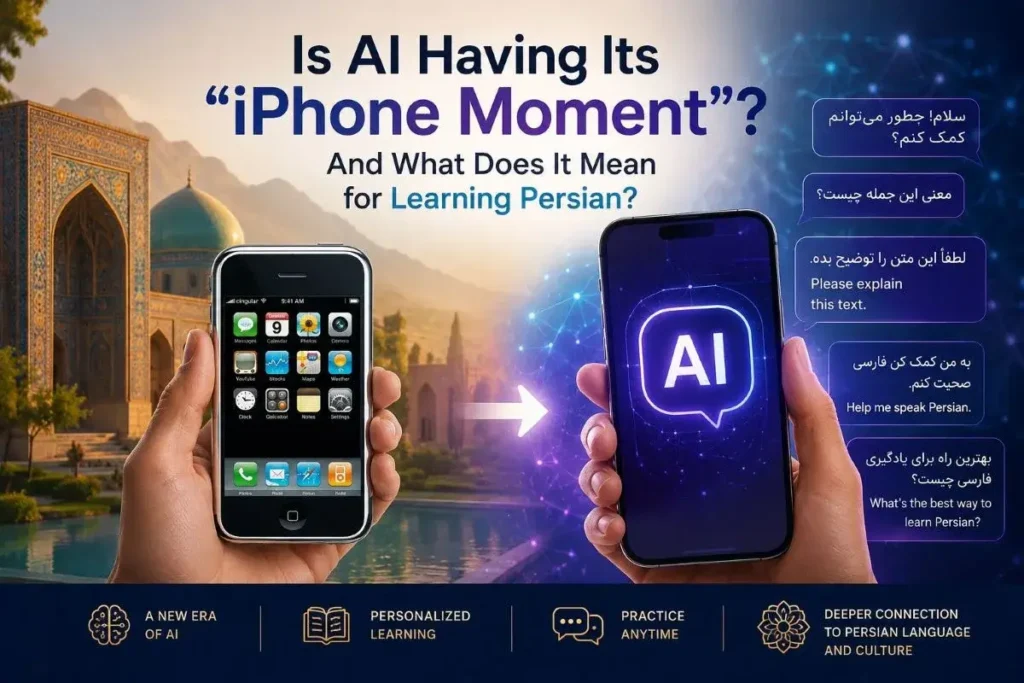
I recently read an article by Om Malik with a bold headline: “AI Models Are Having Their iPhone Moment — What’s Next?”
The author argues that artificial intelligence — especially large language models — has crossed a threshold. It’s no longer a complex lab technology; it has become ubiquitous, cheap, always available, and multimodal, much like the iPhone in 2007, which put a phone, camera, browser, and touch sensor into millions of pockets overnight and gave birth to the app ecosystem.
The three pillars of this “iPhone moment” for AI are:
- Cheap and accessible: No need for massive servers anymore; models run on phones, even offline.
- Multimodal: They see, hear, and speak — not just process text.
- A platform for countless innovations: Anyone can build new tools on this foundation.
For those of us passionate about teaching Persian, the real question is:
How does this shift affect learning Persian as a foreign language, and where does Joy of Persian stand in this new landscape?
Let’s take a practical, sober look.
From “Language-Learning Apps” to an “Intelligent Language Companion”
Until yesterday, learning a language meant installing a few apps, memorizing flashcards, attending online classes with a teacher, and hoping for a real conversation one day.
With AI’s “iPhone moment,” we are entering an era where every learner carries an intelligent language companion in their pocket: always awake, endlessly patient, multisensory, and deeply personalized.
What can this companion do that was impossible before?
1. A 24/7 Persian tutor — inside your phone
Imagine a learner at midnight constructing a sentence:
“I went to the market yesterday and bought a nice book.”
They instantly ask, “Is this sentence correct?” And an AI assistant, running on the phone without internet, responds:
“The sentence is completely correct. If you want to sound more natural, you could replace ‘nice’ with ‘beautiful’ — both are fine, but ‘beautiful’ is a bit more common in this context. Would you like to practice a short dialogue based on this sentence?”
No more “limited resources.” Every learner has a full-time Persian assistant that can even extract new vocabulary from the conversation and save it for later review.
2. Natural spoken conversation with feedback on pronunciation and intonation
The “iPhone moment” means models don’t just write text; they hear and speak like a human. For Persian learners, this means:
- A fluid spoken dialogue on any topic — from daily weather to Hafez’s poetry.
- Pronunciation analysis: “Pause a little more on the word ‘why,’ and soften the ‘gh’ sound in ‘sorrow’ — now try again.”
- Real-life simulations: a job interview in Persian, shopping at Tehran’s Tajrish Bazaar, or chatting with an Iranian colleague. The AI plays the other person’s role and shifts the conversation based on your answers.
3. Deep personalization: Persian designed just for you
When models are cheap and ubiquitous, a learning plan can be shaped by long-term memory and your unique interests:
- The intelligent assistant knows which grammar structures you repeatedly get wrong and designs the next exercise specifically to target that weakness.
- If you love Iranian cuisine, all vocabulary and examples come from the world of cooking: “ghormeh sabzi,” “saffron,” “stew.” If you’re into football, you practice with commentary from a national team match. Motivation never drops.
4. Immersive, context-aware learning (with camera and AR)
The iPhone wasn’t just a phone; its camera opened a universe of apps. Now, “multimodal” AI models can see. For the Persian learner, that means:
- Point your phone’s camera at an object — a samovar, a Persian rug, a street sign — and the AI names it in Persian, pronounces it, and uses it in a natural sentence.
- Walking through Shiraz’s Vakil Bazaar: point the camera at an old sign, the model reads the text, explains the meaning, and suggests a short role-play with a shopkeeper. The boundary between “lesson” and “life” completely dissolves.
5. No more excuses for “I’m too shy to speak”
One of the biggest barriers to speaking Persian — especially for heritage learners who don’t use Persian at home — is the fear of making mistakes and being judged.
A neutral, always kind AI companion removes that fear. You can stumble, stutter, and get stuck mid-sentence dozens of times, and it helps you without a trace of judgment. Then, with the confidence built in this “safe practice room,” you step into real conversations with real people.
But What Happens When the Language Is Persian?
So far, the picture I’ve painted relies largely on what AI can do in high-resource languages like English. The reality, however, is that Persian, with all its richness and history, is a low-resource language in the tech world. That means AI has some serious limitations for Persian that can’t be ignored.
- Weaker machine translation: Automatic Persian translators still make glaring mistakes in complex sentences, colloquial expressions, or literary texts.
- Immature literary analysis: When it comes to Hafez, Rumi, or Sa’di, language models often fail to grasp layers of meaning, ambiguity, and cultural references, offering shallow or outright wrong interpretations.
- Speech recognition and generation lag behind: Persian speech models still struggle with different accents (Tehrani, Isfahani, Afghan, etc.) and with producing truly natural-sounding speech.
- Smaller training data: Models are trained on vast datasets, and for Persian this volume is far smaller than for English. The result: answers can be clichéd, incomplete, or factually incorrect.
This gap makes human expertise and specialized content twice as valuable.
At Joy of Persian, we don’t just recognize these limitations — we design our educational content precisely to fill this void: courses where every single sentence is crafted and reviewed by an expert with deep linguistic and literary knowledge. When a learner reads Rumi’s Masnavi or attends a live workshop, they encounter a profound, human understanding that still remains years ahead of what AI can offer.
What Fills the Space That AI Leaves?
This is where the conversation deepens, and where Joy of Persian’s lived experience comes in.
We’ve been teaching Persian online for ten years — from our foundational Let’s Learn Persian courses to the analysis of Sa’di’s Golestan and Rumi’s Masnavi with distinguished scholars. And we’ve seen firsthand that a language is not just a collection of words and rules. A language means culture, spontaneous humor, body language, eye contact, empathy, and that meaningful pause a real teacher understands.
Dr. Leila Seyedghasem, co-founder and lead instructor at Joy of Persian, winner of the Jalal Al-e Ahmad Literary Award and Iran’s Book of the Year, often repeats one principle in her live workshops:
“No algorithm can see that warm look in a learner’s eyes when they truly grasp a line of poetry — and respond in the moment with a word of genuine encouragement.”
So AI’s “iPhone moment” doesn’t eliminate the teacher; it elevates the teacher’s role from a mere transmitter of information to a mentor, motivator, experience designer, and facilitator of human connection.
In our own “flipped classroom” model, we are already living this future: the learner works through carefully designed offline content, then joins a live workshop with Dr. Seyedghasem to practice exactly what no machine can provide: open-ended cultural discussions, the feel of a ghazal, and a human bond with the Persian language.
Why This Analysis Matters to Joy of Persian
Because what we’re discussing here isn’t a distant speculation to us.
For the past ten years, Dr. Leila Seyedghasem has taught Persian to students from every corner of the world. Her focus remains squarely on teaching and direct human connection, not on tech tools. Yet, on occasions when two students with different profiles attend a class simultaneously, she uses AI as a practical helper to design a lesson plan that serves both learners harmoniously. Our flipped classroom model — where meticulously prepared offline content meets live workshops — is the product of real classroom experience, not a theoretical idea.
Even two years ago, in our post “Will AI Make Language Learning Obsolete?”, we explored the opportunities and challenges of AI for learning Persian. Now, with the emergence of the “iPhone moment,” rather than repeating those thoughts, we can extend the discussion with fresh, tangible evidence and show how the real teacher’s role becomes deeper, not obsolete.
When we talk about the changing role of the teacher today, our analysis doesn’t rely on a single trending article; it rests on ten years of online classes, real learner feedback, and the lessons drawn from direct engagement with Persian culture and literature. This blend of technological awareness and lived experience builds the credibility and trust we want Joy of Persian to be known for.
Final Word: We’re Only at the Beginning
AI’s “iPhone moment” is not a threat to our love for teaching Persian. On the contrary, it’s a historic opportunity to amplify the most human parts of education and delegate repetitive tasks to intelligent assistants.
With its immense cultural and literary heritage, the Persian language needs that “warm human gaze” more than any other. At Joy of Persian, we hold on to exactly that, while wisely welcoming any new tool that helps us improve.
If you’d like to see this philosophy in action, take a look at our courses and workshops — whether to start Persian with Let’s Learn Persian or to immerse yourself in the world of Sa’di and Rumi.
Your intelligent companion is in your pocket, but your real teacher is right in front of you — with the same passion and expertise that have captured our hearts for years.
Have a question or experience of your own on this topic? We’d love to hear from you in the comments.
 Add as a preferred source on Google
(Click the link and check the box next to our name)