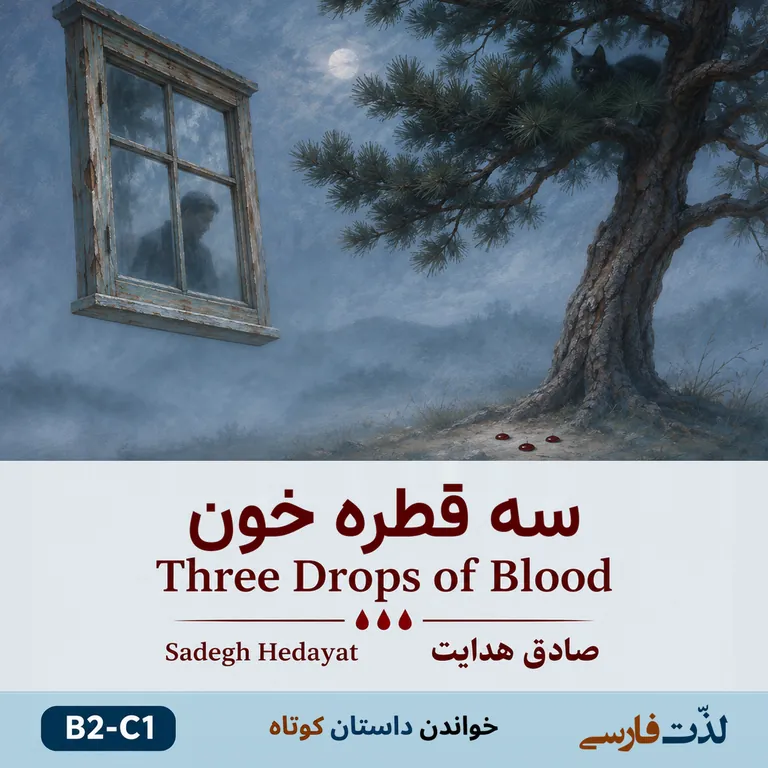
سه قطره خون · Level: B2–C1
Read Sadegh Hedayat’s short story in the original Persian (Farsi), in seven guided parts.
For upper-intermediate learners and heritage speakers ready to read Persian literature in the original.
📖 7 Guided Parts ⏱️ ~10 hr. of Active Study 📆 1-Year Access 💸 14-Day Guarantee
- Read a complete classic of modern Persian fiction in the original, unsimplified
- Learn 170 high-value words: 50 for active use, 120 to recognize, with spaced review
- Understand the culture behind the text: the food, music, beliefs and objects of 1930s Tehran
- Discuss literature in Persian and voice your own reading of the story
Course at a Glance
Who This Course Is For
Upper-intermediate and advanced learners (B2–C1) who have finished their coursebooks and want to read real Persian literature.
Heritage speakers who grew up speaking Persian outside Iran and want to read Hedayat in his own words.
Readers of world literature who know Hedayat in translation and want to meet the original.
Are you ready? B2 is a good guide. The free Part 1 is the real test: if you can follow it with the mini-dictionary beside each passage, you are ready.
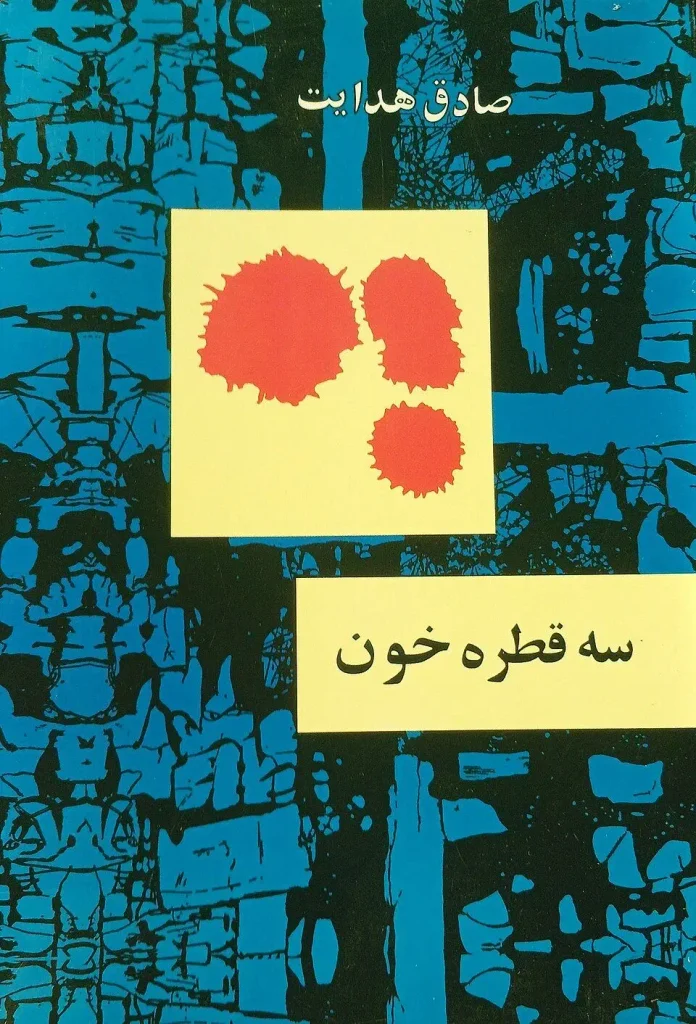
Why This Work?
In 1932 Sadegh Hedayat published his second collection of short stories, Three Drops of Blood. The title story opens in an asylum. A patient has begged for pen and paper for a year; when they finally arrive, he can write only three words.
In about 2,900 words, the story moves between the everyday speech of 1930s Tehran, a poem in classical style and a folk legend. For a learner, that means one short text with many registers of Persian, read exactly as Iranian readers read it.
- Published 1932
- About 2,900 words
- Level B2–C1
At their publication, many of Hedayat’s fictions constituted unprecedented, influential events in Persian fiction.
Michael Craig Hillmann, Encyclopaedia Iranica
See How a Lesson Works
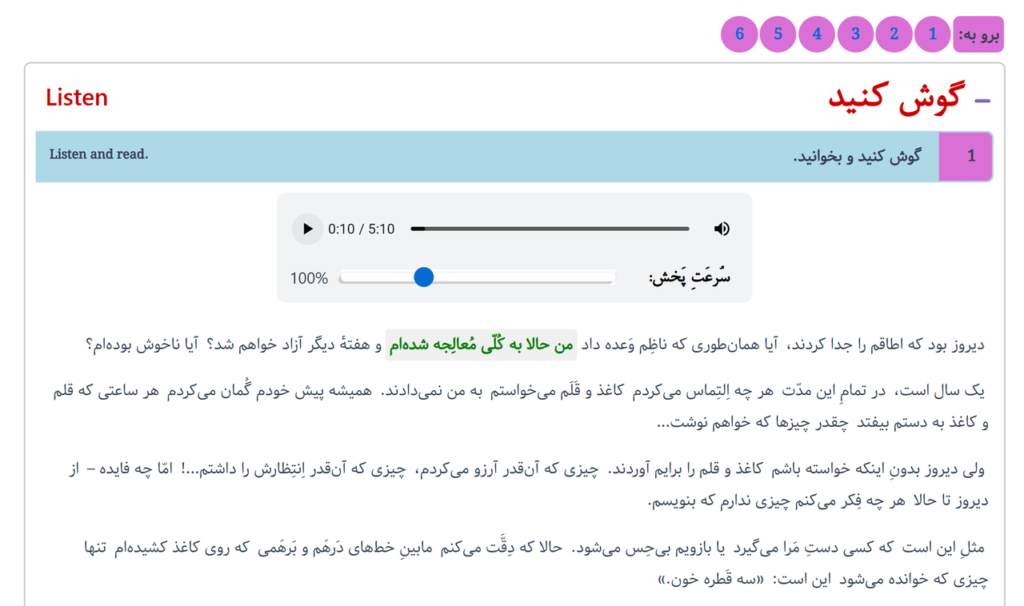
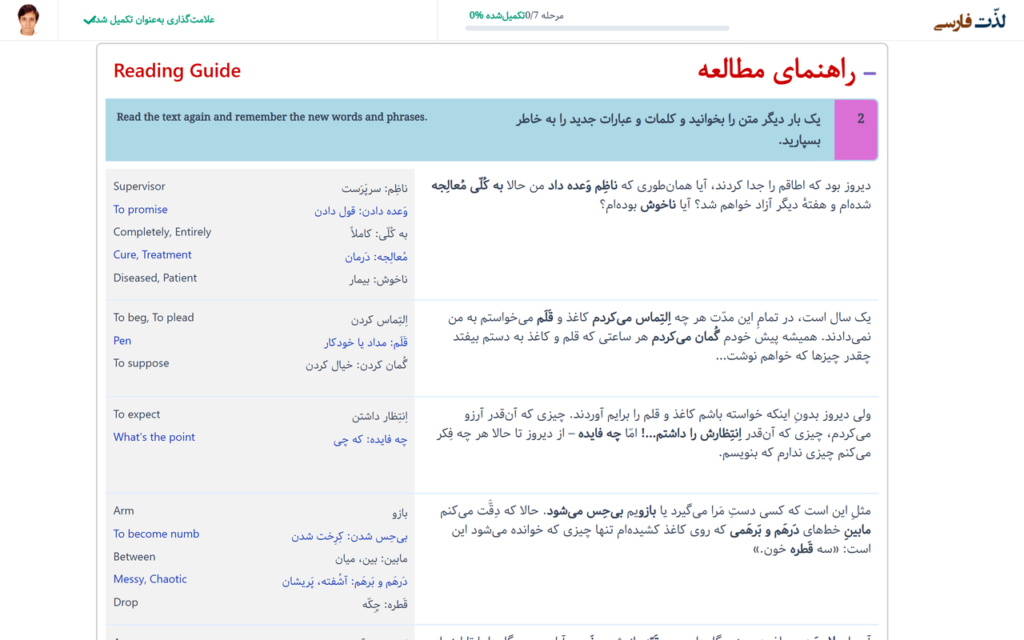
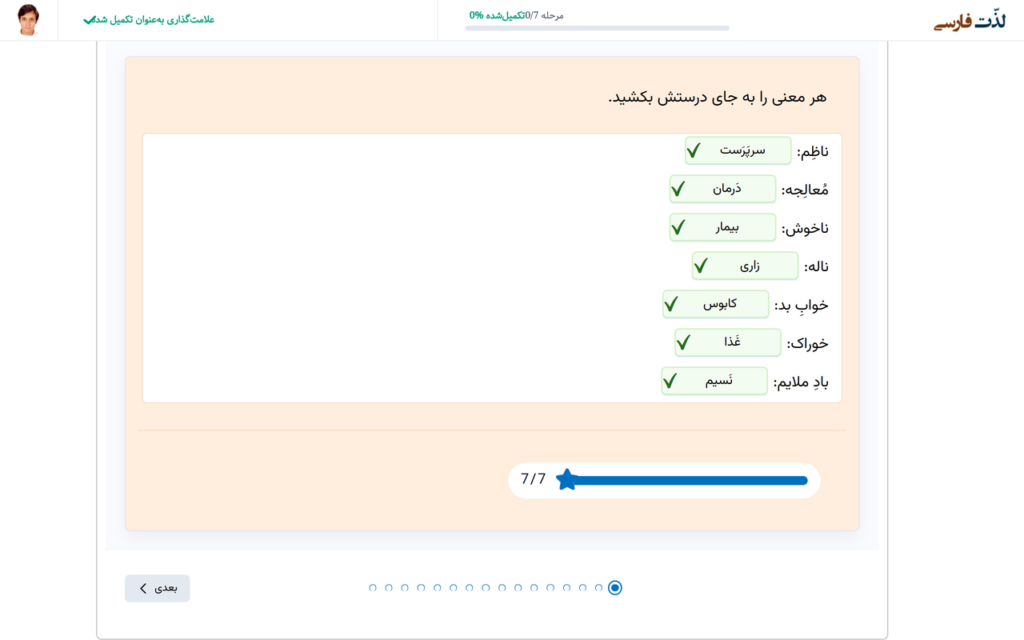
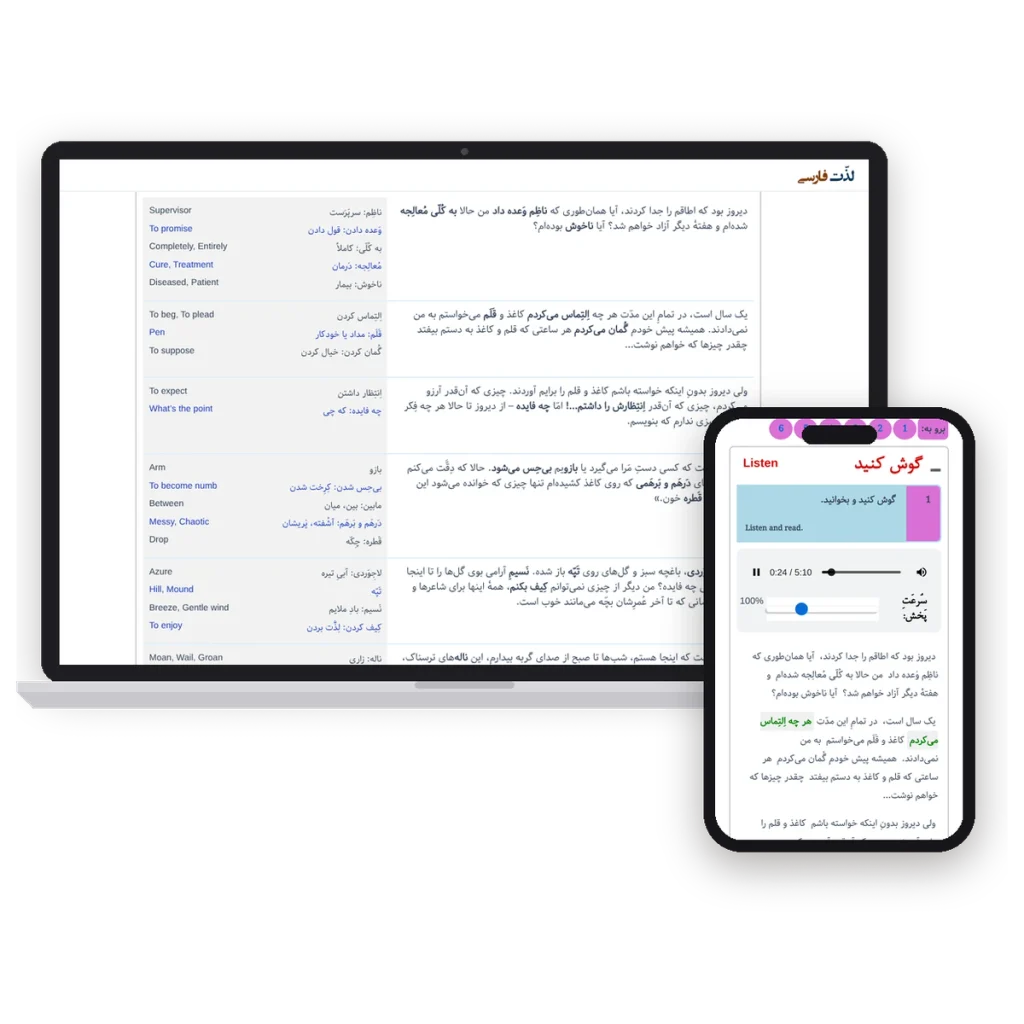
Each part moves from listening to reading to practice. Here is what the exercises look like in Part 1.
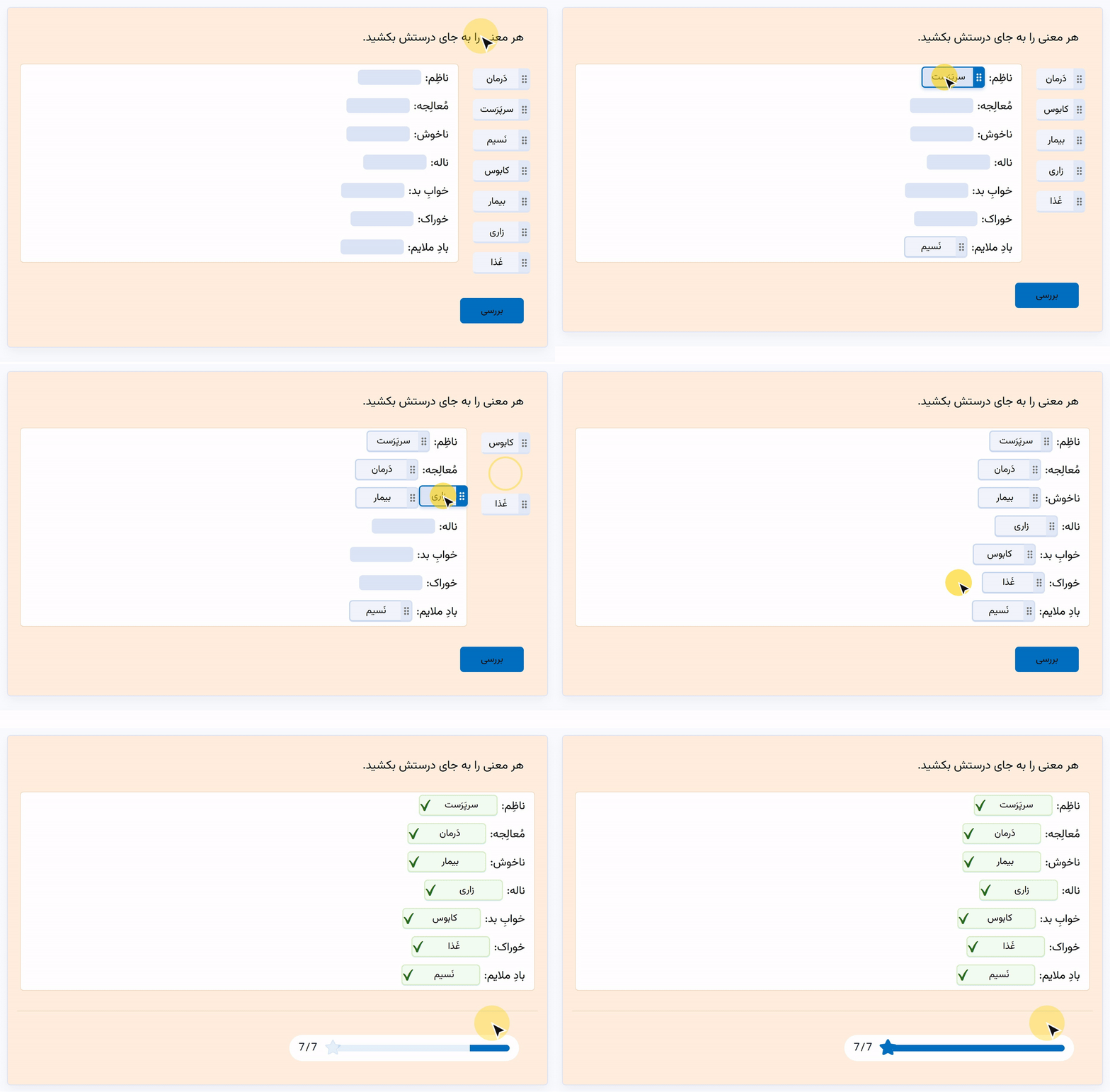
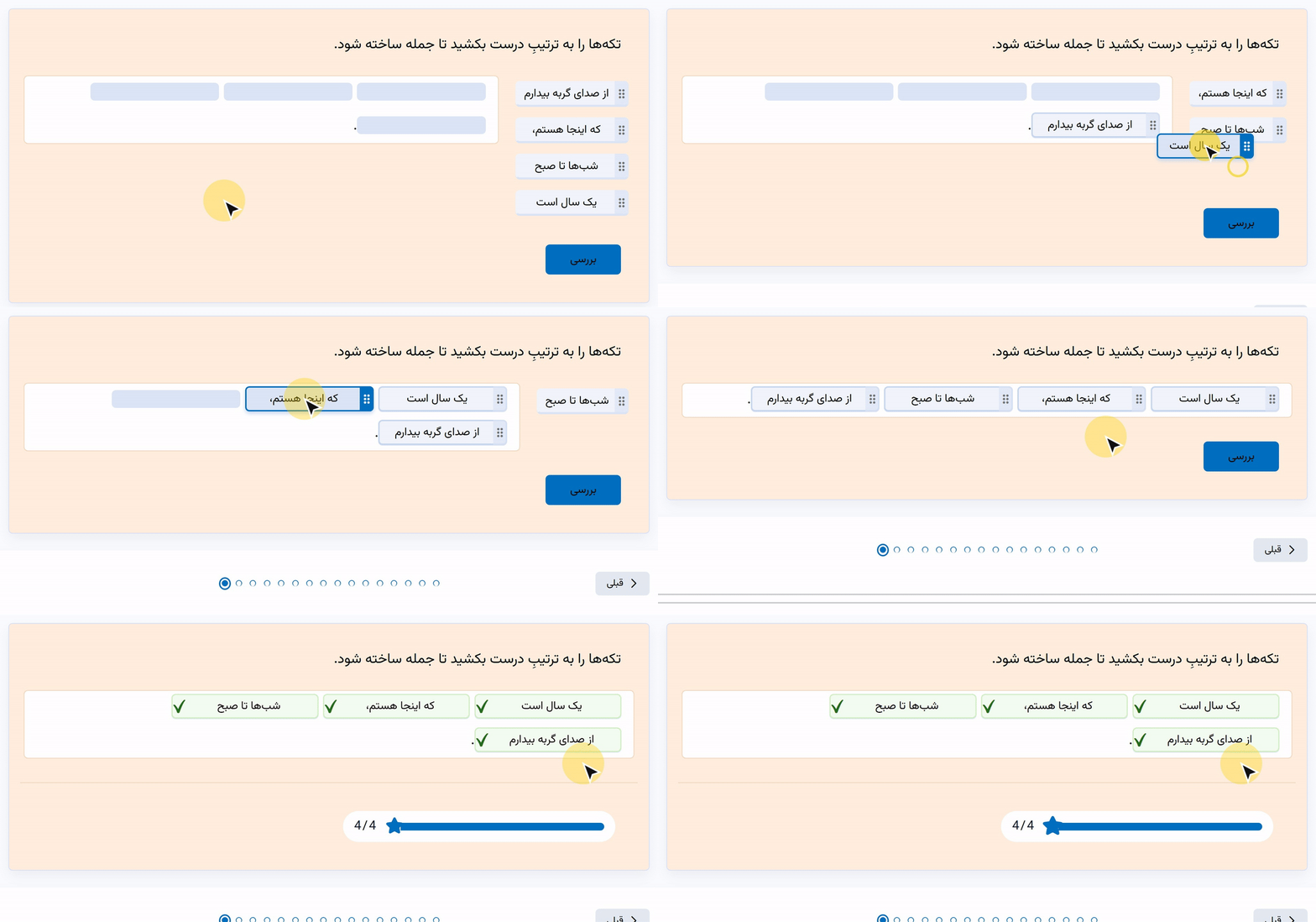
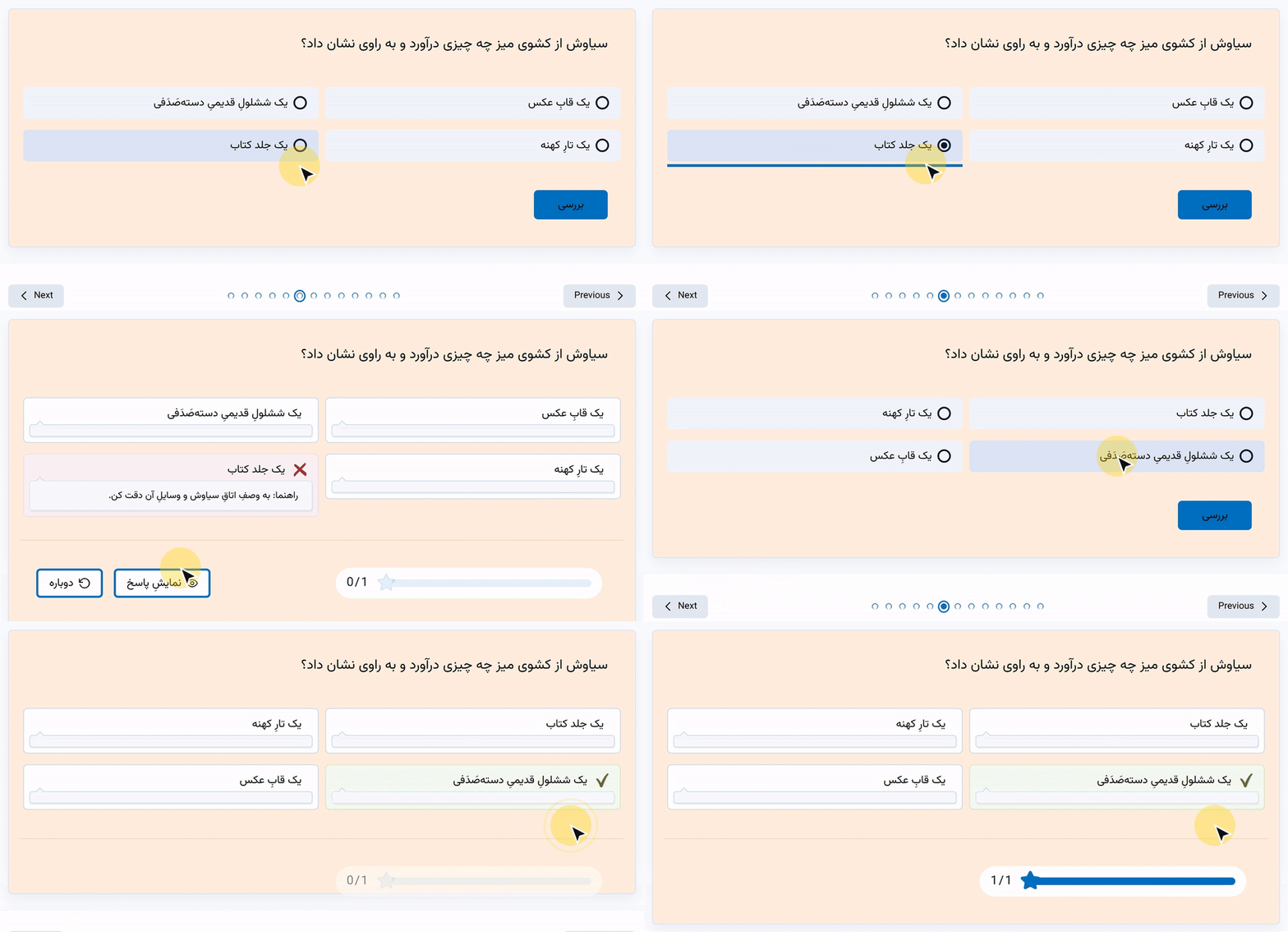
How One Part (Lesson) Works, from Start to Finish
- ListenSynchronized Audio & TextA native narrator, not AI, reads the part while each line highlights (5–6 min of audio).
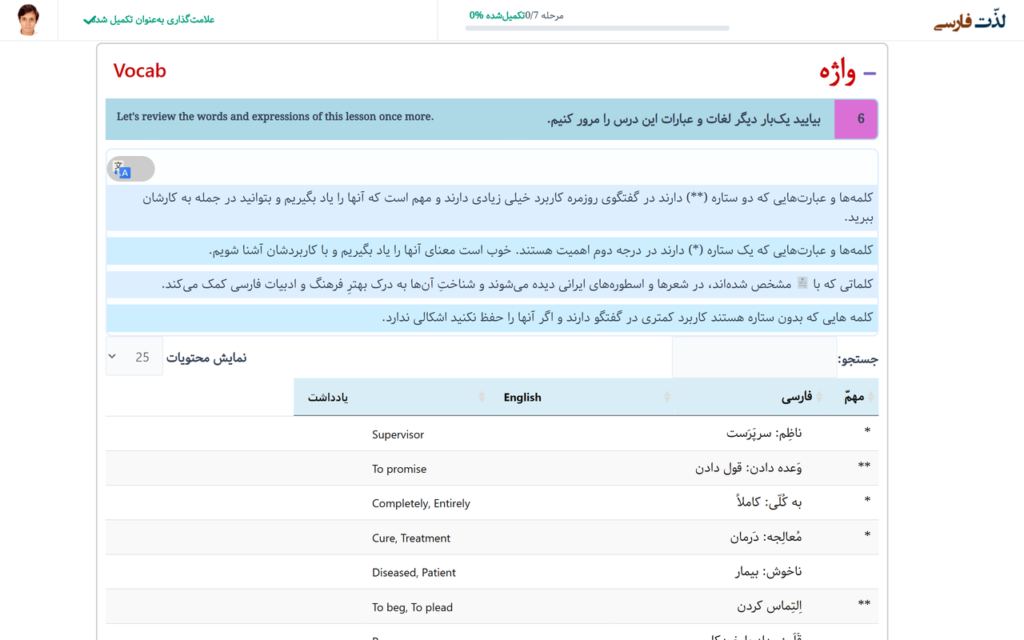
- ReadIn-depth Reading GuideShort passages, new words in bold, a Persian–English mini-dictionary beside each one.
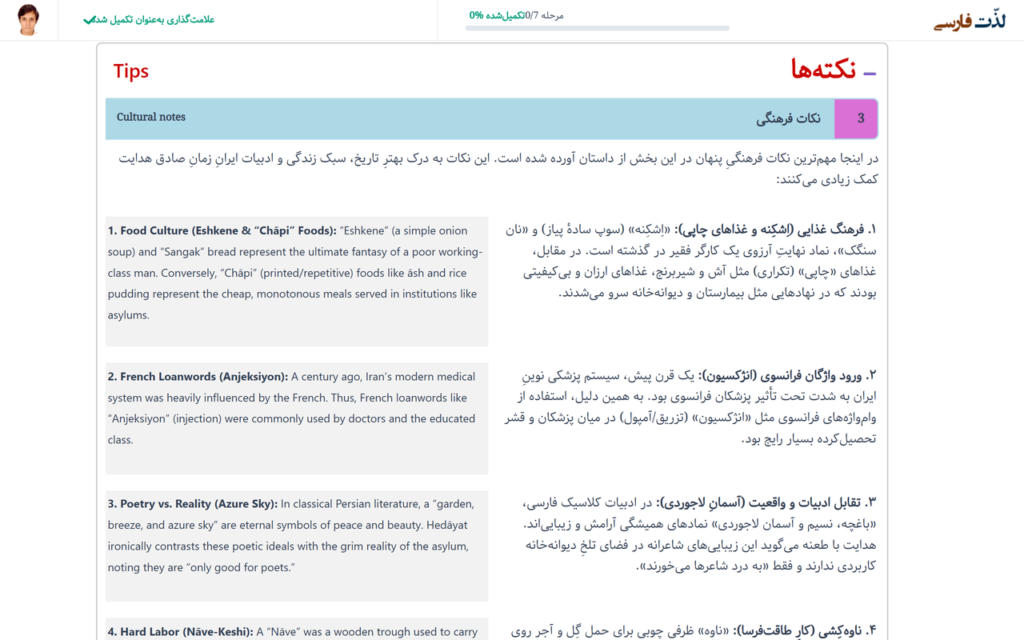
- UnderstandVisual & Historical ArchivesBilingual cultural notes with pictures and sound, from sangak bread to the tar.
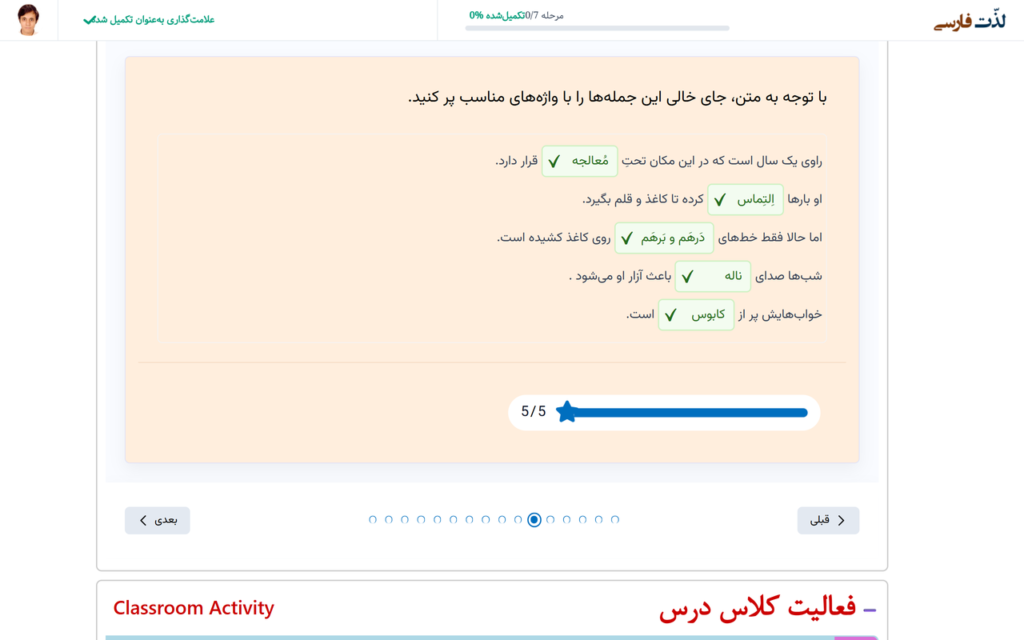
- PractiseInteractive Exercises12–16 exercises per part, with instant feedback.
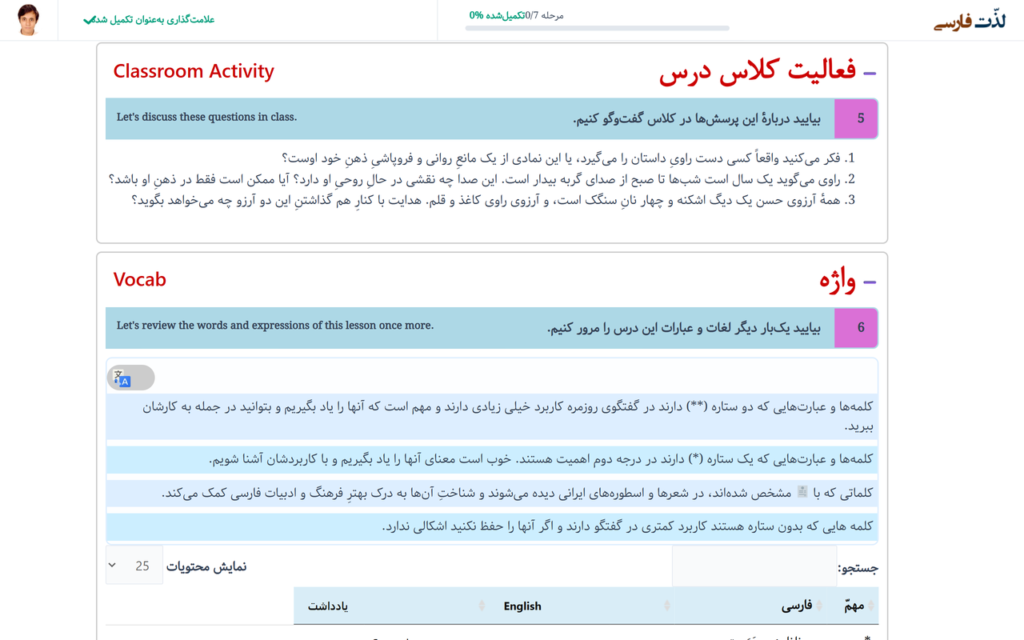
- DiscussClassroom ActivityOpen questions for class or for your own notes.
- ReviewEnhanced Vocabulary BankEvery word tagged by how often it is used today, with spaced review, about 5 min a day.
Words Through Time: some words meant something else in 1932. Notes and one exercise per part compare the old meaning with today’s.
The Seven Parts
~10 hr. of Active Study in total
Part 1 Free
Pen and Paper
قلم و کاغذ
~1.5 hr.
What you learn
Words for the asylum and its routine, French loanwords such as اِنژکسیون, and the food of the poor: eshkeneh and sangak.
Part 2
Inmates and Keepers
اهلِ تیمارستان
~1.5 hr.
What you learn
Causative verbs (خوراندن، ترکاندن), old cosmetics (سفیدآب و سرخاب) and the folk legend of the morgh-e haq.
Part 3
The Neighbor Who Wrote Poetry
همسایهای که شعر میگفت
~1.5 hr.
What you learn
Read a poem in classical style, idioms of luck (بخت و طالع) and the world of Dar ol-Fonun and the tar.
Part 4
A Visit to Siavash
دیدار با سیاوش
~1.5 hr.
What you learn
Describe rooms and objects, read Hedayat’s similes (چشمهای سُرمهکشیده) and spot words whose meaning has changed.
Part 5
Nāzi, the Calico Cat
نازی، گربهٔ گلباقالی
~1.5 hr.
What you learn
Words for animal behaviour and feeling, and literary verbs such as آشکار نمودن.
Part 6
Spring Fever
شورِ بهار
~1.5 hr.
What you learn
Sounds and movement, and everyday expressions such as از جا در رفتن and خسته و کوفته.
Part 7
The Witness
شاهد
~1.5 hr.
What you learn
Dialogue and reported speech, and old meanings such as تغیّر (anger) and قابل (skilled).
The Team Behind the Course

Dr. Leila Seyedghasem
Course Developer & Narrator
PhD in Persian Language and Literature, University of Tehran. Over ten years of teaching and more than 6,000 lessons with international students. She has lectured at Shahid Beheshti University and is the author of Sa’di and Mosques of Iran. Her work on Persian rhetoric received Iran’s Book of the Year Award and the Jalal Al-e Ahmad Literary Award. Co-founder of Joy of Persian and of the Literary Map of Iran.
Many students know Hedayat only through The Blind Owl, so I chose the short story closest to it in style and structure. In a textbook you learn the language; in this story you meet it as it really is, with all its complexity.
Dr. Leila Seyedghasem
In her own voice
Why I chose this story
In Persian, with English subtitles
Press play to hear Dr. Leila, with Persian and English subtitles.
Read the transcript
من از میونِ داستانهای کوتاهِ صادق هدایت این را انتخاب کردم، برای اینکه ساختارش و سبکش از همه به بوف کور نزدیکتره.
Of all Sadegh Hedayat’s short stories, I chose this one because its structure and style are the closest to The Blind Owl.
بوف کورِ صادق هدایت خیلی محبوبه و به زبانهای دیگه خیلی ترجمه شده.
Hedayat’s novel The Blind Owl is much loved and has been widely translated.
و میدونم خیلی از دانشجوها صادق هدایت را فقط با بوف کور میشناسند.
And I know many students know Hedayat only through The Blind Owl.
سعی کردم از بین داستانهای کوتاه داستانی را انتخاب کنم که از نظر سبک و ساختار به بوف کور نزدیک باشه، و این داستان از همه نزدیکتره.
So I looked among his short stories for the one closest to it in style and structure, and this story is the closest.
خواندنِ این داستان به زبانآموز چه چیزی میده که کتاب درسی نمیده؟
What does reading this story give a learner that a textbook doesn’t?
کتاب درسی خیلی سرراست و مستقیمه و خیلی کم سراغِ زبانِ غیرمستقیم میره.
A textbook is direct and straightforward; it rarely goes near indirect language.
ضربالمثلهای کمتری توی کتاب درسی هست، و توصیفهای جزئی هم کمتر.
Textbooks have fewer proverbs, and fewer detailed descriptions.
ولی توی این داستان خیلی توصیف میبینیم: توصیفِ شخصیتها، مکانها، حتی حیوانها، رفتار انسانی و رفتار حیوانی. اینها در کتاب درسی نیست.
But this story is full of description: of characters, places, even animals, of human and animal behaviour. You won’t find that in a textbook.
و با واقعیتِ زبان روبهرو میشن. در کتاب درسی زبان را یاد میگیرند، اما در این داستان با واقعیتِ زبان، با همهٔ پیچیدگیها و هوشمندیاش، روبهرو میشن.
And they meet language as it really is. In a textbook they learn the language; in this story they meet it for real, with all its complexity and intelligence.

Abolfazl Ahani
Founder & Instructional Designer
After 15 years leading large-scale oil and gas projects, he founded Joy of Persian in 2022 and built the platform this course runs on.
What Students Say About Dr. Leila’s Literature Teaching
From classics to novels

Mikuru
She is a very good teacher! I learned basic Persian in college, but I continue to study Iranian literature with her. She teaches with full-fledged literary knowledge, from classical poetry such as Saadi and Rumi to contemporary novels.
Persian Literature class with Leila • Sep 2021
Material worth reading

Kashif
Leila chooses very interesting, level-appropriate and engaging topics and material. […] I am finding the lessons very enjoyable and hope to continue learning for a long time to come.
Persian Literature for Beginners with Leila • Nov 2024
Words and their roots

Yilin
Dr. Leila explains grammar extremely clearly, and I also really like that she knows the etymology of many words […]
Persian Language classes with Leila • Oct 2025


Handpicked from 400+ five-star reviews since 2015.
Start Your Persian Journey Today
Limited Launch Spots 🔥 First 10 save 30% → Next 20 save 20% → Next 30 save 10%.
💎 Active Launch Tier: 30% Off
Start learning right away: the first part is free and open to everyone; full access activates usually within a few hours, at most 1 business day.
Enroll with peace of mind: every purchase comes with a 14-day money-back guarantee.
Price: €150 €105
📜 Original, Unsimplified Text 🎧 Native Narrator, Not AI 📚 Bilingual Mini-Dictionary⏳ Full Year Access (No Recurring Subscriptions)

Pay securely with your card via our partner,
Buy Me a Coffee:
💬 Group Purchase: Learn together, save 15 % — use code GP15 at checkout.
Your Questions, Answered
Is my Persian (Farsi) good enough for this course?
The course is written for B2–C1 learners. The best test is the free Part 1: if you can follow it with the mini-dictionary beside each passage, you are ready. Every part has the same support.
What if I get stuck?
Each passage has a mini-dictionary, and each part has cultural notes and instant feedback on the exercises. If one point is still unclear, you can ask Dr. Leila a question and receive a short recorded answer. More on getting help.
Does the course offer live sessions or one-on-one tutoring?
The course itself is self-paced. For live discussion of the story, you can book 1-on-1 classes with Dr. Leila or plan a custom online workshop for your group.
How long does the course take?
About 10 hours of active study: about 1.5 hours for each of the seven parts, including vocabulary practice. Spaced review adds about 5 minutes a day. How we estimate study time.
Is the text simplified?
No. You read Hedayat’s original 1932 text, word for word. The support sits beside the text: the mini-dictionary, notes and exercises.
How long do I have access, and can I get a refund?
One payment gives you one full year of access, with no subscription. If the course is not right for you, you can ask for a full refund within 14 days, minus transaction fees.
Do I need to type in Persian?
Only in the listen-and-write exercises, and an on-screen Persian keyboard is built in. You can also use your own keyboard.
Is the story suitable for everyone?
The story is set in an asylum and deals with madness and death. It contains no graphic images, and the course illustrations show only everyday objects of the period: food, music, clothing and the house.
Still more questions?
See our Help Center