
⚡ Quick Summary (TL;DR):
The Persian numbers in 6 bullets
- Atoms: Memorise 1 to 10. The teens are those units fused with dah, with predictable sound changes.
- The Tens: Learn 20 to 90. Only 50, 70 and 80 are built transparently from 5, 7 and 8.
- The hundreds: sad, plus eight compressed forms from devist (200) to nohsad (900).
- The Connector: Join any parts with -o- (and). Biggest first, smallest last.
- Scale Words: hezar (1,000), milyun (1,000,000), milyard (1,000,000,000).
- Compounds: Everything else is assembly. Roughly thirty memorised words and one connector produce every number up to a billion.
Search engines will happily tell you how to count to ten in Persian. They give you the lookup table. What they fail to explain is the underlying mechanism that turns those ten words into any number you will ever need to say.
The Persian number system is an additive pattern. You only need to memorise about thirty base words. Once you have them, a single connector generates every number from 21 to a billion.
The atoms (1 to 10)
These are the indivisible units. You must memorise them. The cards below include native audio to lock in the pronunciation before you start building compounds.
Eleven to nineteen
The teens are built by taking the unit and attaching a softened version of ten (dah).
The tens (20 to 100)
The multiples of ten have to be memorised alongside the atoms. Only 50, 70 and 80 are transparently built from 5, 7 and 8; the rest are related to their units historically but have their own shapes.
The one rule that builds every compound
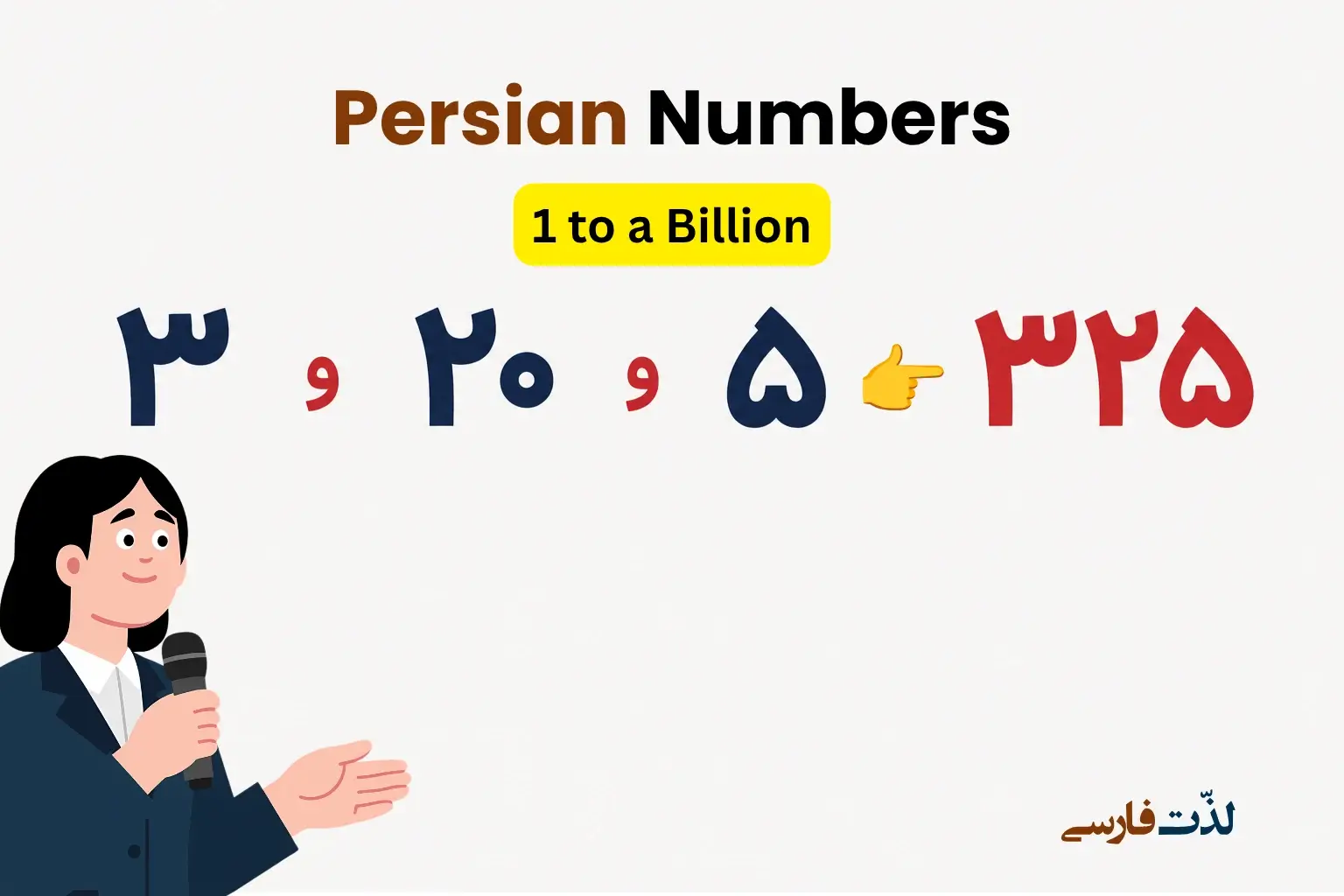
This is the core of the Persian number system. To build any number between 21 and 99, you take the ten, add the connector -o- (meaning “and”), and finish with the unit.
- 21: bist-o-yek
- 45: chehel-o-panj
- 99: navad-o-noh
You will notice there are no audio players for the compound numbers above. This is intentional: you hear every atom in the cards and build the compounds yourself. The rhythm never changes. It is always largest value to smallest value, glued together with -o-.
Hundreds and the scale words
The pattern scales indefinitely.
| Western | Persian Digits | Persian Word | Transliteration |
|---|---|---|---|
| 100 | ۱۰۰ | صد | sad |
| 200 | ۲۰۰ | دویست | devist |
| 300 | ۳۰۰ | سیصد | sisad |
| 400 | ۴۰۰ | چهارصد | chahārsad |
| 500 | ۵۰۰ | پانصد | pānsad |
| 600 | ۶۰۰ | ششصد | sheshsad |
| 700 | ۷۰۰ | هفتصد | haftsad |
| 800 | ۸۰۰ | هشتصد | hashtsad |
| 900 | ۹۰۰ | نهصد | nohsad |
Two of these hide their unit. devist (200) contains no visible sad at all, and the si in sisad (300) is an old form of se (three), not the si that means thirty. Three thousand is se hezār; si hezār is thirty thousand.
When something follows the hundred, the same connector returns: 101 is sad-o-yek, 550 is pānsad-o-panjāh.
There are no recordings for the hundreds, and none are needed: you already hear sad and every unit, and the fusion rule above builds the rest.
Above 999, a scale word follows each group of three digits:
- 1,000: hezār
- 1,000,000: milyun
- 1,000,000,000: milyard
One thing to unlearn from English. sad and hezār stand alone: 100 is sad and 1,000 is hezār, never yek sad or yek hezār. The larger two behave the opposite way and always need the unit: 1,000,000 is yek milyun and 1,000,000,000 is yek milyard, never milyun on its own.
The English word “billion” means different things in short-scale and long-scale usage, so we state the top of our range explicitly: milyārd = 1,000,000,000 = 10^9.
Now the full chain. Take 2,345,678. Split it into three-digit groups, read each group as its own compound, and attach its scale word:
- 2 → do milyun
- 345 → sisad-o-chehel-o-panj hezār
- 678 → sheshsad-o-haftād-o-hasht
Glue the groups with the same -o- and the whole number reads: do milyun-o-sisad-o-chehel-o-panj hezar-o-sheshsad-o-haftād-o-hasht.
Persian digit glyphs against Western numerals
Persian is written right-to-left, but numbers are written left-to-right, exactly like English. The shapes of 4, 5, and 6 differ from the standard Arabic forms used in the Gulf.
| Western | Persian | Name |
|---|---|---|
| 0 | ۰ | sefr |
| 1 | ۱ | yek |
| 2 | ۲ | do |
| 3 | ۳ | se |
| 4 | ۴ | chahār |
| 5 | ۵ | panj |
| 6 | ۶ | shesh |
| 7 | ۷ | haft |
| 8 | ۸ | hasht |
| 9 | ۹ | noh |
For a complete breakdown of the script, see our Persian alphabet chart.
Ordinal numbers
Cardinals count. Ordinals rank, and Persian builds them from the cardinals you already have by adding -om (ـم).
| Cardinal | Ordinal | Transliteration | Meaning |
|---|---|---|---|
| دو | دوّم | dovvom | second |
| سه | سوّم | sevvom | third |
| چهار | چهارم | chahārom | fourth |
| ده | دهم | dahom | tenth |
| بیست | بیستم | bistom | twentieth |
| صد | صدم | sadom | hundredth |
Two places where the rule bends. Standing on its own, “first” is avval (اول), a word borrowed from Arabic rather than built from yek. The regular form yekom (یکم) does exist and is the one you use in dates and inside compounds. And se takes a linking consonant: sevom, never seom.
In a compound, only the last element carries the suffix. 21st is bist-o-yekom, 105th is sad-o-panjom. The connector does not change.
Ordinals sit in one of two frames. After the noun with an ezāfe, which is the everyday spoken form: ketāb-e dovom (کتاب دوم), the second book. Or before the noun in the -omin form: dovomin ketāb (دومین کتاب), which reads as more formal or emphatic.
Interactive practice
Reference lists are what search engines reproduce. The widgets below force you to build the system in real time.
I sat the academic IELTS. The parts I expected to lose points on, the long lectures and the multi-speaker discussions, I handled. What I kept getting wrong was the numbers: a date, a room number, a price read out at normal speed. I had to go back and drill the beginner material I assumed I was long past.
I suspect the trap is the same for English speakers learning Persian. Every other part of a sentence gives you a second chance: context, repetition, a word you can guess from the one beside it. A number gives you none of that. shesh (6) and shast (60) differ by one vowel, and if you miss which one landed, nothing else in the sentence will tell you. Recognising shast in a table is a different skill from catching it in speech, which is why the first widget plays a sound and asks you to name it rather than the other way round.
Put the pattern to work
Memorising atoms and connectors solves the arithmetic. Reading a clock or stating your age requires muscle memory. The building blocks in this post map directly to our A1 curriculum. You will use the numbers 1 to 20 to state your profession and read the clock in lessons 6, 7, and 9. Finally, you will use the tens and sad to state your exact age in lesson 11. Leave the lookup tables behind and start building full sentences in Let’s Learn Persian A1.
FAQ
How to count 1 to 10 in Persian?
The atoms are yek, do, se, chahār, panj, shesh, haft, hasht, noh, and dah. Once you have these ten words, the system scales by adding the connector -o- to build any larger figure.
Are Arabic and Persian numbers the same?
The spoken words are completely different, as Persian is an Indo-European language and Arabic is Semitic. The written glyphs share a common origin, but Persian uses Eastern Arabic numerals where the shapes for 4, 5, and 6 differ from the standard forms used in the Arab Gulf.
Why are Persian numbers written left to right?
While the Persian script flows right-to-left, mathematical figures and numerals are written and read left-to-right, exactly as they are in English. This prevents ambiguity when writing equations or phone numbers.
What is the classifier “tā” in Persian numbers?
When counting physical objects, Persian inserts a classifier between the number and the noun. The universal one is tā, so “two apples” comes out as “two of apple”: do tā sib. Note what does not happen to the noun. It stays singular. The number already carries the plurality, so do tā sib and do sib are both correct, while do sibhā is not.
How do you say 1 billion in Persian?
One billion is yek milyard. In the Persian system, milyard = 1,000,000,000 = 10^9. We state this explicitly because the English word “billion” means different things in short-scale and long-scale counting systems.
 Add as a preferred source on Google
(Click the link and check the box next to our name)