
1. The Crisis of the Persian Intermediate Plateau: Why Persian Learners Get Stuck
The journey of learning Persian often begins with a burst of excitement. Many learners find themselves enchanted by the melodic flow of the language and the visual beauty of the script. However, after the initial “honeymoon phase” of learning greetings and basic grammar, a structural crisis often sets in. This is known in Second Language Acquisition (SLA) as the “Persian intermediate plateau”—a phase where learners, having exhausted beginner resources, face a precipitous drop in available, level-appropriate material necessary to reach advanced proficiency.
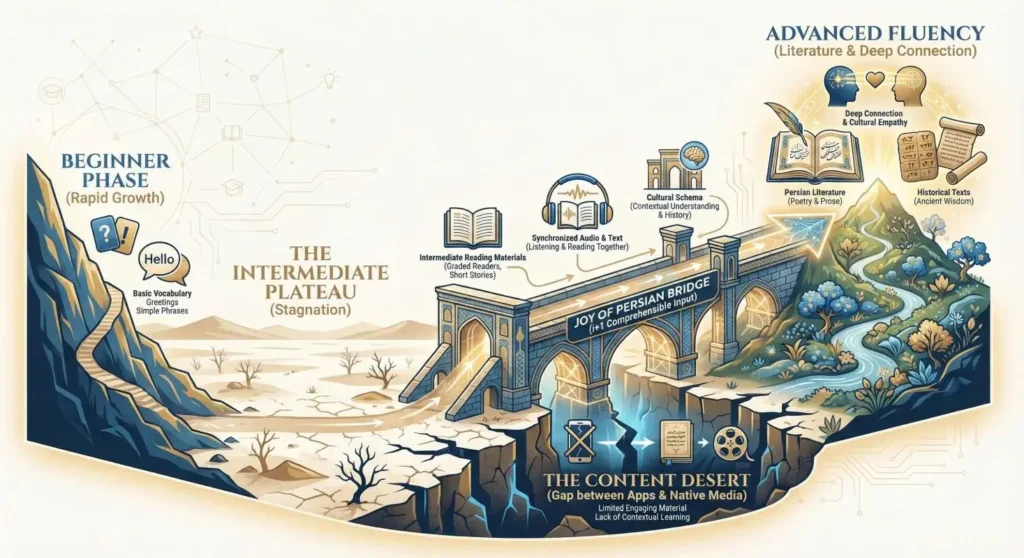
For the Persian learner, this plateau is not just a mental block; it is a product of the current educational landscape. Unlike commonly taught languages like Spanish or French, where the transition from “See Spot Run” to “Don Quixote” is supported by thousands of graded materials, Persian remains heavily entrenched in traditional, grammar-heavy methodologies. This lag has created what we call a “content desert”: a vast emptiness between the oasis of beginner apps and the ocean of native literature.
In this desert, learners often “perish” linguistically, unable to find the bridge that leads them from basic conversation to the profound wisdom of Rumi or the complexities of modern Iranian cinema. This disparity is empirically visible in the availability of Persian Comprehensible Input resources. A comparative analysis of curated language learning directories reveals a stark imbalance: for instance, Spanish learners can access dozens of specialized graded podcasts for various levels, whereas Persian learners typically have access to fewer than five active, level-appropriate equivalents. Compare Spanish Podcasts vs. Persian Podcasts listings at All Language Resources.
This article explores the theoretical underpinnings of Persian Comprehensible Input (CI) and how a modern, academic-driven approach—specifically the Joy of Persian ecosystem—is terraforming this desert through a refined process of Persian Language Acquisition.
Time to read:
Table of Contents
2. The Architecture of Acquisition: Krashen’s Hypotheses and Modern Refinements
The theoretical foundation of this analysis rests on Stephen Krashen’s Monitor Model, a set of five hypotheses that revolutionized SLA in the 1980s. While elements of Krashen’s theory have been debated and refined by subsequent scholars like Bill VanPatten and Paul Nation, the core distinction between “learning” and “acquisition” remains the most powerful explanatory tool for the failures of traditional Persian pedagogy.
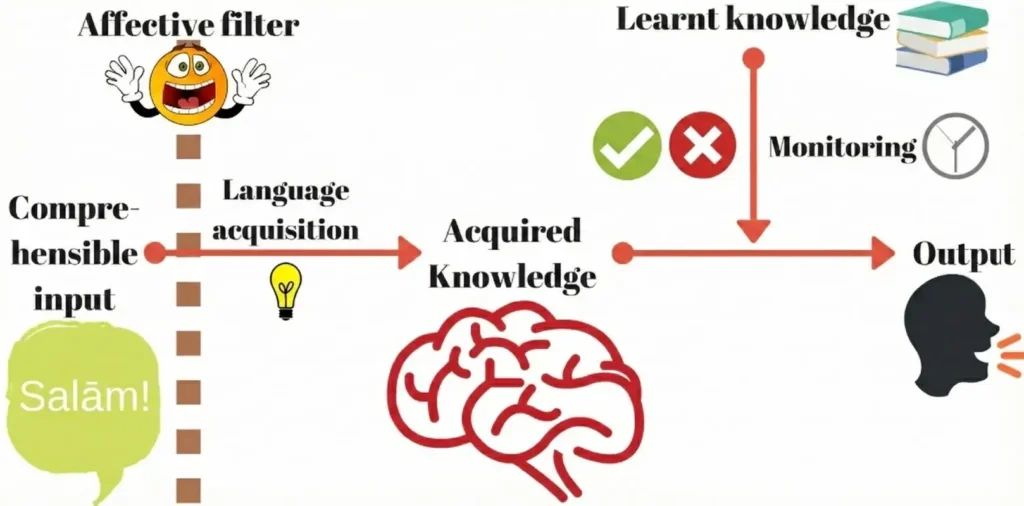
2.1 The Acquisition-Learning Hypothesis
The most fundamental of Krashen’s tenets is the distinction between two independent systems for developing language ability:
- Acquisition: A subconscious process similar to how children develop their first language. It requires meaningful interaction in the target language—natural communication—in which speakers are concerned not with the form of their utterances but with the messages they are conveying and understanding.
- Learning: A conscious process that results in “knowing about” language. It involves formal instruction and is characterized by the explicit knowledge of grammar rules, such as the specific conjugation of the Persian subjunctive or the rules of the Ezāfe construction.
Implications for Persian:
Current Persian instruction is overwhelmingly focused on learning—memorizing conjugation tables and rules. However, fluency originates solely from the acquired system, which can only be built through exposure to Persian Comprehensible Input, not through the rote memorization of grammar.
2.2 The Input Hypothesis (i+1)
The Input Hypothesis posits that acquisition occurs in only one way: when the learner understands messages that contain structure a little beyond their current level of competence. If the learner’s current level is i, the input must be i+1.
- Comprehensibility: The learner must understand the meaning of the message. This comprehension is aided by context, world knowledge, and extra-linguistic information (e.g., images, gestures).
- Sufficiency: The input must be abundant. A few sentences are insufficient; the brain requires massive exposure to detect statistical patterns in the language.
The Persian Context:
Achieving i+1 in Persian is notoriously difficult for English speakers (Category IV difficulty).
- i+0: In the case of Persian, existing beginner-level apps typically provide input that is overly simplistic, decontextualized from cultural and discursive settings, and heavily reliant on vocabulary memorization and translation drills rather than meaningful discourse.
- i+10: Native media (BBC Persian, Iranian cinema) creates a “comprehensibility gap.” The vocabulary load, cultural references, and speed of delivery are far beyond the i+1 zone, rendering the input merely “noise” to the learner’s brain.
- The Missing i+1: The Joy of Persian “Beyond the Core” courses attempt to manufacture this missing middle ground. By using controlled vocabulary, reading guides, and familiar thematic schemas (e.g., a mountain climb), they aim to keep the input understandable while introducing new language.
2.3 The Affective Filter Hypothesis
Krashen argues that attitudinal variables relate directly to language acquisition. Motivation, self-confidence, and anxiety combine to form the “Affective Filter”. If the filter is “up” (high anxiety, low motivation), input is blocked from reaching the Language Acquisition Device (LAD) in the brain.
Persian-Specific Anxiety Factors:
- Script Anxiety: The Persian alphabet (modified Arabic script) is a significant barrier. Learners often feel illiterate even after months of study, raising anxiety levels.
- Cultural Distance: For Western learners, the lack of shared cognates and cultural reference points can lead to feelings of alienation.
- Performance Pressure: Traditional classes often demand early production (speaking), which forces learners to perform before they have acquired enough language, causing acute stress.
The “Beyond the Core” courses mitigate this by focusing on receptive skills (reading/listening) first, allowing for a “silent period” where the learner absorbs the language without the pressure of immediate output. Furthermore, the thematic focus on high culture (such as poetry, architecture, mythology, and geography) leverages intrinsic motivation, lowering the filter by engaging the learner’s intellectual curiosity.
2.4 Modern Refinements: Input Processing and the Four Strands
While Krashen provides the macro-theory, modern SLA research offers micro-level insights crucial for analyzing course design.
Bill VanPatten’s Input Processing (IP):
VanPatten critiques the idea that any comprehensible input leads to acquisition. He argues that learners have limited processing capacity and will naturally process input for meaning before form.
- The Primacy of Meaning Principle: If a sentence contains a lexical indicator of time (e.g., “Yesterday”) and a grammatical indicator (the verb suffix), the learner will attend to “Yesterday” and ignore the suffix because it is redundant.
- Our Approach: To counter this “lazy brain” effect, we don’t just provide passive content. We design our Reading Guides and Interactive Workshops to ensure you are attending to the structural nuances that carry deeper meaning. While our synchronized audio-text highlights specifically solve the “Abjad problem” (missing vowels), our curriculum as a whole is curated to move you beyond “just getting the gist.” We guide you to notice the subtle textures of the language—the small details that turn simple understanding into true, high-level acquisition.
Paul Nation’s Four Strands:
While we are deep believers in the power of input, we don’t follow a “purist” or restricted model. Instead, we integrate Paul Nation’s Four Strands theory to ensure our students develop a well-rounded, functional mastery of Persian. Nation argues that for true proficiency, a learner needs a balance of four equal components. Here is how we’ve built that balance into the Joy of Persian ecosystem:
- Meaning-focused Input (25%): This is the heart of our “Beyond the Core” courses. Through stories like Damavand or Deserts of Iran, you engage with rich, authentic Persian where the primary goal is understanding the message, not just the mechanics.
- Meaning-focused Output (25%): We solve the “silent period” frustration through our Interactive Workshops and 1-1 classes. Here, you are forced to use the language to communicate real ideas, turning your acquired knowledge into active speech.
- Language-focused Learning (25%): We recognize that adult learners benefit from strategic clarity. Our Reading Guides, synchronized audio, and vocabulary banks provide the deliberate study of script you need to accelerate your progress without getting bogged down. We reserve explicit discussions about grammar and syntax for our workshops and 1-1 classes, providing “Just-in-Time” explanations that solve your specific linguistic puzzles.
- Fluency Development (25%): We encourage you to revisit familiar stories and engage in repetitive, high-speed practice in our workshops. This strand is about making what you already know “faster” and more automatic, moving you toward that effortless flow.
By adopting this hybrid model, we ensure that you aren’t just a “passive listener” or a “grammar robot,” but a balanced communicator who can read, listen, speak, and understand Persian with confidence.
3. The Anatomy of Scarcity: Mapping the Content Desert
To evaluate the current state of Persian learning, we must map the wasteland it seeks to irrigate. The resource landscape for Persian typically follows a “U-shaped” distribution.
3.1 The “U-Shaped” Distribution of Resources
- Beginner Abundance: There is a saturation of resources for total beginners. Popular websites like Chai and Conversation, PersianPod101, and Pimsleur offer excellent entry points for survival phrases, often relying on transliteration to bypass the script.
- Advanced/Native Abundance: For the advanced scholar, there is an unlimited supply of classical literature (Saadi, Hafez) and modern media.
- The Intermediate Void: Between “Where is the library?” and “The geopolitical ramifications of the nuclear deal,” there is almost nothing to read or listen to at an B1/B2 level.
3.2 The Emergence of “Digital Oases”
While the “desert” has historically been empty, it is important to acknowledge that the landscape is changing. Modern learners now have access to independent “oases” of Comprehensible Input:
- Persian with Majid and Persian with Asal: These YouTube channels have pioneered CI for Persian, providing visual and auditory input that attempts to bridge the gap.
- Persian with Dallas: Offers podcast-style immersion for those looking to move beyond textbook sentences.
- Bplus Podcast: While a masterpiece of Persian storytelling, it often serves as the “ocean” rather than the bridge; its linguistic density remains i+10 for many intermediate learners.
However, the primary challenge remains systematic progression. While YouTube videos provide helpful snapshots, they often lack the academic scaffolding required to move a learner through a structured curriculum toward literary fluency.
4. Joy of Persian: An Academic Response to the Desert
Seeing this gap in the market, we built Joy of Persian as a targeted response to the limitations of traditional learning. Our platform is a digital evolution of Dr. Leila Seyedghasem’s lifelong academic work. With her Ph.D. in Persian Literature from the University of Tehran, she brings a deep “rhetorical awareness” to our curriculum that you won’t find in generic apps.
4.1. From Sentences to Discourse
Unlike many resources created by language influencers, Joy of Persian is built on the “Teaching Persian to Foreigners” series—books like Damavand, Mosques of Iran, and Saadi. These materials move beyond sentence-level drills to discourse-level processing, focusing on how the language persuades, narrates, and flows.
4.2. Content-Based Instruction (CBI)
The platform utilizes Content-Based Instruction (CBI), a powerful corollary to the Input Hypothesis. By focusing on subjects like Geography, Mythology, or Wisdom, the language becomes the medium rather than the message. This bypasses the learner’s “Monitor” and facilitates subconscious acquisition. We have explored why this deep, thematic engagement is critical in a separate feature, where we discuss why standard conversational drills—or “Kitchen Farsi”—often leave learners blind to the historical, literary, and geographical depths of the Persian-speaking world. You can read the full breakdown here: 4 Surprising Truths About Iran That Your “Kitchen Farsi” Won’t Teach You.
5. Case Studies: Theory in Motion
5.1. Introduction: How we bridge the gap between “Kitchen Farsi” and Fluency
The following case studies illustrate how Joy of Persian applies the i+1 principle and Content-Based Instruction (CBI) to real-world courses. While each course explores a different facet of Persian identity, they all share a Universal Learning Toolkit designed to eliminate cognitive friction:
Advanced Study Tools (Available in Beyond the Core and Persian Literature courses):
- Synchronized Audio & Text: Read along with a native speaker through a professional interface where the text highlights in real-time. We use 100% authentic human narration. Why this matters? Persian is an “orthographically deep” language (short vowels are not written), which often leads AI to mispronounce words or guess incorrectly. Our audio—recorded in professional studios or narrated by Dr. Leila Seyedghasem—ensures you acquire the correct recognition and cadence that AI simply cannot replicate yet.
- In-depth Reading Guides: Think of it as a mini-dictionary built right into the text. We highlight crucial new words and provide their definitions in the side notes, so you can read with confidence and maintain your “flow state” without ever having to stop and look up a word.
- Scaffolded Exercises: Each lesson ends with 25–60 interactive practices to consolidate new vocabulary without rote memorization.
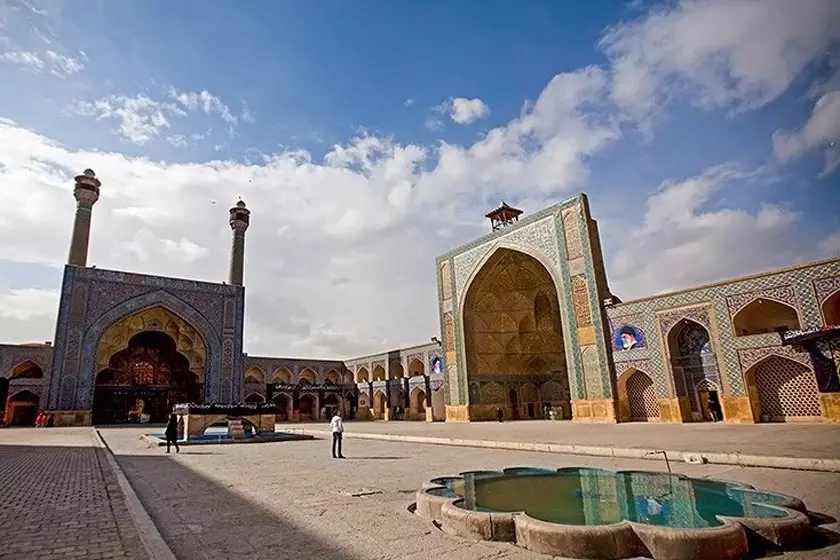
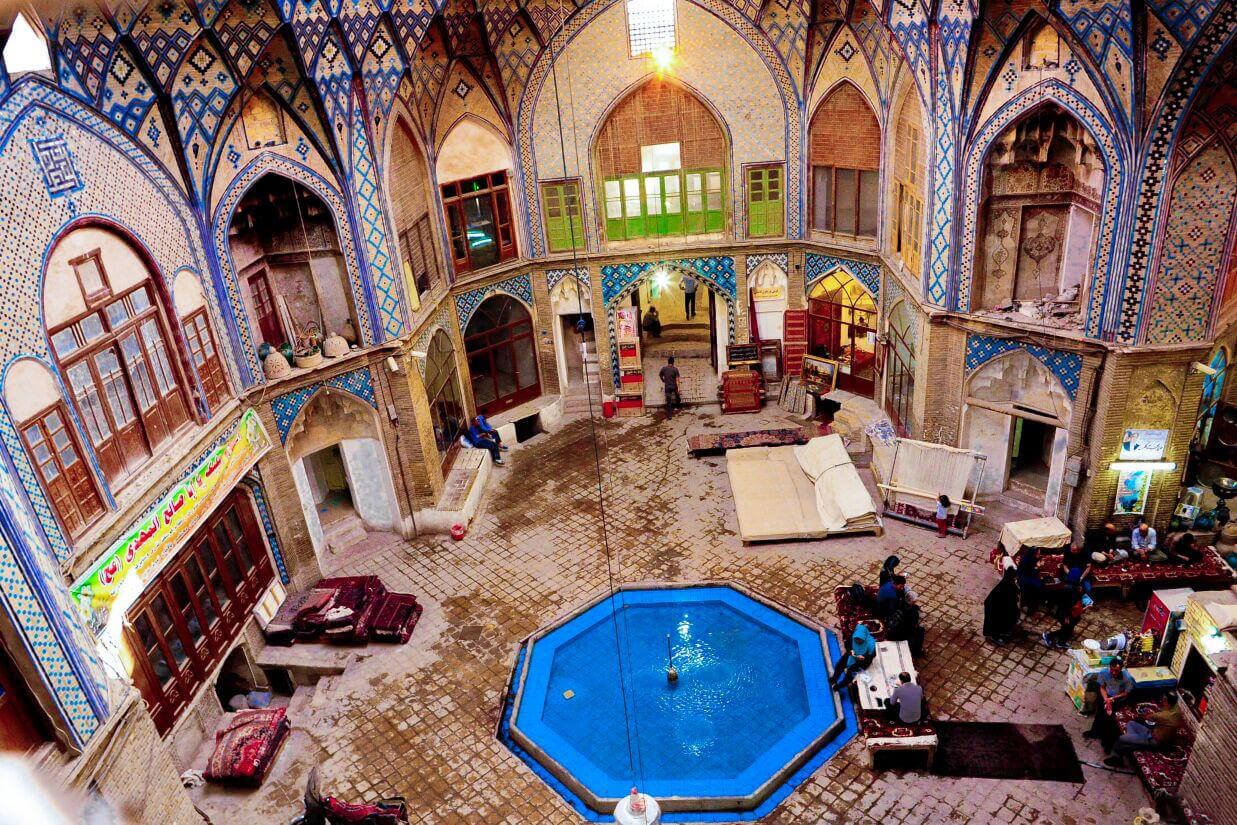
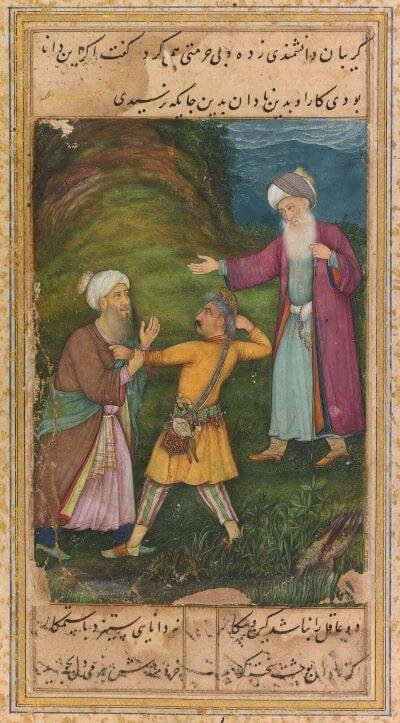
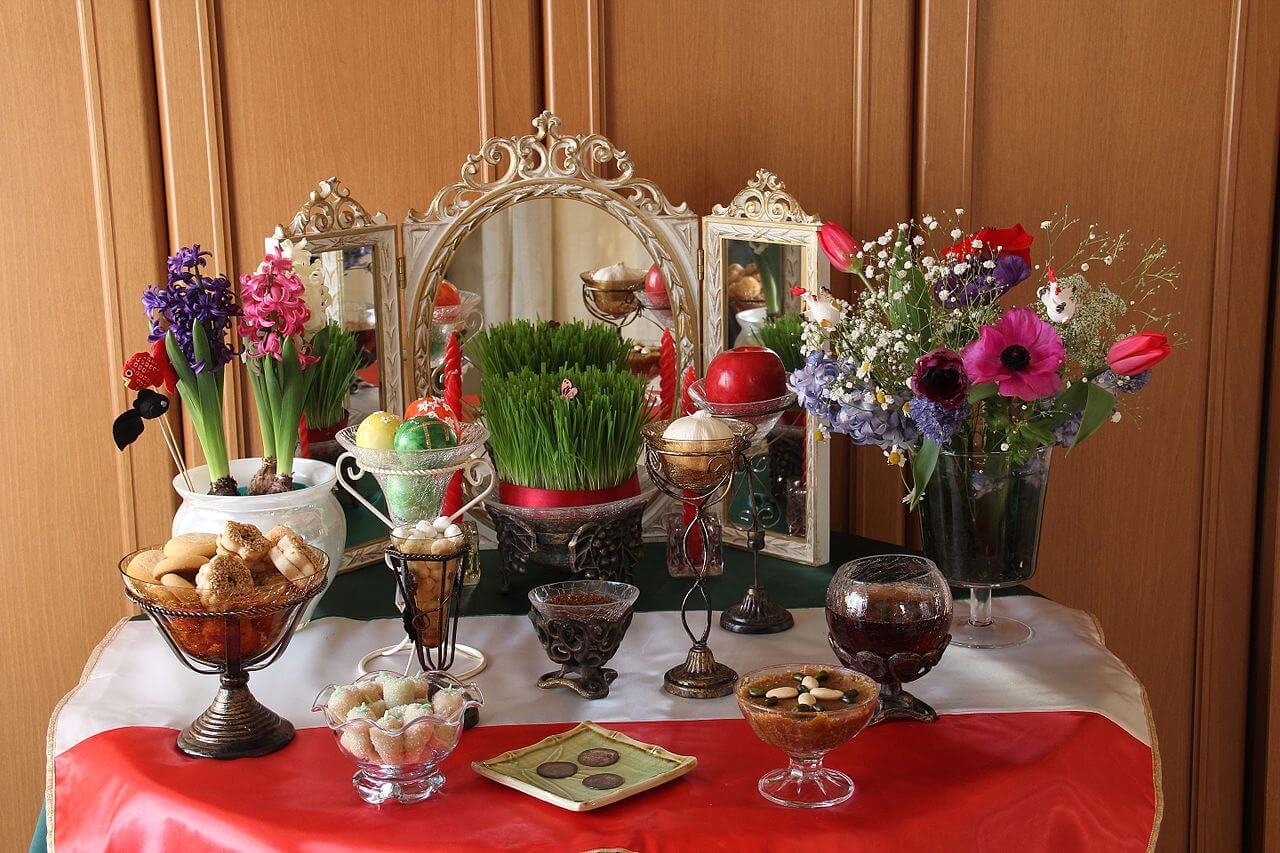
- Immersive Visuals & Rare Artifacts: You won’t just read the culture; you will see it. We integrate a diverse visual library to connect every word to a memory, featuring archaeological wonders, living history and architecture, artistic depictions of myths and legends, cultural symbols, and antique miniatures from masterpieces like the Shahnameh of Shah Tahmasp and exquisite Golestan manuscripts.












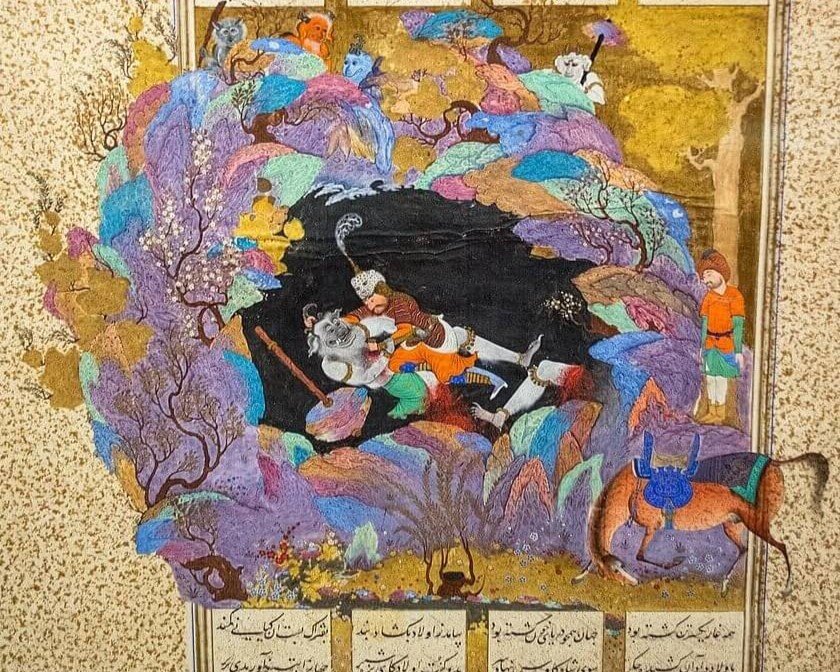

5.2. “Damavand” – Narrative as Scaffolding
The “Damavand: City, Mountain, and Myths” course serves as a prime example of how narrative structure can be used to engineer i+1 input. Designed for intermediate to advanced learners, this course is structured into five immersive lessons: Journey to Damavand, The City of Damavand, Foothill of Damavand, The Morning Ascent, and Reaching the Summit. Each lesson builds progressively, incorporating over 170 new Persian words and more than 50 interactive practice sessions. The content weaves authentic texts on Persian culture, history, and mythology, drawing from the Shahnameh (The Book of Kings) to feature legends of heroes like Rostam, Keyumars, Jamshid, Zahhāk, Fereydun, and Arash the Archer.
- The Schema Effect: The course follows a physical journey—from the city foothills to the summit. This narrative arc creates a Schema (a mental framework) that helps the brain activate related concepts. When a learner enters the “Morning Ascent” lesson, they expect to hear words related to climbing and nature, which makes even unknown words comprehensible. For instance, the “Journey to Damavand” lesson begins with a first-person narrative describing the ascent on a beautiful day in early Farvardin, traveling via Haraz Road from Tehran. It anthropomorphizes the mountain as a woman in a white headscarf, gray dress, and green skirt, blending vivid imagery with mythological elements like the legend of Damavand’s creation from the Alborz range.
- Mythological Anchors: By integrating the legend of Zahhāk—the tyrant king who defeated Jamshid and grew snakes from his shoulders—we create an emotional memory trace that truly sticks. For instance, teaching words like maghz (brain) or ketf (shoulder) through the terrifying story of Zahhāk feeding his snakes is far more effective than rote memorization from a sterile vocabulary list. Our narrative follows the arc of his tyranny and eventual downfall as Fereydun is born in Damavand to capture him, weaving in deep cultural layers like Keyumars and the Pishdadian dynasty. To complete this immersion, we pair these legends with illustrations from antique miniatures, such as the Shahnameh of Shah Tahmasp, alongside modern photography.

Damavand: An Intermediate Persian Reading Practice Adventure
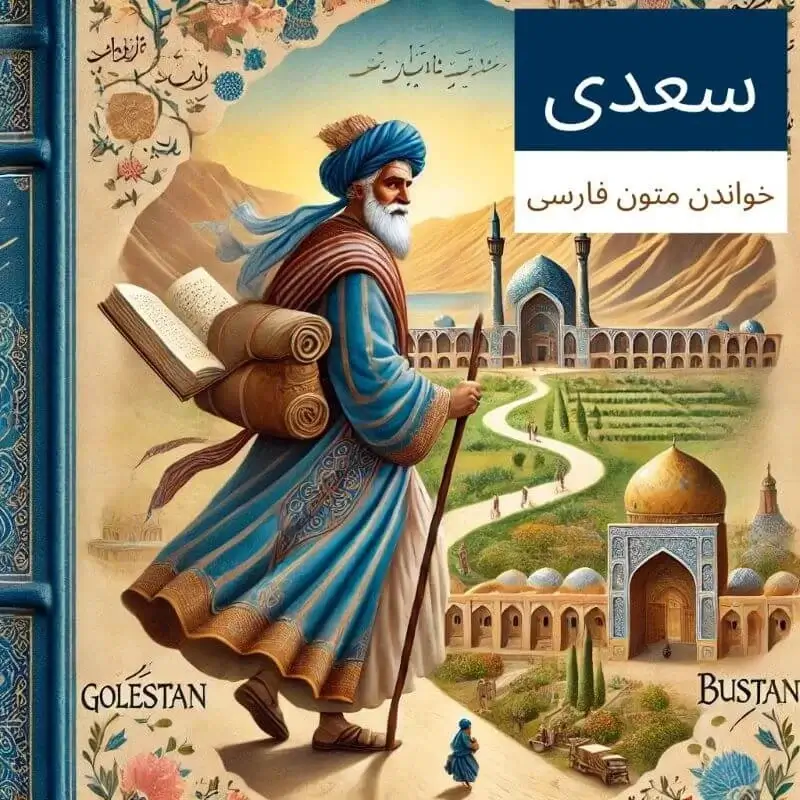
5.3. “Saadi” – Acquiring Classical Wisdom
Many intermediate learners assume that classical literature is off-limits. The “Saadi: Life, Works, and Enduring Wisdom” course challenges this by applying CI principles to Saadi’s biography and legacy. Part of the “Reading Persian Texts” series for beginner to intermediate learners, it spans five lessons: Biography of Saadi, Saadi’s Souvenirs, Saadi’s Beliefs, The Grandeur of Saadi, and Practice and Contemplation. Learners master over 190 new words and complete 25+ practice sessions, exploring Saadi’s life, his major works (Golestan and Bustan), and cultural wisdom through selected stories.
- Focus on Storytelling over Code: A traditional class might use Saadi to teach “obsolete verbal prefixes”. In contrast, we focus on the narrative drive of Saadi’s parables: “Why did the King spare the slave?”. In our “Biography of Saadi” lesson, we narrate his life in a simple, engaging style—telling the story of a boy born 800 years ago in Shiraz who was orphaned at 12. We follow his journey to Baghdad’s Nizamiyya University to study the Quran and religious sciences, and then through 20+ years of travels across Mosul, Damascus, Levant, Hejaz, Yemen, Turkey, and India. By observing everyone from powerful kings to humble beggars, Saadi honed the very storytelling skills we use to teach you today. When he returned to Shiraz at age 50, he brought back “souvenirs” of wisdom regarding fate, morals, and destiny that remain universal.
- The Power of Simplified Narrative: To bridge the gap between “Kitchen Farsi” and classical prose, we have carefully selected and simplified eight timeless parables from the Golestan and Bustan for the intermediate level. These are not “dumbed-down” texts; they are graded narratives designed to provide i+1 input while preserving the “soul” of Saadi’s wisdom. For example, we simplify a complex moral tale into a punchy, comprehensible story:
A tyrant king asked a wise man (Zāhed), “Which act of worship is best?” The wise man replied: “For you, a midday nap—because in that moment, you are not hurting anyone.”
Saadi: Life, Works, and Enduring Wisdom
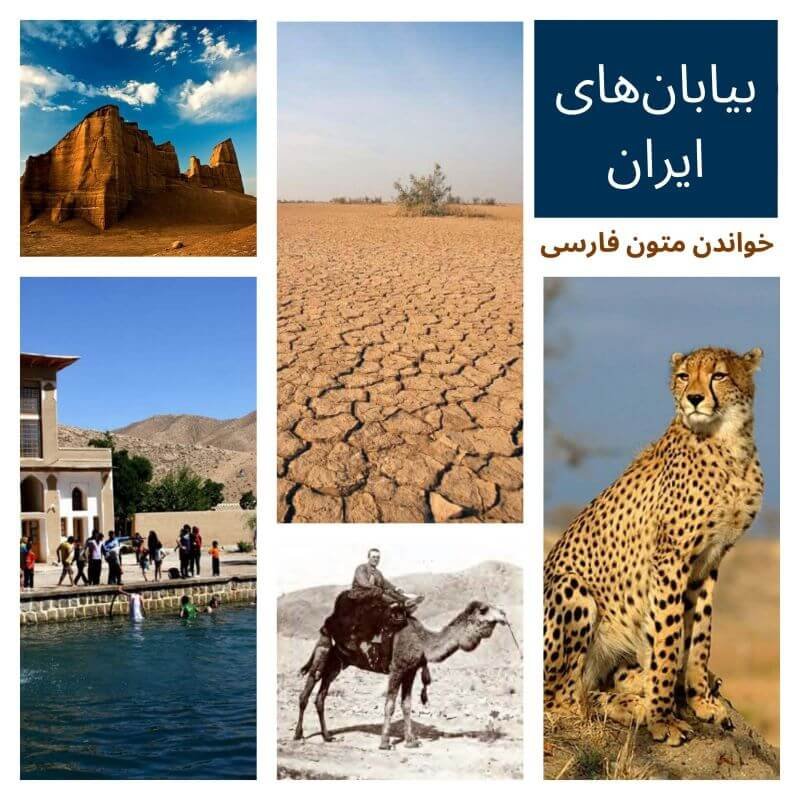
5.4. “Deserts of Iran” – Geographical Exploration as Scaffolding
Our course, “Deserts of Iran: Cities, Landscapes, and Historical Figures” represents the purest application of Content-Based Instruction (CBI) in our curriculum. While many learners view deserts as barren wastelands, we use them as a rich narrative landscape to teach complex Persian. This course, part of our “Reading Persian Texts” series, guides intermediate learners through 8 immersive lessons—from the biological adaptations of desert flora and fauna to the architectural marvels of ancient civilizations. By the end, our students master 360 new Persian words and tackle 60 interactive practices.
- Nature as Narrative: We begin the journey with a poetic introduction that personifies the desert. Instead of a dry list of geographical terms, we narrate the desert waking up: “Sands follow the breeze like sleepy soldiers” and “stars go out one by one like lanterns” as the sun rises over the Dasht-e Kavir. This anthropomorphism transforms “noise” into i+1 input, allowing learners to acquire evocative words like lājevardi (azure) and khāb-āloude (drowsy) through vivid, multi-sensory storytelling.
- Technical Marvels as Vocabulary: We move beyond “Kitchen Farsi” by teaching the language of survival and innovation. You won’t just learn the word for water; you will learn the mechanism of the Qanat (underground aqueducts) and the Bādgir (windcatchers). As we discussed in our article 4 Surprising Truths About Iran That Your “Kitchen Farsi” Won’t Teach You, understanding these “engines of civilization” is what separates a student of grammar from a true reader of Persian culture. We bind these specialized terms directly to historical and architectural contexts—exploring 12 iconic cities like Yazd, Kashan, and Kerman—ensuring the vocabulary sticks because it is tied to a functional reality.
- Immersive Scaffolding: Like our other “Beyond the Core” offerings, this course is powered by Synchronized Audio recorded by Dr. Leila Seyedghasem and our signature Reading Guides. These guides act as a built-in mini-dictionary in the side notes, providing instant translations for terms like namak-zār (salt flat) or bātlāgh (swamp). This ensures you stay in a “flow state,” acquiring the language of geography and history without ever having to break your immersion to flip through a dictionary.
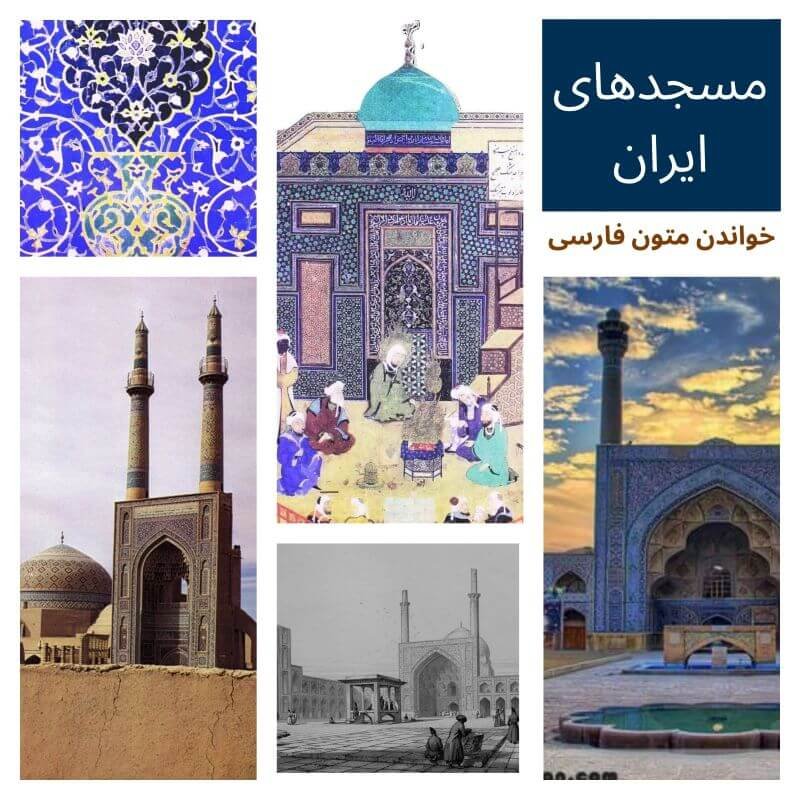
5.5. “Mosques of Iran” – Architecture and Spirituality as Language
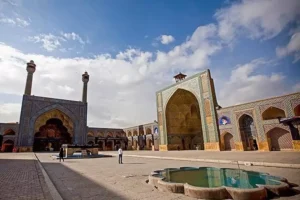
We designed “Mosques of Iran: History, Architecture, and Art” to take the concept of Content-Based Instruction to its most intricate level, inviting you to explore what we call the “language of space”. In this course, we move beyond abstract vocabulary to show how Persian architecture narrates spiritual history across 1,400 years of evolution—from the repurposed fire temples of the Sassanid era to the turquoise masterpieces of Isfahan. Through three major sections covering history, structure, and decoration, our students master 330 new Persian words and complete 50 interactive practices, acquiring the language of art, ritual, and history simultaneously.
- Learning through Function: We believe that words like Gonbad (dome), Manāre (minaret), or Mehrāb (prayer niche) shouldn’t be learned from a list; they are best acquired through their function within the physical space of the mosque. In our lessons on mosque architecture, you explore the transition from the open Ṣahn (courtyard) to the towering Eyvān (iwan) and the serene Shabestān (prayer hall). By defining these spaces through their role in Persian life, the vocabulary becomes functional and deeply rooted in your memory.
- Visual-Linguistic Binding: One of the greatest challenges in learning Persian is the distance between the word and the concept. We solve this by using Visual-Linguistic Binding. When you learn about the intricate Muqarnas-kāri (stalactite ornamentation) or the delicate Kāshi-kāri (tilework), you aren’t just reading a definition; you are seeing these masterpieces through historical archives while hearing the native narration. Whether it is the calligraphy of a Katibe (inscription) or the fine detail of Gach-bori (stucco carving), the image binds directly to the Persian word, bypassing the need for English translation.
6. The Result: Lowering the “Affective Filter”
By combining Targeted Technology with Cultural Depth, Joy of Persian solves the two biggest hurdles for intermediate learners:
- Solving the Orthographic Bottleneck: The Persian alphabet (Abjad) omits short vowels, making “sounding out” new words impossible for many. Our Synced Audio & Text allows the brain to map sound to shape instantly, building sight-recognition rather than painful decoding.
- Leveraging Identity: For learners like Kamran (Heritage) or Emily (Personal Connection), Persian is more than a skill—it’s identity. By focusing on poetry, architecture, and history, we lower the Affective Filter (anxiety). When a student is deeply moved by a story of Saadi or the majesty of Damavand, their brain’s “Language Acquisition Device” opens up, and the language is acquired naturally, not just “learned” through effort.
Always watch your mood!
If you don’t feel well studying Persian, try to find out why and fix it.

7. The Hybrid Path to Proficiency: Activating the Input
While Comprehensible Input is the engine of acquisition, Joy of Persian recognizes that true fluency requires a Hybrid Ecosystem. We balance the “Four Strands” of language learning—Input, Output, Language-focused Learning, and Fluency—through a Flipped Learning model.
In this model, the asynchronous courses handle the “Input,” while our live sessions (Workshops & 1-1 Classes) focus on Meaning-Focused Output.
The Flipped Methodology: Why it Works
In both our group and private sessions, you don’t spend time listening to a lecture. You arrive having already “consumed” the i+1 input from the course. This allows the live session to become a “High-Intensity Output Zone” where:
- The Silent Period Ends: You begin to produce language in a low-stress environment.
- Just-in-Time Grammar: Instead of abstract rules, instructors provide “Language-focused Learning” exactly when you struggle with a construction, making the grammar “stick” through immediate use.
Choosing Your Path: Workshops vs. 1-1 Classes
Both paths offer flipped learning and speaking practice, but they serve different strategic needs for the learner. Crucially, every enrollment in a live session—whether a group workshop or a private class—includes the related asynchronous course as a free gift, ensuring you have the “Input Engine” ready for the live sessions.
| Feature | Flipped Workshops (Group) | 1-1 Online Classes (Private) |
| The Core Benefit | Cohort Learning: You learn from others’ questions and build a sense of belonging with a community. | Bespoke Precision: 100% of the instructor’s attention is on your specific pace and “Grammar Gaps.” |
| Dynamics | Interactive group energy; seeing that you are not alone in your struggles. | Deeply personalized scaffolding; immediate correction of your specific accent or syntax. |
| Flexibility | Fixed Schedule: Sessions are at pre-set times, requiring a commitment to the cohort. | High Flexibility: You coordinate the schedule directly with the teacher to fit your life. |
| Investment | Accessible: More affordable as the instructor’s fee is shared among the group. | Premium: A higher investment for specialized, one-on-one expertise. |
8. Frequently Asked Questions (FAQ)
Still have questions about bridging the gap to Persian fluency? We’ve gathered the most common inquiries about the science of acquisition and our unique methodology to help you find the best path forward. Click on each question below to explore how you can finally break through the intermediate plateau.
What is the Persian Intermediate Plateau and why do learners get stuck there?
How does Comprehensible Input (CI) help overcome the challenges in Persian language acquisition?
Comprehensible Input (CI) helps by providing understandable messages in Persian that are slightly beyond the learner’s current level (i+1), allowing subconscious acquisition rather than conscious learning. It addresses the content desert by supplying abundant, context-rich exposure through meaningful discourse, aiding pattern detection in the brain.
For Persian, CI bridges the gap from basic apps to native media, reducing the comprehensibility gap caused by vocabulary load, cultural references, and delivery speed. Platforms like Joy of Persian use CI via controlled vocabulary, reading guides, and thematic content (e.g., stories about mountains or poetry), making input comprehensible with aids like images and narratives, thus facilitating progression without rote memorization.
What are the key differences between language “acquisition” and “learning” according to Krashen’s hypotheses?
According to Stephen Krashen’s Acquisition-Learning Hypothesis, there is a fundamental distinction between “knowing” a language and actually “using” it:
- Acquisition (The Fluency Engine): A subconscious process similar to how children develop their first language. It happens through meaningful interaction and exposure to Comprehensible Input. Acquisition is the only source of true, spontaneous fluency.
- Learning (The Internal Editor): A conscious, academic process of gaining explicit knowledge about rules (e.g., memorizing the Ezāfe or subjunctive conjugations). This system acts only as a “Monitor” or editor; it is often too slow to be useful in real-world conversation.
The Verdict: Traditional Persian pedagogy fails because it focuses almost entirely on learning. At Joy of Persian, we prioritize acquisition so you can stop “calculating” grammar in your head and start speaking with natural confidence.
How does the Joy of Persian platform address the i+1 input level for intermediate learners?
We terraform the “Content Desert” through our Beyond the Core courses (like Damavand or Saadi). We use several strategic “scaffolding” tools to ensure the input stays at the $i+1$ level:
- Narrative Scaffolding: Using familiar journeys or myths to provide context.
- Advanced Study Tools: Professional human narration (to solve the vowel/script problem) and In-depth Reading Guides that act as an instant mini-dictionary.This ensures you stay in a “flow state” rather than constantly stopping to check a dictionary.
What role does the Affective Filter play in Persian learning, and how can it be lowered?
The Affective Filter, per Krashen’s hypothesis, is a mental barrier formed by motivation, self-confidence, and anxiety that blocks input from reaching the brain’s Language Acquisition Device (LAD) when “up” (high anxiety, low motivation). In Persian learning, it arises from script anxiety (feeling illiterate due to the modified Arabic script), cultural distance (lack of shared cognates/references), and performance pressure (early speaking demands). It can be lowered by focusing on receptive skills first (reading/listening) for a “silent period,” leveraging intrinsic motivation through engaging themes like poetry, architecture, and mythology, and using technology like synced audio to reduce orthographic bottlenecks. Joy of Persian lowers it via cultural depth and low-stress environments in workshops, making acquisition natural and enjoyable.
I found other apps like “Ling” or “Mondly” that offer Farsi. Are they good alternatives?
Proceed with extreme caution. While it is tempting to use these apps because they look like Duolingo, they often suffer from the exact technical issues we described above.
For example, we recently analyzed the promotional material for the Ling App, which markets itself as a top Farsi alternative. In their own demonstration video, the Persian text is displayed with Left-to-Right (LTR) alignment, effectively spelling the sentences backward.
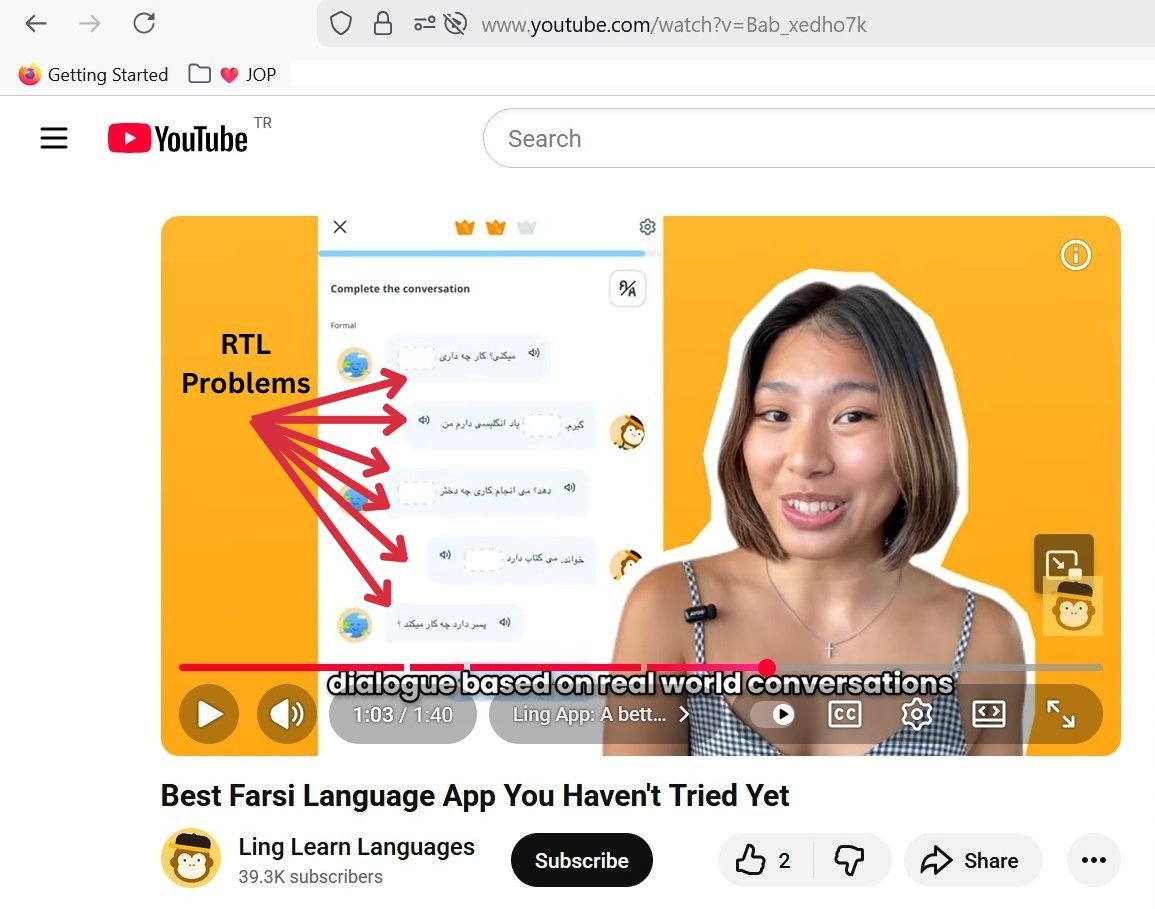
The Evidence: In the video, the Persian sentence “What is the girl doing?” (دختر چه کاری انجام میدهد؟) is displayed incorrectly as:
دهد؟می انجام کاری چه دختر
Notice the critical errors:
- Reversed Word Order: The subject (Girl) is on the far left instead of the right.
- Broken Prefix Form: The Zero-Width Non-Joiner in «میدهد» fails, causing the prefix «می» to detach and appear as «می» and «دهد».
- Displaced Punctuation: The question mark appears in the middle of the sentence rather than at the end.
The English Equivalent: To understand how confusing this is, imagine taking the English sentence “What is the girl doing?” and forcing it into the same broken structure. It would look like this:
ing? do girl the is What
The Result: If you try to read this as a Persian speaker, it is nonsense. You would have to force your brain to read Persian “backwards” to make sense of it.
This is a classic “cookie-cutter” app problem: developers take a code template built for English or Spanish and simply paste Persian words into it without adjusting the underlying engineering for Right-to-Left scripts.
For the fuller picture, we tested Ling and Mondly side-by-side with 12 other options — podcasts, tutors, university-style courses — in our 2026 comparison of the best online Persian courses, including what each platform actually teaches (and what it skips).
With so many apps, podcasts, and videos available, how can I know if this course is right for me?
That’s an excellent question. The flood of free resources can be overwhelming, and while tools like YouTube, apps, and podcasts are fantastic supplements, they often provide a fragmented learning experience. You might learn a word here and a grammar rule there, but it’s very difficult to build a solid, comprehensive foundation.
The “right choice” depends on your learning goals. Our courses are designed to solve the exact problem of fragmentation. Here’s how Joy of Persian is different:
- A Structured, Academic Path: Instead of random videos, our courses (like Let’s Learn Persian! A1 & A2) provide a structured, step-by-step curriculum.This is a complete learning experience designed for deep comprehension, vocabulary acquisition, and practical exercises—a clear path from one level to the next.
- Unmatched Expertise: Our courses are developed by Dr. Leila Seyedghasem, our co-founder with over 9+ years of online university teaching experience. She is a recipient of prestigious honors, including the Jalal Al-e Ahmad Literary Award and Iran’s Book of the Year Award. You aren’t learning from a hobbyist; you are learning from a distinguished, professional educator who has taught at the university level.
- Authentic Audio (Dual-Audio, Never AI): Immerse yourself in real Persian from day one with professionally recorded native voices—never AI. Our unique dual-audio system lets you practice both 🔵Formal Persian (news, speeches) and 🔴Spoken Persian (everyday talk) side by side, helping you master natural pronunciation and listening skills.
- A Feature for Every Step of Your Journey: Our platform is built on proven instructional design principles to give you the right tools at the right time. As you progress, you unlock new features specific to your learning stage:
- Tier 1: Core Experience: All courses are built on a core foundation of expert-led curriculum, authentic human audio, interactive exercises (based on text, audio, and quizzes), and flexible self-paced learning, backed by a free preview and a 14-day money-back guarantee.
- Tier 2: Foundation Essentials: Our foundational language courses add essential tools, including a clear roadmap and our unique side-by-side audio tracks to help you master both Formal and Spoken Persian.
- Tier 3: Advanced Study Tools: Advanced literature and thematic courses unlock powerful academic tools, such as synchronized audio & text, in-depth reading guides with built-in definitions, and rich visual/historical archives.
For more details see: here.
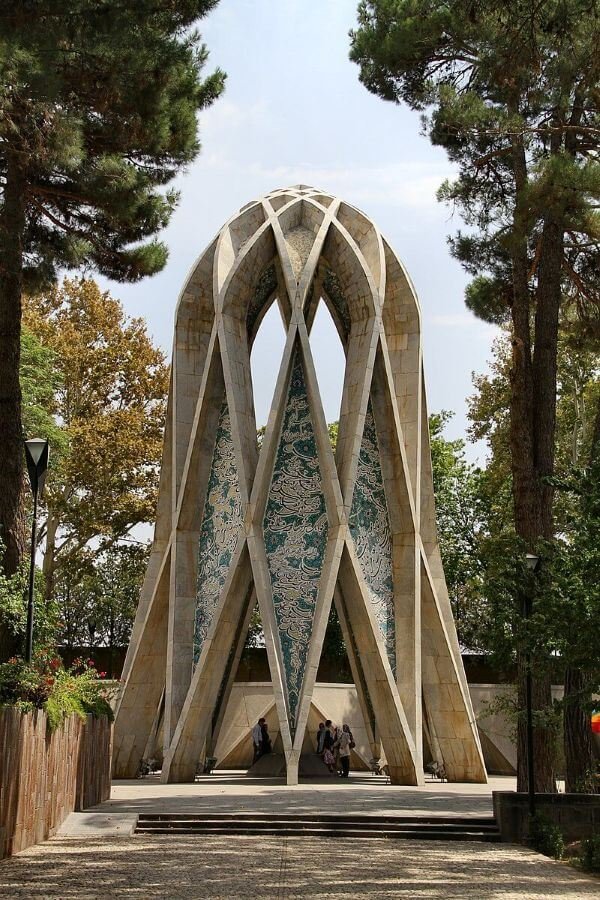
- Beyond Language—Into Literature: Most apps stop at basic vocabulary. We are one of the few platforms that take you from learning the language to truly appreciating the culture. We offer in-depth courses on literary masterpieces like Sa’di’s Golestan and the Rubaiyat of Khayyam, taught with the same academic rigor.
- A Clear Path to Mastery: We offer different ways to learn based on your needs:
- Async Courses: Perfect for self-paced, structured learning.
- Live Workshops: For those who want to combine the async course material with live, interactive “flipped classroom” sessions led directly by Dr. Seyedghasem.
- 1-on-1 Classes: For a fully personalized, guided experience.
This course is the right choice for you if:
- You feel overwhelmed by scattered resources and crave a clear, structured, A-to-Z learning program.
- You value learning from a highly qualified, award-winning university instructor.
- Your goal isn’t just to “learn some Farsi” but to build a deep, lasting connection with Persian language, culture, and classical literature.
- You want a complete system of lessons, exercises, and comprehension tasks, not just isolated videos.
We invite you to explore our free demos (No Signup Required) to get a feel for our teaching style. We believe you’ll immediately see the depth and quality that set our formal courses apart.
9. Conclusion: A Blueprint for the Future
The “content desert” in Persian is not an inevitable geographic feature; it is a man-made disaster of pedagogy. By relying on outdated methods and neglecting the intermediate learner, the field has historically failed to turn “students of Persian” into “speakers of Persian”.
The Joy of Persian ecosystem demonstrates that even in a “Less Commonly Taught Language,” the desert can bloom. By watering the roots of acquisition with compelling content, bridging the script gap with technology, and completing the learning cycle through live workshops and 1-1 mentorship, we can provide a sustainable path to true proficiency. The shift from deciphering grammar to living inside the culture is the only way forward. For the diaspora seeking roots, the lover seeking connection, or the scholar seeking depth, the bridge is finally being built.
 Add as a preferred source on Google
(Click the link and check the box next to our name)