
No — the courses are in Persian script from the first lesson. Our blog articles do use full transliteration, since they’re written for a general audience: the blog meets you where you are, the courses pull you forward.
The reasoning is simple. Given both a Latin spelling and the script, the eye takes the easier path every time — you read the Latin, and the script stays decoration. The longer that lasts, the longer it takes for real reading to become automatic. And reading is what unlocks everything else, from a menu in Tehran to a page of Hafez.
So instead of a crutch, you get support:
- Native audio, never AI. Every course is recorded by native speakers — so you learn a word by hearing it, not by spelling it out in Latin letters.
- Formal and Spoken side by side. In our core language courses, the dialogues and selected exercises carry two recordings of the same line: 🔵 Formal Persian, the register you’ll read, and 🔴 Spoken Persian, the register you’ll actually hear. Textbooks teach the first and leave you stranded on the second.
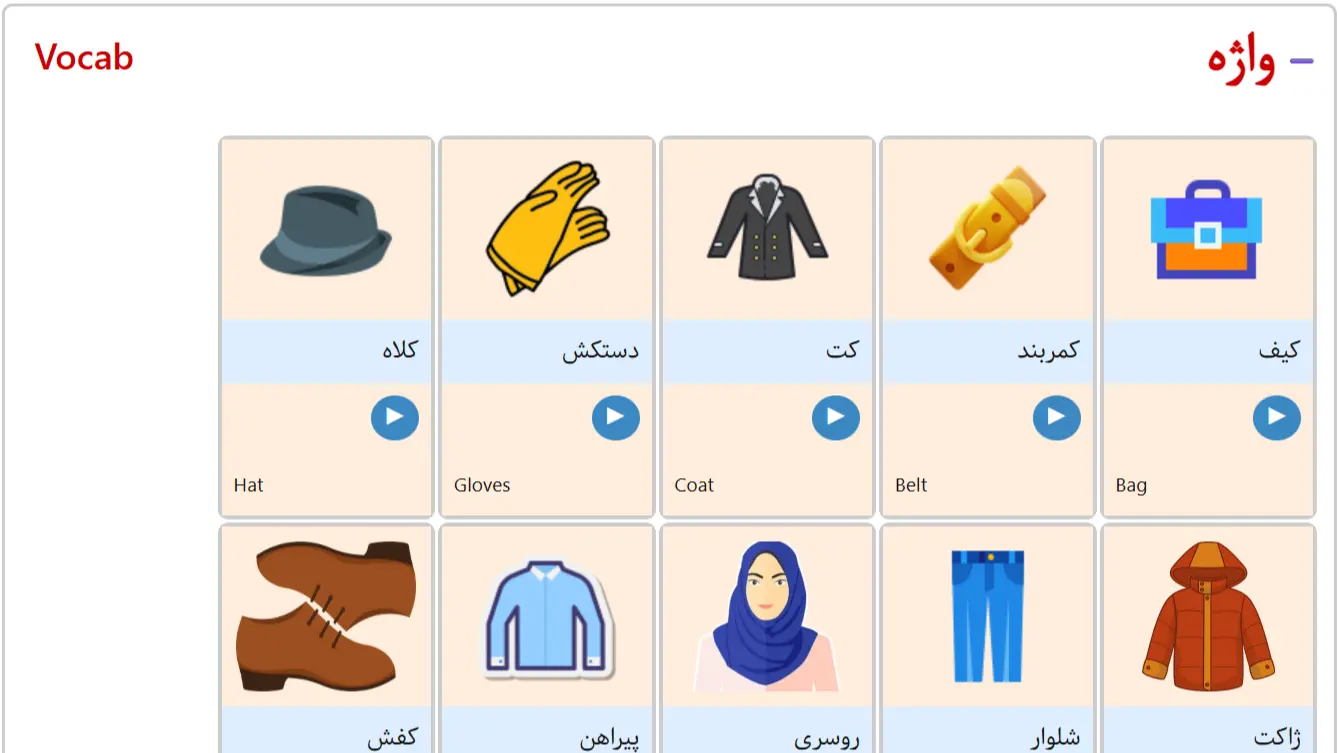
- Multi-sensory flashcards that connect the sound of a word straight to the shape of it, with no Latin step in between.
- In the literature courses, the audio runs synchronized with the text, so your eye stays on the Persian line while you hear it read.
- A free demo lesson, no signup, in every course — so you can see exactly what a page looks like before you decide.
And if you can’t read the script yet, you shouldn’t start here. Start with the script: our Persian alphabet courses cover all 32 letters in full, and the first lesson of each is free to try. Either one gets you ready for A1.