
Many dedicated language learners fall into the “Grammarian” trap, diving so deep into the mechanics of mood and tense that they never learn to swim in everyday conversation. The result? They can deconstruct a hypothetical sentence, but falter at the counter ordering a coffee.
The escape isn’t more study, but smarter study. This is where the Pareto Principle, or the 80/20 rule, becomes a lifeline. For Persian, this means learning to float with the core 20% of grammar, which will support you in 80% of your daily interactions.
The secret lies in a counter-intuitive fact: Modern Persian doesn’t rely on memorizing thousands of individual, standalone verbs. Instead, it uses a clever and highly efficient system where a small set of core “Light Verbs” combine with nouns or adjectives to form Persian Compound Verbs that express nearly any action.
Time to read:
Table of Contents
You Don’t Need a Dictionary-Sized Verb List
The first thing to understand is a core, counter-intuitive fact about Persian: compared to European languages, it has a surprisingly small number of simple, standalone verbs.
Multiple linguistic researchers have confirmed this. Sadeghi (1993) identifies 252 simple verbs, of which only 115 are in common use. Khanlari (1986) lists a total of 279, while Tabatabaei (1997) notes around 400, with about half of those being obsolete in modern conversation.
What might seem like a limitation is actually the language’s greatest strength for a learner. This small verb inventory forces the language to be systematic and modular. Instead of having a unique verb for every action, Persian builds them using a logical system of compound verbs, known as Light Verb Constructions (LVCs).
According to Rasekh-Mahand (2025), all researchers of the Persian language agree that the number of simple verbs in this language is low compared to, for instance, European languages, and the dominant method for forming new verbs in this language is the construction of compound verbs.
The “Golden 7” Persian Light Verbs
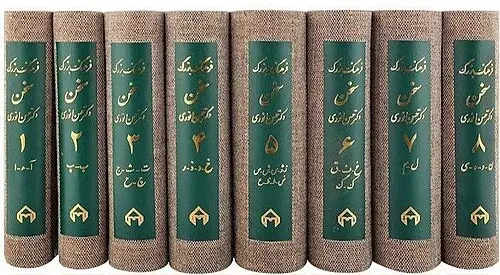
To identify the most effective verbs, we rely on the extensive data analysis performed by Naghzguy-Kohan & Abdolmaleki (2014) on the Farhang-e Bozorg-e Sokhan Dictionary (Anvari, 2003). This monumental 8-volume dictionary is the “Gold Standard” of the Persian language, containing:
- Over 75,000 main entries and 45,000 sub-entries.
- 160,000 documented quotes and 100,000 examples.
- 1,500 images to illustrate complex terms.
Based on the frequency analysis from this dataset, we have identified the “Golden 7” verbs that power the language. If you master the conjugation of these 7 verbs, your vocabulary will effectively quadruple overnight because you are leveraging the core 20% of the language to cover 80% of your needs.
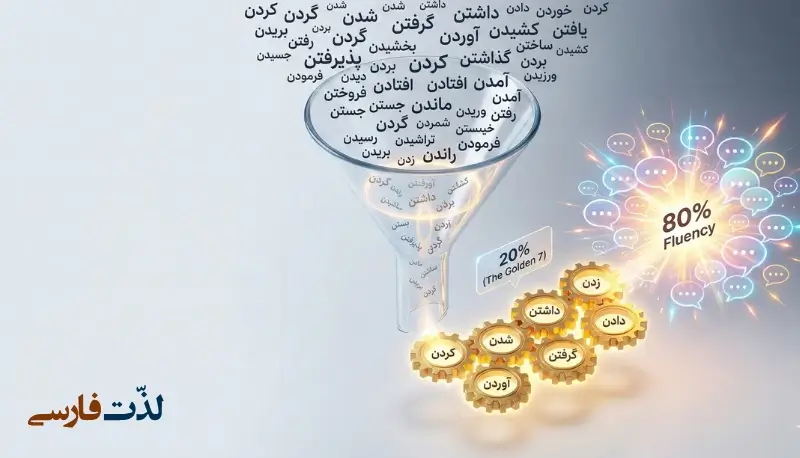
| # | Light Verb | Phonetic | Primary Meaning | Examples of Compound Usage |
| 1 | کردن | Kardan | To do / make | Tamiz kardan (To clean), Safar kardan (To travel) |
| 2 | شدن | Shodan | To become | Bidār shodan (To wake up), Gom shodan (To get lost) |
| 3 | داشتن | Dāshtan | To have | Dust dāshtan (To love), E’teghād dāshtan (To believe) |
| 4 | دادن | Dādan | To give | Yād dādan (To teach), Pas dādan (To return/give back) |
| 5 | گرفتن | Gereftan | To take / get | Yād gereftan (To learn), Tasmim gereftan (To decide) |
| 6 | زدن | Zadan | To hit / strike | Harf zadan (To talk), Mesvāk zadan (To brush teeth) |
| 7 | آوردن | āvardan | To bring | Tashrif āvardan (To come – formal), Imān āvardan (To believe) |
Stems are Everything
The strategic advantage for the learner is profound: You only need to master the conjugation of the Light Verb. The noun or adjective (NVE) is invariable—it never changes with tense, person, or number. All the heavy lifting of conjugation—the past stem, the present stem, the prefixes, and the suffixes—is confined to this small set of light verbs.
So,focus on memorizing just two stems (Past and Present) for each of these seven verbs. Once you know these 14 stems, you have the foundation for all tenses and moods in Persian.
To practice these stems and see how they work in every tense, we recommend using the Persian Verb Conjugator as your primary reference tool. However, to help you bridge the gap between formal (written) and spoken (conversational) Persian—the secret to sounding natural—we have provided these conjugation tables for the “Golden 7.” These tables ensure you follow the core rule of subject-verb agreement while highlighting the nuances of everyday interaction.
1. kardan (کردن) — To Do / Make
- Past Stem: kard | Present Stem: kon
| Person | Pronoun | Simple Past (Stem + Ending) | Present Tense (mi- + Stem + Ending) |
| 1st Sing. | man (I) | kard-am | mi-kon-am |
| 2nd Sing. | to (You) | kard-i | mi-kon-i |
| 3rd Sing. | u / un (spoken) (He/She/It) | kard | mi-kon-ad / -e (spoken) |
| 1st Plur. | mā (We) | kard-im | mi-kon-im |
| 2nd Plur. | shomā (You all) | kard-id / –in (spoken) | mi-kon-id / –in |
| 3rd Plur. | ānhā / unā (spoken) (They) | kard-and / –an (spoken) | mi-kon-and / –an (spoken) |
2. shodan (شدن) — To Become
- Past Stem: shod | Present Stem: sho
| Person | Pronoun | Simple Past | Present Tense (mi- + Stem + Ending) |
| 1st Sing. | man (I) | shod-am | mi-shav-am / mi-sh-am (spoken) |
| 2nd Sing. | to (You) | shod-i | mi-shav-i / mi-sh-i (spoken) |
| 3rd Sing. | u / un (spoken) (He/She/It) | shod | mi-shav-ad / mi-sh-e (spoken) |
| 1st Plur. | mā (We) | shod-im | mi-shav-im / mi-sh-im (spoken) |
| 2nd Plur. | shomā (You all) | shod-id | mi-shav-id / mi-sh-in (spoken) |
| 3rd Plur. | ānhā / unā (spoken) (They) | shod-and / -an (spoken) | mi-shav-and / mi-sh-an (spoken) |
3. dāshtan (داشتن) — To Have
- Past Stem: dāsht | Present Stem: dār
- Note: This verb uniquely does not take the “mi-” prefix in the simple present tense.
| Person | Pronoun | Simple Past | Present Tense (Stem + Ending Only) |
| 1st Sing. | man (I) | dāsht-am | dār-am |
| 2nd Sing. | to (You) | dāsht-i | dār-i |
| 3rd Sing. | u / un (spoken) (He/She/It) | dāsht | dār-d / –e (spoken) |
| 1st Plur. | mā (We) | dāsht-im | dār-im |
| 2nd Plur. | shomā (You all) | dāsht-id | dār-id |
| 3rd Plur. | ānhā / unā (spoken) (They) | dāsht-an | dār-and / –an(spoken) |
4. dādan (دادن) — To Give
- Past Stem: dād | Present Stem: de
| Person | Pronoun | Simple Past | Present Tense (mi- + Stem + Ending) |
| 1st Sing. | man (I) | dād-am | mi-dah-am / mi-d-am(spoken) |
| 2nd Sing. | to (You) | dād-i | mi-dah-i / mi-d-i (spoken) |
| 3rd Sing. | u / un (spoken) (He/She/It) | dād | mi-dah-ad / mi-d-e(spoken) |
| 1st Plur. | mā (We) | dād-im | mi-dah-im / mi-d-im (spoken) |
| 2nd Plur. | shomā (You all) | dād-id | mi-dah-id / mi-d-in (spoken) |
| 3rd Plur. | ānhā / unā (spoken) (They) | dād-and / –an (spoken) | mi-dah-and / mi-d-an (spoken) |
5. gereftan (گرفتن) — To Take / Catch
- Past Stem: gereft | Present Stem: gir
| Person | Pronoun | Simple Past | Present Tense (mi- + Stem + Ending) |
| 1st Sing. | man (I) | gereft-am | mi-gir-am |
| 2nd Sing. | to (You) | gereft-i | mi-gir-i |
| 3rd Sing. | u / un (spoken) (He/She/It) | gereft | mi-gir-ad / mi-gir-e(spoken) |
| 1st Plur. | mā (We) | gereft-im | mi-gir-im |
| 2nd Plur. | shomā (You all) | gereft-id | mi-gir-id / –in (spoken) |
| 3rd Plur. | ānhā / unā (spoken) (They) | gereft-and / –an (spoken) | mi-gir-and / –an (spoken) |
6. Zadan (زدن) — To Hit / Strike
- Past Stem: zad | Present Stem: zan
| Person | Pronoun | Simple Past | Present Tense (mi- + Stem + Ending) |
| 1st Sing. | man (I) | zad-am | mi-zan-am |
| 2nd Sing. | to (You) | zad-i | mi-zan-i |
| 3rd Sing. | u / un (spoken) (He/She/It) | zad | mi-zan-ad / –e (spoken) |
| 1st Plur. | mā (We) | zad-im | mi-zan-im |
| 2nd Plur. | shomā (You all) | zad-id | mi-zan-id / –in (spoken) |
| 3rd Plur. | ānhā / unā (spoken) (They) | zad-and / –an (spoken) | mi-zan-and / –an (spoken) |
7. Āvardan (آوردن) — To Bring
- Past Stem: āvard | Present Stem: āvar
| Person | Pronoun | Simple Past | Present Tense (mi- + Stem + Ending) |
| 1st Sing. | man (I) | āvard-am | mi-āvar-am / mi-ār-am (spoken) |
| 2nd Sing. | to (You) | āvard-i | mi-āvar-i / mi-ār-i (spoken) |
| 3rd Sing. | u / un (spoken) (He/She/It) | āvard | mi-āvar-ad / mi-ār-e (spoken) |
| 1st Plur. | mā (We) | āvard-im | mi-āvar-im/ mi-ār-im (spoken) |
| 2nd Plur. | shomā (You all) | āvard-id | mi-āvar-id / mi-ār-in (spoken) |
| 3rd Plur. | ānhā / unā (spoken) (They) | āvard-and / –an (spoken) | mi-āvar-and / mi-ār-an (spoken) |
Master the “Swiss Army Knife” of Persian: Kardan
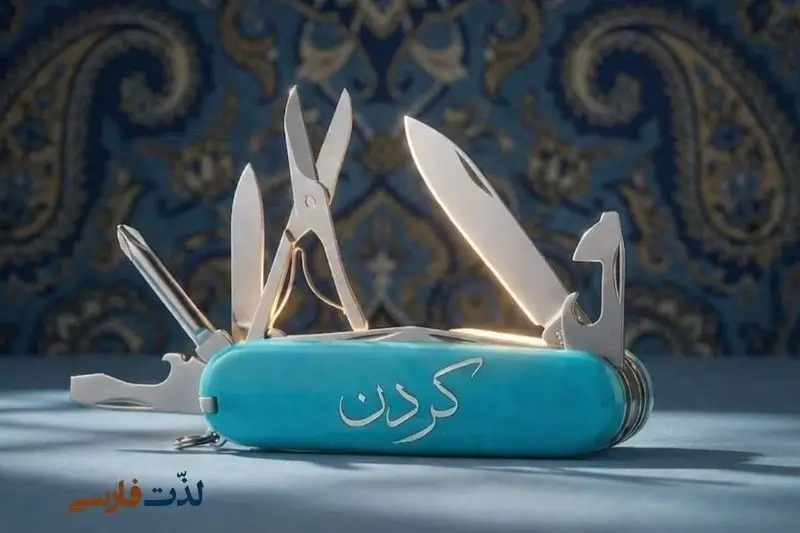
If you learn only one light verb, make it kardan (to do/make). It is the single most powerful, versatile verb in the entire language—a true “Swiss Army knife.”
Here’s the “Quick and Dirty” technique: if you know the Persian noun for an action but not the specific verb, you can simply add kardan to it and have an 80% chance of being correct and completely understood.
- ta’mir (repair) + kardan = ta’mir kardan (to repair)
- pārk (parking) + kardan = pārk kardan (to park)
- ta’yid (confirm) + kardan = ta’yid kardan (to confirm)
This isn’t just a beginner’s trick; it’s the fundamental engine of the language. This realization empowers you as a learner, allowing you to actively create verbs based on the nouns you know, rather than just passively memorizing endless lists.
Understand the Power Duo: Action (Kardan) vs. Transformation (Shodan)
While kardan is the star, it has an essential partner: shodan (to become). Together, this pair forms the “beating heart” of Persian compound verbs. They often work in tandem to express the difference between an active, intentional action versus a passive change of state or transformation.
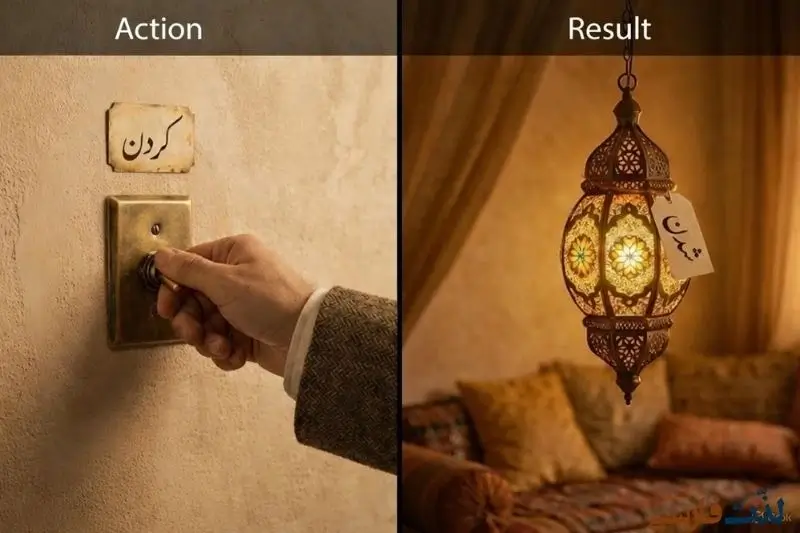
A simple analogy is a light switch. Kardan is the hand that actively flips the switch. Shodan is the light that turns on as a result of that action.
Their importance is backed by data. An analysis of the comprehensive Farhang-e Bozorg-e Sokhan dictionary shows that kardan appears in over 2,400 compound verb constructions, and shodan appears in over 900.
The “Scale Technique” table below clearly illustrates their active/passive relationship:
| Situation (State) | To Cause the State (Active – Kardan) | To Enter the State (Result – Shodan) |
| Tired (Khaste) | khaste kardan (To tire someone) | khaste shodan (To get tired) |
| Open (Bāz) | bāz kardan (To open something) | bāz shodan (To become open) |
| Awake (Bidār) | bidâr kardan (To wake someone up) | bidār shodan (To wake up) |
Think in Pictures, Not Lists: The Secret of “Image Schemas”
Why do we say “hit a smile” (labkhand zadan) or “pull a breath” (nafas keshidan)? To a traditional learner, it looks random. To a Cognitive Learner, it makes perfect sense.
This approach—teaching through Image Schemas (mental pictures)—is a proven pedagogical tool. Andrzej Kurtyka (2001) demonstrated that this cognitive method significantly helps students master complex English phrasal verbs. Similarly, a study by Shahhoseini & Mahmoodi-Bakhtiari in the Handbook of Teaching and Learning Persian as a Second Language found that students using these mental images performed significantly better at predicting the meaning of new verbs.
The most effective way to master light verbs isn’t by memorizing hundreds of combinations. It’s by adopting a cognitive approach. Instead of a list, you learn the core “mental image” or “image schema” behind each light verb. Once you understand this core concept, you can logically predict the meaning of new verb phrases you’ve never encountered before.
Here are the mental images for three of the most common light verbs:
Zadan: The Image of Sudden Impact or a Spark

The core image of zadan is a “quick, sudden impact.” Think of a brief, sharp contact or a sudden burst of energy. This single image branches into a few logical sub-schemas:
- Physical Impact: The most literal meaning.
- dar zadan (to knock): The quick impact of a hand on a door.
- Sudden Burst: Creating a sound or expression that appears instantly.
- labkhand zadan (to smile): A smile appearing as a sudden “burst” on the face.
- Attachment: Making a sudden, sharp connection.
- telefon zadan (to call): Making a sudden connection across a network.
Gereftan: The Image of Grasping or Encompassing
The core image of gereftan is “closing a fist around something”—to possess it, block it, or be overcome by it. Understanding its three main schemas transforms it from a random list of meanings into a predictable system.
Note: We explore gereftan here in its broadest sense as a key verb. This includes both its role in creating compound verbs when paired with a noun (like yād gereftan), and its standalone use to describe a specific state (like sedā gereftan).

- The Possession Schema: This is about actively grasping or receiving something tangible or abstract.
- yād gereftan (to learn): You are mentally “grasping” knowledge and making it your own.
- The Blockage Schema: Here, the image is of something being blocked or constricted, preventing a natural flow.
- sedā gereftan (to get hoarse): Your vocal cords feel constricted or “blocked,” preventing clear sound.
- The Infection/Effect Schema: In this case, an external force “grabs” or encompasses you, causing a change.
- ātash gereftan (to catch fire): Flames suddenly encompass an object, taking it over.
Keshidan: The Image of Pulling or Extending

The core image of keshidan is “pulling something along a path or extending it” over space or time. This visual logic unlocks its diverse uses.
- The Path Schema: This involves extending something along a physical line or path.
- derāz keshidan (to lie down): You are extending your body along a horizontal path.
- The Force/Intake Schema: This describes using force to pull something (like air or smoke) inward.
- nafas keshidan (to breathe): You are actively pulling air into your body.
- The Endurance Schema: This applies the concept of “extending” to abstract feelings or states over time.
- entezār keshidan (to wait for): You are stretching out the feeling of anticipation over a period of time.
The “Bilingual” Shortcut: A Bridge, Not a Destination
While linguistic purists might feel a bit nostalgic for “pure” Persian, the reality of modern conversation—especially among the diaspora and certain affluent circles in North Tehran—offers you a unique strategic advantage. Research shows that when these speakers want to use an English action, they adapt it using the exact same Light Verb system you are learning.
However, it is important to treat this as a short-term opportunity rather than a permanent habit. This phenomenon is largely limited to specific social groups, and over-reliance on it can lead to a linguistic divide. We can see a cautionary tale in the rise of “Urdish“ (a heavy mix of Urdu and English) in Pakistan. In that context, the linguistic gap has become so wide that the elite and the general public sometimes struggle to communicate, occasionally even requiring subtitles on YouTube to bridge the understanding between classes.
For an English speaker, these “Bilingual Compound Verbs” are your training wheels. They allow you to keep the conversation flowing while you are still building your vocabulary. Research on Persian-English codeswitching indicates that 90% of these constructions follow a simple rule: take an English Bare Infinitive (like manage, download, or rehearse) and pair it with a Persian Light Verb.
The Temporary Strategy:
- 79% of the time, “Kardan” is the key: If you are stuck, there is a high chance you can use an English verb with kardan and be understood. For example: manage kardan or rehearse kardan.
- Change of state uses “Shodan” (11%): To express a change in state, like being “offended,” some bilingual speakers use offended shodan.
- Transactions use “dādan” (5%): Used for actions like “order dādan” (to order) or “solution dādan” (to give a solution).
The Goal: Use this “cheat code” to gain confidence in the short term, but aim to master the authentic Persian equivalents in the medium term. True fluency means being able to connect with all Persians, regardless of their background or location.
🎁 Ready to Level Up?
Mastering the “Golden 7” is your foundation, but true fluency requires moving beyond survival mode. If you’re feeling stuck, here is your roadmap:
- Break the Plateau: Learn how to stop relying on English “cheat codes” and start using authentic Persian in our guide to Breaking the Intermediate Plateau.
- Beyond Kitchen Farsi: Discover why “survival Persian” isn’t enough for deep connection in What Your “Kitchen Farsi” Won’t Teach You.
The Next Step: Ready to express your true self? Join our Beyond the Core curriculum. These courses use a scaffolded, content-based approach—featuring synchronized audio and tailored glossaries—designed to help you cross the threshold into authentic Persian literacy.
FAQs
No questions found.
Conclusion: Stop Memorizing, Start Seeing the System
The key to unlocking fluency in Persian is a mental shift. It requires moving away from the brute-force memorization of endless verb lists and toward an appreciation of the language’s elegant, logical, and highly efficient system of light verbs. By mastering a handful of core verbs and their underlying “image schemas,” you aren’t just learning words; you are learning the very logic that drives the language.
Now that you see the underlying logic, what’s the first idea you feel empowered to build and express in Persian?
 Add as a preferred source on Google
(Click the link and check the box next to our name)