
Happy New Year! (Sāl-e No Mobārak!)
As we step into 2026, we wish you a thoughtful and meaningful New Year—one shaped not by rushed resolutions, but by intention, depth, and quiet courage.
As we stand at the threshold of a new year, many of us draft resolutions that feel more like defense than intention. We react to demands, squeeze life into leftover calendar spaces, and promise vague things like “learn more” or “finally study Persian seriously.”
But what if you approached 2026 differently? What if you designed it like an architect of your life?
At Joy of Persian, we believe that learning a language is not just an intellectual pursuit. It is a way of designing a rich life—one filled with meaning, beauty, and deep human connection. Instead of reacting to the year, what if you intentionally designed a year of cultural depth?
This article builds on a deeper mindset shift we’ve been exploring at Joy of Persian—one that moves learners away from burnout-driven resolutions and toward sustainable, meaningful progress. If learning Persian has ever felt exhausting rather than enlivening, that shift matters more than any technique.
Time to read:
Table of Contents
The System Problem: Why Good Intentions Aren’t Enough
The issue isn’t a lack of time; it’s a “system problem.” We see this exact failure pattern every January in language learning. Most learners don’t quit Persian because they’re lazy or undisciplined; they quit because they’re running the wrong mental operating system—one built on force, anxiety, and school-style “practice,” rather than on how the brain actually acquires language.
This is the core mindset shift for learning Persian in 2026: replacing willpower with systems, pressure with input, and burnout with sustainable curiosity.
Just as a manufacturing line without a quality system produces defects, a life without an intentional system produces forgettable years. Most of our personal systems are built to optimize for efficiency, but a rich life requires a system that prioritizes Depth over Speed and Transformation over Comfort.
This requires harmonizing two powerful, opposing forces: the additive, dynamic energy of the West, which seeks to add novelty and friction, and the subtractive, cyclical wisdom of Persian culture, which seeks to remove stagnation.
My professional background is in Industrial Engineering, where I served as a lead auditor for the ISO 9001 quality management system in the oil and gas industry. There, I learned a critical lesson that applies as much to life as it does to manufacturing: “failing to plan is planning to fail.”
But a plan alone isn’t enough to withstand reality. As the legendary boxer Mike Tyson said:
“Everyone has a plan until they get punched in the mouth.”
A good system plans for that “first punch”—the moment motivation wanes, a project gets complicated, or life simply gets in the way. For this, we can turn to the PDCA (Plan, Do, Check, Act) cycle, a robust framework for continuous improvement developed by Dr. W. Edwards Deming. It provides the structure needed to build a plan that is both ambitious and resilient.
Your Persian PDCA Cycle for 2026
This four-step cycle is your blueprint for building a year of profound cultural depth. It transforms vague intentions into a concrete, actionable system.
1. PLAN: The Architecture of Your Year
The planning phase is the most critical, and it begins with subtraction, not addition. You must clear space before you can build.
Phase 1: Get Light with a Mental Khane-takani
The Persian tradition of Khane-takani (“shaking the house”) is a deep spring cleaning that prepares a home for the New Year. This is the subtractive wisdom at the heart of our plan. Your first step is to perform a mental and digital Khane-takani to declutter what no longer serves you.
Delete those generic language apps that have been guilt-tripping you with notifications for months. If they haven’t worked, they are just “digital baggage.” Clear a physical “Persian corner” in your home—a dedicated space for your books, your tea, and your focus. This isn’t about theoretical perfection; it’s about creating a space for maximum practical impact.
Phase 2: Close the Books on 2025
Before designing the future, look back and celebrate the progress you’ve already made. Did you learn the alphabet this year? Did you understand a joke at a family gathering for the first time? Acknowledge these victories.
Here is the “Joy Twist”: write three handwritten thank-you notes to people who supported your learning journey—a patient partner, a dedicated teacher, or a friend who encouraged you. The physical act of writing creates an “ink stain in the brain,” forging a connection that a fleeting text message never could.
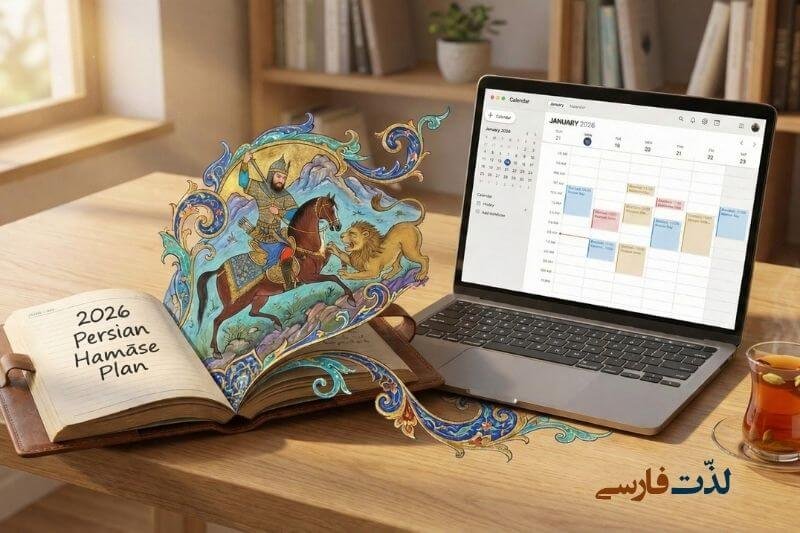
Phase 3: Define Your Persian Hamāse
Hamāse (حماسه) in Persian literature means more than an “epic.”
It refers to a defining heroic undertaking—a sustained act of courage and commitment that reveals a person’s character and leaves a lasting mark.
A hamāse is not a single moment of success, but a journey that demands endurance, integrity, and purpose.

Closely tied to this idea is Haft Khān (هفتخان), the “Seven Labors” completed by the legendary hero Rostam in Ferdowsi’s Shāhnāmeh. While these labors are often described as battles with monsters, their deeper meaning is symbolic: each khān represents an inner and outer obstacle—fear, exhaustion, doubt, distraction—that must be overcome through strength, wisdom, and patience.
Importantly, the goal of Haft Khān is never the struggle itself.
The struggle exists because something precious lies beyond it.
Together, hamāse and Haft Khān offer a powerful metaphor: a great goal is not reached in one leap, but through a series of meaningful challenges that shape who you become along the way.
By translating this mythic structure into everyday life, we can turn an ancient epic into a modern, lived experience. In this post, I use Hamāse not as a literary term, but as a practical framework for personal growth.
A Persian Hamāse is one big, year-defining commitment—your personal Haft Khān.
You are not “fighting” the Persian language or its literature. You are moving toward it, step by step, by overcoming the very real obstacles that prevent depth: inconsistency, fear of mistakes, scattered attention, and the temptation to quit.
To qualify as a true Hamāse, this commitment must meet two criteria:
- The Scare Factor: The goal must induce genuine anxiety. If you are 100% sure you can do it, it is not a Hamāse.
- The 50/50 Rule: There should be genuine uncertainty about success. This uncertainty creates seriousness, humility, and preparation.
This idea of voluntary struggle echoes a well-known Persian proverb:
نابرده رنج، گنج میسر نمیشود (nā-borde ranj, ganj moyassar nemishavad = No pain, no gain.)
The “ranj” here is not suffering for its own sake—it is the effort required to reach something valuable. And Persian, with its language, literature, and worldview, is precisely that kind of treasure.
Examples: Your 2026 Persian Hamāse
| Persona | Your 2026 Persian Hamāse |
|---|---|
| Emily (The Partner) | Host a full dinner party where you speak only Persian for the first 30 minutes. |
| Kamran (The Heritage Learner) | Travel to a Persian-speaking community and navigate an entire day without using English. |
| Sara (The Scholar) | Study a classical masterpiece like the Qābus-Nameh or Golestan of Sa’di through our Literature Lectures and memorize ten verses by heart. |
Phase 4: Plan Your Haft Khān – One Stage per Season
A Hamāse unfolds over time. To make your epic livable—not overwhelming—you begin with one Haft Khān per season. Each stage is a deliberate “mini-adventure”: a focused passage that moves the Hamāse forward, without demanding its completion in a single year.
Think of this year as the opening act of your Hamāse. You are not finishing the epic; you are entering it.
Below are examples of how one year of Haft Khān stages might look for different paths. At the end of the year, you pause, reflect, and consciously plan the next stages of the Hamāse for the year ahead.
For the Beginner (Language Foundations as Haft Khān):
- Quarter 1: Complete the A1 course and master the alphabet.
- Quarter 2: Complete the A2 course and hold your first 5-minute conversation.
- Quarter 3: Complete the B1-1 course and write a short letter in Persian.
- Quarter 4: Complete the Damavand course and watch an Iranian film with Persian subtitles.
For Sara (The Scholar – Texts as Trials):
- Quarter 1: Complete the Masnavi course at Joy of Persian, memorizing key verses.
- Quarter 2: Complete the Golestan of Sa’di course.
- Quarter 3: Complete the Rubaiyat of Khayyam course.
- Quarter 4: Complete the Tarikh-e Beyhaqi course.
If a Hamāse is a journey, then you need a map. This is what that map looks like.
Your Learning Path

Persian Alphabet
– Effortless Persian: Learn Persian with Rumi
– The Complete Persian Alphabet (Coming Soon!)

→ Core Curriculum
– Let’s Learn Persian! (A1)
– Let’s Learn Persian! (A2)
– Let’s Learn Persian! (B1-1)
– Let’s Learn Persian! (B1-2) (Coming Soon!)

→ Beyond the Core

→ Persian Literature
Classical Texts:
– Golestan of Sa’di
– Masnavi of Rumi
– Rubaiyat of Khayyam
– History of Beyhaghi
Modern Texts:
– Little Black Fish
2. DO: Enter the Peak State for Learning
Mastering a language requires more than just brute-force memorization; it requires the right state of mind. To connect with the soul of Persian, create a sensory ritual that signals to your brain it’s time to enter a “Peak State” for deep learning.
- The Sensory Start: Brew a cup of Iranian tea with cinnamon (dārchin – دارچین), or cardamom (hel – هِل). The aroma itself is an invitation to the culture.
- The Auditory Anchor: Listen to the meditative strings of a Setār for 5 minutes before you begin. Tune your mind to the frequency of Persian art.
- The Poetic Pause: Read one verse of Rumi or Hafez to connect with the “language of the heart” and remind yourself why you started this journey.

This is also where our philosophy of “learn from masters” comes into play. At Joy of Persian, you are guided by PhD-level experts who understand both the mechanics of the language and the soul of its literature.
3. CHECK: The Quarterly Review
This step is the essential audit that ensures your plan is working and your life is aligned with your values. At the end of each quarter, perform an “Audit of the Heart.” Look at your calendar and your camera roll from the past three months and ask yourself:
- Which activities or people drained your energy (“Energy Vampires”)?
- Which activities gave you the most joy (“Energy Givers”)?
- Do the photos in your camera roll reflect the life you want to be living? You don’t remember days, you remember moments.
Based on this audit, perform a “Purge.” Just as you declutter your home during Khane-takani, you must remove the recurring obligations and commitments that drain you and make no room for joy.
Many learners find it helpful to pair this quarterly audit with a simple, analog reflection system. Instead of tracking streaks or forcing daily quotas, they use a bullet journal to quietly log what they actually did: what lessons they touched, which words stayed with them, and which cultural moments felt alive. Over time, these handwritten notes reveal patterns no app can show—where curiosity flowed, where energy dipped, and how learning unfolded at a human pace.
4. ACT: Discipline and Commitment
This final phase is about adjusting your plan based on your quarterly review and, most importantly, maintaining discipline.
One of the most powerful tools for this is Social Commitment. Share your Hamāse with friends and family. Research shows that making a public commitment dramatically increases the likelihood of achieving a goal. It creates a network of accountability and support.
To ensure the year doesn’t slip away, follow these three rules:
- Change Starts Before the New Year: Do not wait for an arbitrary date like January 1st or March 21st. If you decide to change, start immediately. The “New Year” can be a psychological crutch that enables procrastination.
- Lock In Your Priorities: Once your Hamāse and quarterly adventures are on the calendar, they are non-negotiable. They are the big rocks you place in the jar first. Learn to say “No” to the things that threaten these core commitments.
- Hustle Isn’t the Answer: Strategic, focused work is what “moves the needle.” Being busy is not the same as being effective. Busyness is often a form of laziness—lazy thinking and indiscriminate action. It allows you to avoid the hard, strategic work required to identify what truly matters.
A Practical Note for Emily: Planning for Nowruz
For learners like Emily, who are connecting with Iranian culture through a partner and their family, the spring is a season of profound cultural importance. To fully participate, start planning now—three months ahead—for these major events:
- Chaharshanbe Suri (Wednesday Fire Festival)
- Nowruz (The New Year)
- The Haft-Sin table
- Sizdah Bedar (13th day of the New Year)
Planning involves more than just logistics. Take the time to learn the cultural significance and historical roots of these traditions. This proactive learning will transform you from a passive guest into a cherished participant who honors the family’s heritage.
Three Thank-Yous — The Full One Comes Later
A proper, detailed note of gratitude deserves its own space. I plan to write that at the beginning of the Persian year 1405.
For now, just three brief but heartfelt thank-yous:
- Leila’s father, who spent nearly three months with us in Istanbul this summer. His presence was a quiet but powerful source of emotional support.
- Professor Jesse Rosenberg, for carefully reviewing our courses and reporting bugs—an invaluable act of care for the work.
- Richard, a retired diplomat, who welcomed the New Year by gifting us seven coffees—a generous and symbolic gesture that meant more than he knows.
2026: A Year You Will Remember
Years blur together when nothing defines them. We don’t remember most of what filled our calendars—emails answered, tasks completed, meetings attended. What remains are moments of meaning: the first time something unfamiliar became intimate, the instant confusion turned into clarity, the quiet satisfaction of belonging.
A Persian Hamāse gives your year a spine.
It does not ask you to do more. It asks you to do what matters, with presence and endurance. It replaces scattered effort with a living structure—one that values depth over speed, transformation over comfort, and memory over metrics. Through this system, learning Persian stops being a background aspiration and becomes a defining thread in the fabric of your life.
Years from now, you may not remember how many lessons you completed. But you will remember:
- The first poem you truly understood.
- The moment Persian stopped feeling “foreign.”
- The quiet confidence of cultural familiarity.
- The sense that you didn’t rush through the year—you inhabited it.
A rich year is never discovered by accident. It is designed with intention, sustained by a system, and deepened through commitment. Choosing a Persian Hamāse is not about mastering everything in twelve months. It is about entering a path worth walking—one that continues to unfold long after the year ends.
As 2026 begins, you are not late, and you are not behind. You are exactly where a meaningful journey starts: at the moment of conscious choice.
This year, choose depth.
This year, design a year you will remember.
This year, begin your Persian Hamāse—with Joy of Persian.
 Add as a preferred source on Google
(Click the link and check the box next to our name)