
Meta: Searching for “Does Duolingo have Persian?” It doesn’t exist. Find out why Farsi breaks the app model and start the best structured A1 alternative course today.
It is a specific, sinking feeling that almost every aspiring Persian speaker has experienced. You feel a sudden spark of motivation. Perhaps you have recently started a relationship with an Iranian partner and you want to surprise their parents with a respectful greeting. Perhaps you are a heritage learner—someone like “Kamran,” born abroad—who finally feels ready to reconnect with the roots your parents left behind. Or maybe you are a lover of literature, like “Sara,” longing to read the verses of Rumi or Hafez in their original melody, untainted by clumsy translations.
You pick up your phone. You download the world’s most famous language learning app. You tap the search bar, your thumbs hovering with anticipation, and you type: “Persian” … No results.
You try again, thinking maybe the terminology is different: “Farsi” … No results.
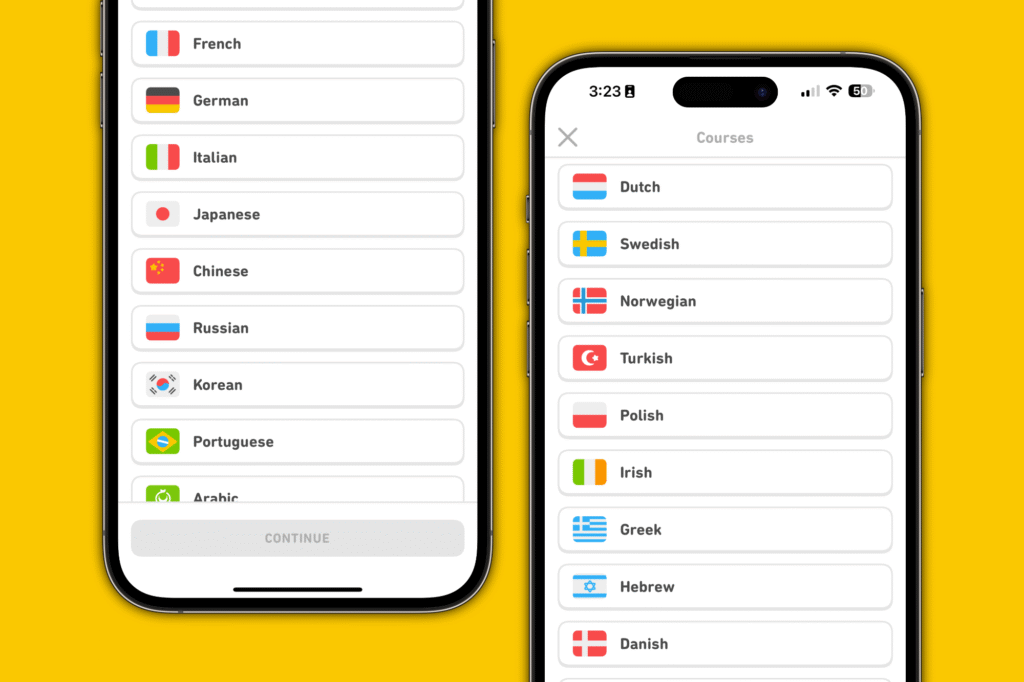
You stare at the screen, confused. You can learn High Valyrian (from Game of Thrones) or Klingon (from Star Trek) on Duolingo. You can learn Latin, a language no one speaks natively anymore. Yet, the language of the Persian Empire, a language spoken by over 110 million people worldwide, a language that serves as the key to a civilization spanning thousands of years, is nowhere to be found.
Does Duolingo have Persian? As of late 2025, the answer remains a frustrating, definitive no. And despite rumors and forum whispers, there is no public evidence that a course is in development.
But here is the controversial truth that most language learners are not ready to hear: You should be glad.
This leads to the obvious question: Why? And more importantly, what should you do instead?
In this comprehensive guide, we will break down exactly why Duolingo has ignored Persian, why the app’s method would likely fail you even if it existed, and the proven, expert-led path that you can start today to achieve true fluency.
Time to read:
Table of Contents
Part 1: The “Why” – The Objective Reasons Persian Is Missing
Most people assume Duolingo has simply “forgotten” Persian or that there isn’t enough demand. While it is true that Duolingo prioritizes languages based on return on investment (ROI), the problem goes much deeper than money. It is structural.
1. The “Spoken vs. Written” Split
This is one of the major challenges that makes Persian harder to fit into a mass-market app’s teaching model. Persian presents a unique linguistic challenge that simple translation apps struggle to handle: a massive gap between how the language is written and how it is spoken. In linguistics, this is often called a “Dual-Register” system.
- ketābi (The Written/Formal Language): This is the language of books, news broadcasts, official documents, and poetry. It adheres to strict, classical grammatical rules.
- goftāri (The Spoken/Colloquial Language): This is the language of everyday life. It is what you hear at the dinner table, in a taxi, or when talking to your partner’s family. It uses heavy contractions, different verb endings, and a relaxed structure .
Why this breaks Duolingo: Duolingo’s core teaching mechanic is simple: “Translate this sentence.” The app presents a sentence and asks you to type the equivalent. But in Persian, which version should it teach?
If the app teaches you the Formal version (which is easier to automate), you will sound like a walking textbook. Imagine saying “I am proceeding to the market” instead of “I’m going to the store.” You would be grammatically correct, but socially awkward. You would be learning a “zombie language”—one that exists on paper but not in the mouths of native speakers.
If the app teaches you only the Spoken version, you will be unable to read any authentic text. You wouldn’t be able to understand the jokes in the family WhatsApp group, read the poetic captions on your partner’s Instagram stories, or even distinguish between different jars of herbs and spices at the Persian grocery store. You might be able to speak, but you would remain dependent on others to translate the world around you—never fully participating in the conversation.
A serious learner needs to master both simultaneously. You need to know that mī-ravam (I go – Formal) becomes mī-ram (I go – Spoken). Duolingo’s single-answer structure makes this duality difficult to handle cleanly, especially for beginners.
2. The Right-to-Left (RTL) Technical Nightmare
It might seem like a small detail, but the direction of the script is a massive engineering hurdle. Persian is written from Right-to-Left (RTL). Most Western apps are built on codebases designed for Left-to-Right (LTR) languages like Spanish, French, or German.
Duolingo has historically struggled with RTL languages. Users learning Arabic or Hebrew on the platform have reported years of persistent bugs, including:
- Reversed Sentences: Where the period appears at the beginning of the sentence instead of the end.
- Broken “Tap” Exercises: When you tap words to build a sentence, the app often scrambles the order because it gets confused by mixing English (LTR) and the target language (RTL) on the same screen.
- Broken Layouts & Lists: Designing an interface for Right-to-Left languages isn’t just about flipping the text. It often breaks the core structure of the app. Users have reported that lists, bullet points, and text alignment often malfunction in RTL modes, causing numbers to appear on the wrong side or text to overlap illegibly.
For a company focused on mass scalability, fixing these bugs for a specific language market can be a high-cost effort with a lower perceived reward compared to launching a new course for English or Spanish learners.
3. The Context Trap
Persian is a “context-heavy” language. In English, a word usually means what it says. In Persian, a word’s meaning often shifts entirely based on who you are talking to and the level of respect required.
Take the simple English phrase: “Do you like it?” In Persian, there is no single translation. Depending on the context, you might say:
- doostesh dāri? (Casual, to a friend)
- azash khoshet miād? (Another casual variation)
- āyā ān rā doost dārid? (Formal, written style)
Duolingo’s system relies on having one “correct” answer to keep the game moving, but a single expected answer doesn’t reflect the range of natural choices Persian speakers use in different contexts.
Part 2: The “Gamification” Trap – Why Apps Fail the Soul of Persian
Let’s imagine for a moment that Duolingo did release a Persian course tomorrow. Let’s assume they fixed the RTL bugs. Would it be the best way for you to learn?
The answer is likely no.
If you are looking for the “best app to learn Farsi,” you are likely looking for convenience. You want to learn on the bus, in 5-minute chunks. But Persian is not just a code to be cracked; it is a culture to be inhabited.
Building a House Without a Blueprint
Gamified apps are excellent for one specific thing: Vocabulary Acquisition. They are great at helping you memorize that sib means “apple” and pesar means “boy.”
But learning Persian via an app is like building a house without a blueprint. You can spend months collecting a pile of beautiful bricks (words). You can earn badges for collecting the most bricks. You can keep your “streak” alive for 100 days. But because you never learned the architectural plan (the grammar structure) or the foundation (the cultural context), the moment you try to build a wall—the moment you try to have a real conversation—the house collapses.
Missing the “Soul” (Taarof and Poetry)
Persian culture is famous for Taarof—a complex, beautiful dance of etiquette that governs social interactions, whether you are in Tehran, Toronto, or Los Angeles.
- When you try to pay for your sangak bread at a Persian grocery store, the cashier might say “ghābel-e shoma ro nadāre” (It’s nothing), even though he definitely expects to be paid.
- At a Persian restaurant, you will witness the “fighting for the bill” ritual, where your partner and their cousins physically wrestle to pay the check.
- You don’t just say ‘Thank you’ (mersi); to an elder family member, you might say “dastetun dard nakone” (May your hand not hurt).
An app that teaches you “How much is this?” without teaching you the ritual of Taarof is setting you up for social failure. You might know the words, but you will miss the meaning.
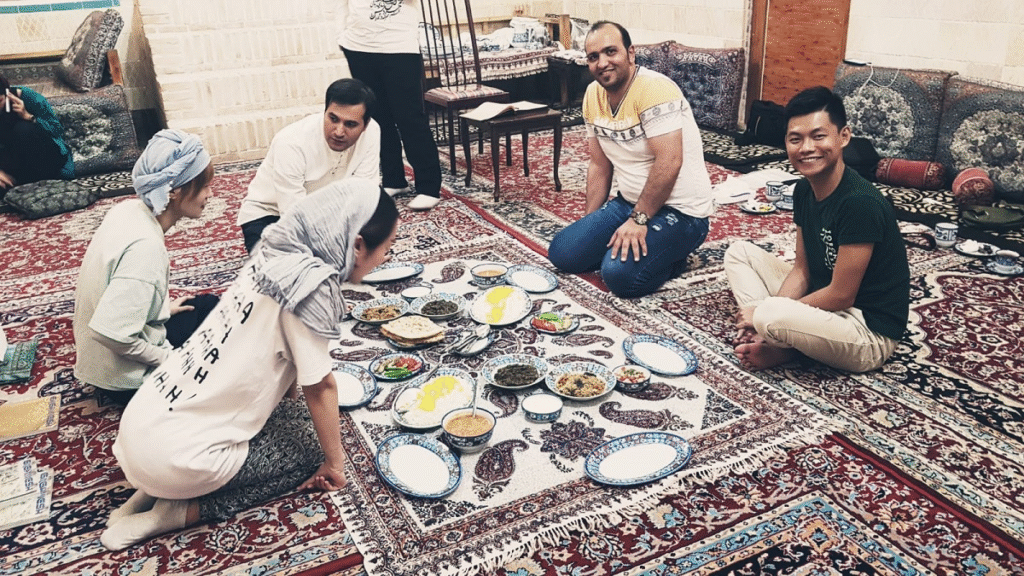
Furthermore, Persian is the language of Rumi, Sa’di, and Hafez. It is a language of rhythm and metaphor. A gamified app that reduces this rich literary tradition to “The cat drinks the milk” is stripping the language of the very thing that makes it worth learning.
The Illusion of Competence (What the Critics Say)
You don’t have to take our word for it. The gap between “playing a language game” and “actually speaking” is a well-documented phenomenon. A recent experiment highlighted by Boing Boing showed that even a 2,000-day streak doesn’t guarantee you can hold a complex conversation. You become an expert at the game, knowing exactly which tile to tap, but you may still struggle to form a sentence in the real world.
As noted by Wired Magazine, if you want to “get serious” about a language, you eventually have to leave the gamified ecosystem behind. True fluency involves what The Atlantic describes as “thinking in another language”—a cognitive shift that requires deep cultural immersion, logic, and context—things that an algorithm simply cannot teach.
Part 3: The Solution – A Structured Path to Real Fluency
If you are tired of searching for “Persian on Duolingo” and coming up empty, it is time to stop waiting and start learning.
At Joy of Persian, we didn’t just write a random curriculum. We took a different approach entirely. We believed that to learn a language as rich as Persian, you need the structure of a university class combined with the interactivity of a modern app.
So, we built exactly that.
1. Built on a Respected Academic Foundation
We didn’t reinvent the wheel; we digitized the gold standard. Our core courses are built directly on the widely respected textbook series Fārsi bīyāmuzīm! (Let’s Learn Persian!), authored by leading scholars from Tarbiat Modarres University, the University of Cambridge, and the University of Tehran.
This ensures you aren’t learning “app-speak.” You are learning with a method that is academically rigorous, culturally rich, and trusted by universities worldwide.
2. Transformed for Online Interaction (Not Just a PDF)
A textbook is great, but it can’t talk back to you. That is where our platform comes in. We transformed this academic material into a fully interactive online experience designed for self-learners.
- No Persian Keyboard Needed: We know installing a Persian keyboard is a hassle for beginners. We redesigned the tasks so you can complete exercises without typing a single letter.
- Interactive Exercises: Forget boring drills. We use drag-and-drop, matching, and sorting games to keep you engaged.
- Instant Feedback: You know immediately if you are right or wrong, just like in an app, but with much deeper content.
- Clear Objectives: Every lesson starts with clear goals, so you never feel lost.
3. A Complete Learning Loop (Not Just Random Taps)
Apps rely on “passive recognition”—you see a word and tap the matching picture. But that doesn’t help you speak. We use a Complete Learning Loop designed to engage all your skills, not just your thumbs:
- Prime Your Brain: You learn key vocabulary with native audio before the lesson, so you aren’t guessing.
- Real Listening: You listen to practical dialogues spoken by humans, not text-to-speech bots.
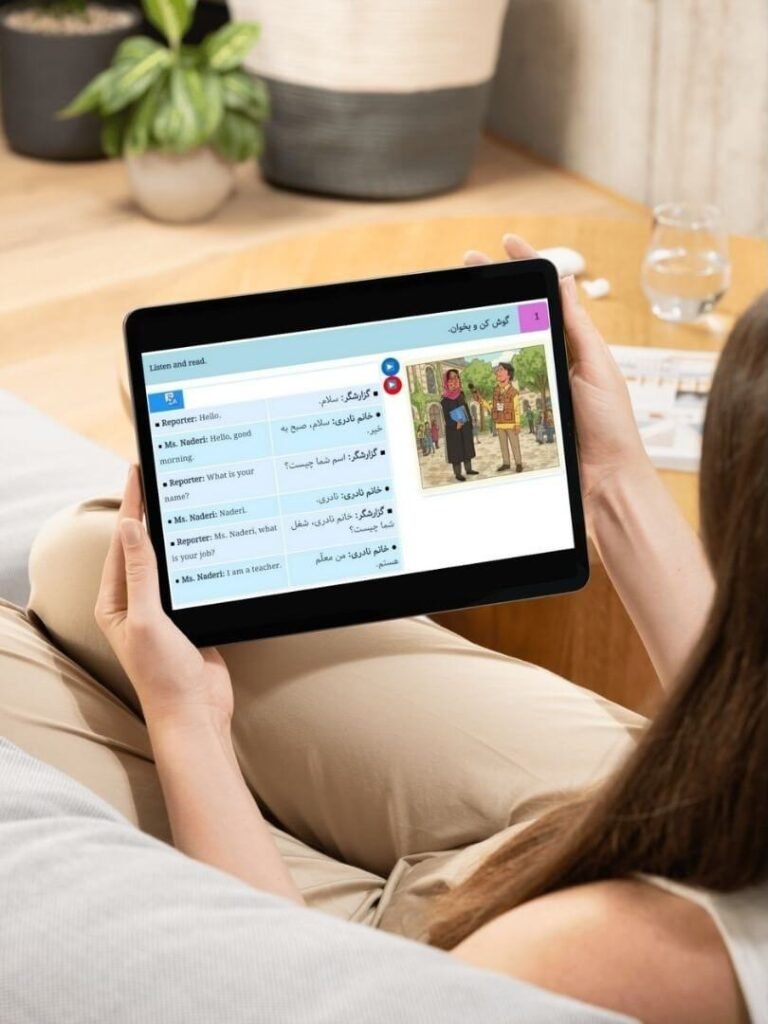
- Active Reading: You read the Persian script—and can toggle the English translation with a simple click if you get stuck.
- Intuitive Grammar: You grasp grammar by seeing patterns in real-world examples, not by memorizing dry rules.
- Immediate Application: You finish by applying your knowledge in interactive drills that ensure you actually know it.
This multi-sensory approach ensures you aren’t just memorizing words for a game, but truly understanding them for life.
Start Your Free Access
Start with a free lesson from our A1 course, designed specifically for absolute beginners. Experience how our clear, step-by-step method removes the guesswork and builds your confidence from day one.
4. The Dual-Register Solution (No More Zombie Language)
We don’t force you to choose between being “book smart” or “street smart.” We teach you both, side-by-side. In our Level A1 and A2 Courses, we use a proprietary audio system:
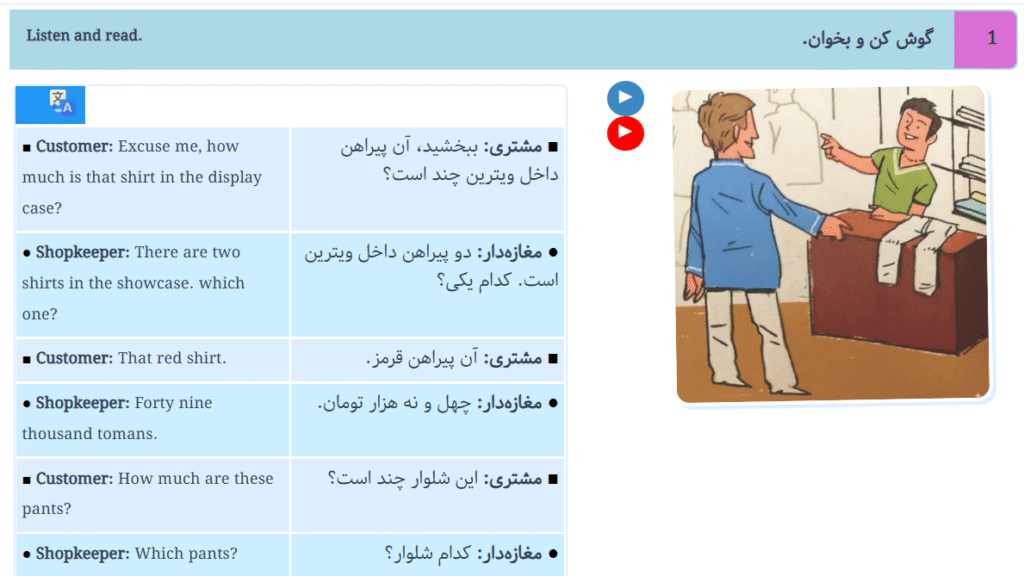
- Blue Audio: Plays the Formal (Written) pronunciation.
- Red Audio: Plays the Spoken (Colloquial) pronunciation.
You see the text, you hear the formal version, and then immediately hear how a native speaker would actually say it in Tehran. This means you can read a news headline and joke with your friends. You are learning the whole language, not a simplified fragment.
5. Structure Over Streaks
Instead of an endless “tree” of random topics, we follow a structured curriculum aligned with the CEFR standards.
- Level A1 (The Foundation): You don’t just memorize words; you build sentences. In the first 15 lessons, you master the essential verbs “to have” (داشتن) and “to be” (بودن). You learn to introduce yourself (Lesson 1), talk about your job (Lesson 6), and navigate numbers up to 100,000 (Lesson 13).
- Grammar that Makes Sense: We don’t just show you patterns and hope you guess the rule. We explain the logic.
- In A1, you master demonstrative pronouns (in vs. ān) and plural formation with hā.
- By A2, you are tackling the present progressive (dāram mikonam – I am doing) and the subjunctive mood, unlocking your ability to express wants and possibilities.
- By B1, you are comfortable with the simple past tense and using relative adjectives to describe the world around you.
6. Cultural Immersion from Lesson One
We believe that language is the carrier of culture. You shouldn’t have to wait until you are fluent to understand Iran.
- Real-World Context: Even in A1, you aren’t just learning numbers; you are learning “Tomans” and how to haggle over prices (Lesson 14). You aren’t just learning days of the week; you are understanding the Friday holiday concept (Lesson 8).
- Deep Dives: As you progress to A2, you explore Yalda Night and the Haft-sin table (Lesson 25). In B1, you travel virtually to the historic villages of Abyaneh and Masuleh (Lesson 3) and explore the traditions of Sizda-be-dar (Lesson 13). You are learning the “Soul” of Persia alongside the syntax.
Part 4: Your Roadmap (Stop Searching for “Duolingo Farsi”, Start Learning the Persian Language)
The search is over. You don’t need to wait for a tech company to decide your heritage is “profitable enough.” The resources are here, today.
But where do you start?
Step 1: Conquer the Script (The 80/20 Rule) Many people stay frozen because the Persian alphabet looks intimidating. They rely on “Finglish” (Persian written in English letters). This is a trap. We apply the Pareto Principle (80/20) here: Learning the alphabet is the 20% of effort that gives you 80% of the access to the language. Once you can read the script, you are independent. You can use dictionaries, read street signs, and access native content.
- Note: If you are a total beginner, start with our special course: “Effortless Persian: Learn Persian with Rumi.“ Thanks to the generous support of the DhunAnand Foundation, this course is completely free until September 30, 2026 (use code:
RUMI-FREE-DA-JOP). It is designed to demystify the alphabet using poetry, not boring drills.
Step 2: Commit to the Core (Level A1) This is where the real journey begins. Designed as a complete guide to Farsi for beginners, our Let’s Learn Persian (A1) course takes you from the alphabet to real conversation. It covers 15 comprehensive lessons with over 200 flashcards and 140 interactive practices.
In the A1 Course, you will:
- Master the Basics: Navigate greetings (Lesson 1) and introduce family members (Lesson 13).
- Handle Daily Life: Learn to tell time precisely (Lesson 9) and talk about your job (Lesson 6).
- Navigate the City: Ask for prices, understand units like kilos, and talk about food (Lesson 14).
- Practice with Native Audio: Train your ear with professional native recordings, not robotic AI.
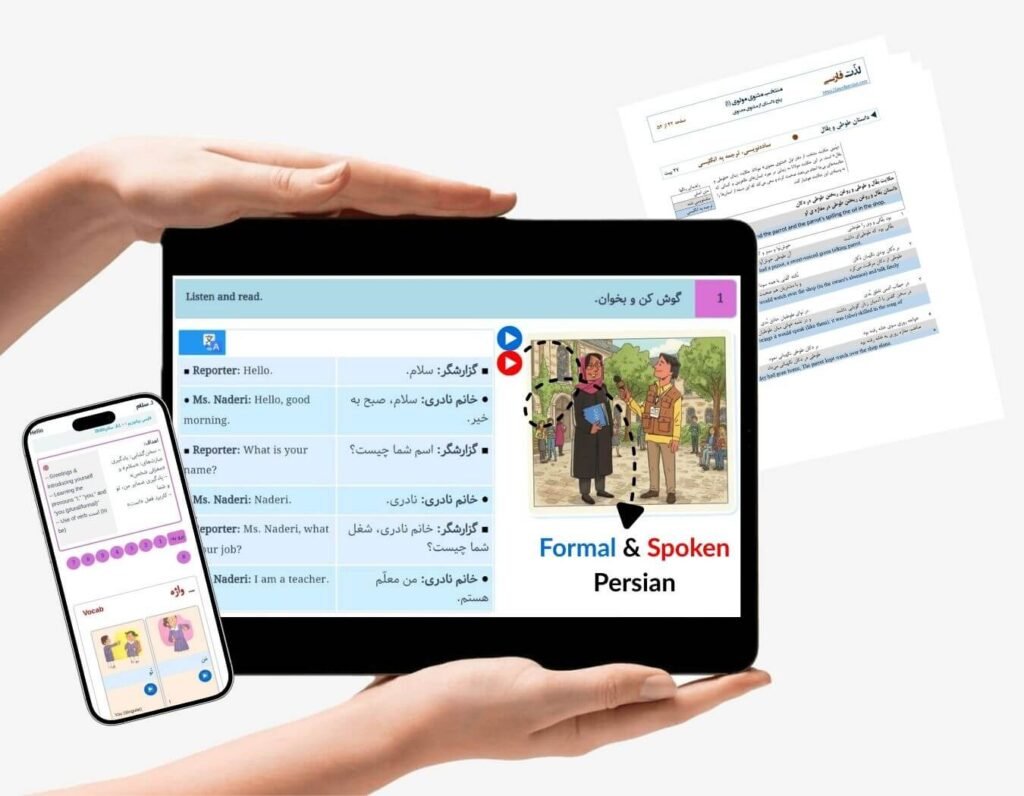
Build your Persian foundation — step by step, with clear lessons, dialogues, and guided practice.
Whether you’re connecting with your partner’s family, reclaiming your heritage, or starting your academic journey—this is the authentic foundation you won’t find on any app.
🏆 Based on an Award-Winning Book 🌟 Unparalleled Learner Experience 🔵Formal and 🔴Spoken Persian 📑 15 Engaging Lessons 📆 1-Year Access 💸 14-Day Guarantee
Ready to Let Your Persian Take Flight?
Skip the wait for Duolingo and start your journey here. From your first letters to classical literature, we’ve got you covered.

Persian Alphabet
– Effortless Persian: Learn Persian with Rumi
– The Complete Persian Alphabet (Coming Soon!)
→ Core Curriculum
– Let’s Learn Persian! (A1)
– Let’s Learn Persian! (A2)
– Let’s Learn Persian! (B1-1)
– Let’s Learn Persian! (B1-2) (Coming Soon!)

→ Beyond the Core

→ Persian Literature
Classical Texts:
– Golestan of Sa’di
– Masnavi of Rumi
– Rubaiyat of Khayyam
– History of Beyhaghi
Modern Texts:
– Little Black Fish
Conclusion: Your Persian Journey Deserves Better Than a Game
Persian is a language of emperors and poets. It deserves more than a 5-minute distraction while you wait for the bus. It deserves a guide.
We believe that a structured, university-quality foundation—not a game—is the best way to learn Persian. And to prove it, we take all the risk. Join the A1 Course today. If you don’t feel the difference in your first two weeks, we offer a 14-day money-back guarantee. No questions asked.
Whether you are Emily, wanting to bridge the gap with a new family; Kamran, seeking the missing piece of your identity; or Sara, chasing the wisdom of the ancients—your path is ready.
Frequently Asked Questions (FAQ)
Do you have a gamified app like Duolingo?
While we don’t have a gamified app like Duolingo (which, by the way, doesn’t currently offer Persian), Joy of Persian focuses on a deep, structured, and joyful learning experience that’s just as engaging—without relying on game mechanics.
Our core courses, such as Let’s Learn Persian! (A1), offer a university-level curriculum presented in an intuitive, interactive format. You’ll explore over 140 interactive exercises—including drag-and-drop matching, word search puzzles, and instant-feedback quizzes—that make learning feel fun and rewarding.
To help you build vocabulary naturally, you’ll also get over 160 interactive flashcards featuring Persian text, native audio, and English translation—designed to engage your eyes, ears, and memory all at once.
With dual audio tracks for formal and spoken Persian, clear progress tracking, and cultural immersion woven into each lesson, our platform makes learning both meaningful and motivating.
It’s perfect for beginners. You can even try the first lesson for free, no signup required.
📖 Read more: Will Duolingo finally add Persian? The definitive answer 2026 and the best alternatives
Do I need to learn the Persian alphabet (Perso-Arabic script)?
Yes, absolutely. While some beginner resources use Latin transliteration (Romanization), learning the script is essential for true fluency. All authentic Persian materials—books, news, social media, and even street signs—are written in the Perso-Arabic script. Relying solely on transliteration will limit you to a small subset of learning materials and prevent you from reading the vast and rich body of Persian literature and media.
If you’re new to the script, our Effortless Persian: Learn Persian with Rumi is the perfect starting point and is designed to get you reading confidently in a very short time.
Is Farsi a difficult language to learn for English speakers?
Farsi is generally considered a hard (“Category III”) language by the U.S. Foreign Service Institute (FSI), meaning it has significant linguistic differences from English but is far easier than “super-hard” languages like Arabic or Chinese.
While the main initial challenge is the script, the grammar is remarkably simple (no gender, no irregular conjugations). Once you master the alphabet, the path to fluency is straightforward.
Here is how Farsi compares to other popular languages in terms of study time required for professional proficiency:
| Category | Difficulty | Time Estimates | Language Examples |
| Category I | Easy | 24-30 weeks (552-690 class hours) | French, Italian, Portuguese, Spanish |
| Category II | Medium
| Approx. 36 weeks (828 class hours) | German, Indonesian |
| Category III | Hard | Approx. 44 weeks (1,012 class hours) | Farsi (Persian), Turkish, Greek, Hebrew, Russian |
| Category IV | Super-Hard | Approx. 88 weeks (2200 class hours) | Arabic, Chinese (Mandarin/Cantonese), Japanese, Korean |
Data based on U.S. Department of State Foreign Service Institute (FSI) estimates for native English speakers.
Is the language called “Persian” or “Farsi”?
“Persian” and “Farsi” refer to the same Indo-European language, spoken by approximately 110-130 million people worldwide, primarily in Iran, Afghanistan, and Tajikistan.
The difference lies in terminology:
- “Farsi” is the endonym (the name used by native speakers in Iran, derived from the Arabic pronunciation of “Parsi” due to the lack of a ‘P’ sound in Arabic)
- “Persian” is the exonym commonly used in English and other Western languages, tracing back to Greek and Latin roots.
“Persian” is often preferred in academic and international contexts as it encompasses related dialects like Dari (in Afghanistan) and Tajiki (in Tajikistan), which share the same roots but have regional variations in vocabulary, pronunciation, and script (e.g., Tajiki uses Cyrillic). In everyday use, both terms are acceptable—much like “Spanish” vs. “español”—but at Joy of Persian, we use “Persian” to reflect the broader cultural and literary heritage that connects speakers across borders.
I found other apps like “Ling” or “Mondly” that offer Farsi. Are they good alternatives?
Proceed with extreme caution. While it is tempting to use these apps because they look like Duolingo, they often suffer from the exact technical issues we described above.
For example, we recently analyzed the promotional material for the Ling App, which markets itself as a top Farsi alternative. In their own demonstration video, the Persian text is displayed with Left-to-Right (LTR) alignment, effectively spelling the sentences backward.
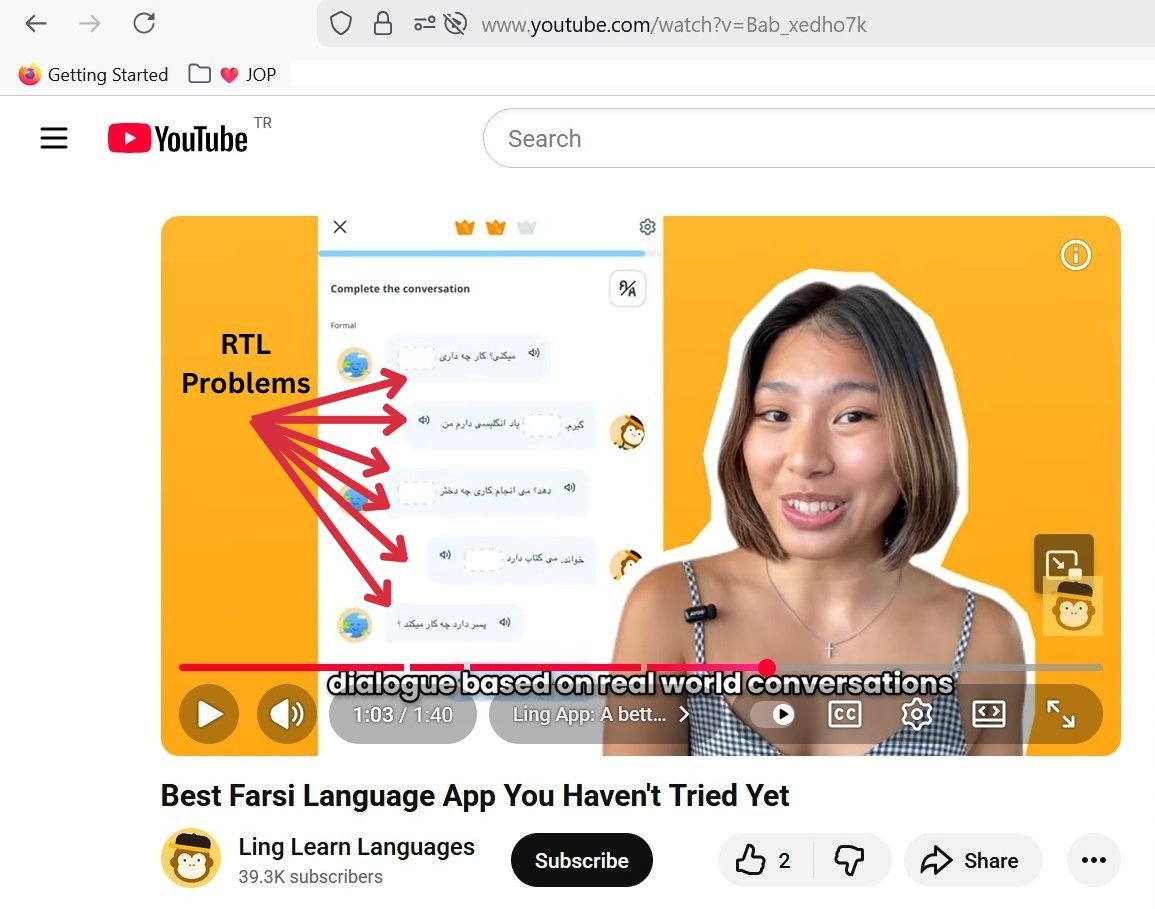
The Evidence: In the video, the Persian sentence “What is the girl doing?” (دختر چه کاری انجام میدهد؟) is displayed incorrectly as:
دهد؟می انجام کاری چه دختر
Notice the critical errors:
- Reversed Word Order: The subject (Girl) is on the far left instead of the right.
- Broken Prefix Form: The Zero-Width Non-Joiner in «میدهد» fails, causing the prefix «می» to detach and appear as «می» and «دهد».
- Displaced Punctuation: The question mark appears in the middle of the sentence rather than at the end.
The English Equivalent: To understand how confusing this is, imagine taking the English sentence “What is the girl doing?” and forcing it into the same broken structure. It would look like this:
ing? do girl the is What
The Result: If you try to read this as a Persian speaker, it is nonsense. You would have to force your brain to read Persian “backwards” to make sense of it.
This is a classic “cookie-cutter” app problem: developers take a code template built for English or Spanish and simply paste Persian words into it without adjusting the underlying engineering for Right-to-Left scripts.
Are there deeper historical or political reasons why Persian is often excluded?
Many scholars argue that the marginalization of a language with approximately 110–130 million speakers worldwide is not accidental. Historical processes like “De-Persianization” (Farsi-Zodayi) have involved deliberate efforts, often tied to colonial and political influences, to reduce Persian’s prominence in regions such as the Indian subcontinent, Central Asia, Afghanistan, and the Persian Gulf.
For example, in the 19th century, British colonial policies actively targeted Persian through “de-Persianization” projects to erode its cultural and administrative influence. While not directly proven to affect modern platforms like Duolingo, these long-standing attitudes may contribute to Persian’s underrepresentation in global language resources.
For deeper context, we recommend watching Professor Mohammad-Reza Shafiei Kadkani’s lecture at the University of Tehran. He explores these historical and political efforts to diminish Persian’s influence in the region.
Is there any chance Duolingo will add Farsi in the future?
While Farsi is one of the most highly requested languages on Duolingo’s forums, the likelihood of a course being added is low. Historically, Duolingo relied on community contributors to build courses, but the company has since shifted to an internal, AI-driven development model. Even when community-driven Farsi courses were proposed, they were not accepted by Duolingo staff [1] [2]. Given the significant technical and linguistic challenges outlined above, a Farsi course would require a major overhaul of Duolingo’s core teaching methodology, making it a low-priority investment for the company.
Why doesn’t Duolingo offer a Persian (Farsi) course?
As of late 2025, Duolingo does not offer a Persian (Farsi) course, and there is no public evidence of one being in development. The primary reasons are complex and structural, going beyond simple demand:
- Linguistic Challenge (Dual-Register System): Persian has a significant difference between its formal, written form (ketābi) and its colloquial, spoken form (goftāri). Duolingo’s translation-based model struggles to teach both simultaneously, which is essential for real-world fluency.
- Technical Hurdles (Right-to-Left Script): Persian uses a Right-to-Left (RTL) script. Duolingo’s platform, built primarily for Left-to-Right languages, has historically faced persistent and complex bugs when implementing RTL languages like Arabic and Hebrew. Fixing these for a new language is a significant engineering investment.
- Context and Culture: Persian is a “context-heavy” language where the correct translation depends heavily on the social relationship between speakers (e.g., the use of Taarof). Duolingo’s single-answer system cannot easily accommodate this linguistic nuance.
Don’t wait for 2026. Don’t wait for the green owl.
Stop wasting time on “cookie-cutter” apps that teach you backward Persian. Join a structured, university-grade course designed for real fluency.

Key Takeaways for the Reader (Summary)
- Duolingo Does Not Have Persian: Likely due to the engineering bugs caused by mixing Right-to-Left (RTL) scripts with English, and the difficulty of teaching Spoken vs. Written Persian simultaneously.
- Gamification Has Limits: Apps often create “Zombie Language” speakers—grammatically correct but socially awkward—because they miss cultural rituals like Taarof.
- A Better Alternative Exists: Joy of Persian isn’t just an app; it is a digital platform built on a respected university curriculum, featuring unique Dual-Register Audio (Formal + Spoken).
- The Best Next Step: Stop waiting for an update that may never come. Start the A1 Course today to master the alphabet and build a foundation that actually works in the real world.
 Add as a preferred source on Google
(Click the link and check the box next to our name)
Excellent article! The point about Farsi’s dual-register system is spot on. That’s the real reason Duolingo shouldn’t handle it — it would only teach a “zombie language.” Thanks for the clear explanation; it validates the frustration of so many learners who wish there was a course.
Thanks for reading, Mia! I’m glad the ‘Zombie Language’ concept resonated with you. It’s frustrating to spend months learning, only to realize native speakers don’t actually talk like that!
We built Joy of Persian precisely to bridge that gap. Hope you stick around for more articles!
I’ve been eager to learn Persian so I can connect more deeply with my husband’s family and culture—especially since we visit Iran often. I was hoping Duolingo would offer a Farsi course because I enjoy their fun, bite-sized lessons, but after reading this, I understand why it’s probably for the best that they don’t. The points about the differences between spoken and formal Persian and the script issues really hit home; I definitely don’t want to end up sounding awkward in conversations!
Your Joy of Persian platform sounds perfect. Do you offer any resources tailored for German speakers, such as comparisons to German grammar? I’d love to try the free A1 course.
Hi Lena,
Thank you for sharing your story! It’s wonderful that you are motivated to connect more deeply with your husband’s family—that emotional connection is the best fuel for learning a new language. You are absolutely right; understanding the nuance between spoken and written Persian is crucial to feeling confident in conversations.
Great news: We are releasing the A1 and A2 courses for German speakers very soon! Regarding the German grammar comparison, that’s a fantastic suggestion. We won’t include it in the initial launch to keep the focus on core communication skills, but we’ll definitely keep it in mind for the future.
Just a quick clarification: the first lesson is free for you to try, rather than the entire course.
Duolingo is completely free, which makes it accessible for everyone. With the title ‘Does Duolingo Have Persian? No, Try This Structured Alternative,’ I was expecting the article to recommend a free alternative as well, to keep things on par with Duolingo’s model. Any truly free options out there for learning Persian?
Hi Joshua,
Thank you for your feedback. You’ve touched on a very important point regarding accessibility.
Duolingo is a great tool for casual exposure, but its “free” model comes with trade-offs, such as repetitive algorithms and a freemium structure. At Joy of Persian, we offer a different value proposition. Our materials are curated by award-winning experts (like Dr. Leila) to provide the depth, cultural nuance, and structure that learners—especially those with Iranian partners or academic goals—often find missing in generic apps.
Producing high-quality, expert-led education requires significant resources, which is why our structured courses and workshops are paid. However, we want everyone to experience our method before committing. That’s why we offer the first lesson of ALL our courses for free—including our “Beyond the Core” series and our Classical Literature courses (like Sa’di and Rumi). This gives you hours of high-quality, structured learning at no cost.
You can also follow our growing YouTube channel (@JoyofPersian), where we are consistently adding more cultural and linguistic content. We believe this “try-before-you-buy” approach offers a fair balance between accessibility and professional quality. We hope you enjoy the free lessons!
Hi! I just read your post about Duolingo not having Persian and tried the A1 course demo — it’s really impressive! I’m genuinely excited and planning to buy the course to finally learn Farsi properly. 😊
I did notice though that the blog hasn’t been updated in quite a while, which made me a bit worried. With the current situation in Iran (the conflict and internet challenges), I wanted to kindly ask: are you still fully active, able to keep supporting the courses, and updating the material?
Thanks so much — really hope to hear from you!
Hi Alex,
Thank you so much for trying out the Let’s Learn Persian (A1) demo and for your kind words! We are thrilled to hear you enjoyed it and are ready to take the next step in learning Farsi.
Your concerns are completely understandable. The heartbreaking events and the current situation in Iran have deeply affected us personally, which understandably caused a temporary pause in our regular blog updates. However, please rest assured that Joy of Persian is fully active and running smoothly. Dr. Leila Seyedghasem, and I are based in Istanbul, which means our daily operations, website stability, and course support are completely unaffected by the internet disruptions inside Iran.
We are fully committed to our students and are always here to support you through the material. We would be absolutely delighted to welcome you to the course!
Please let me know if you have any other questions.