
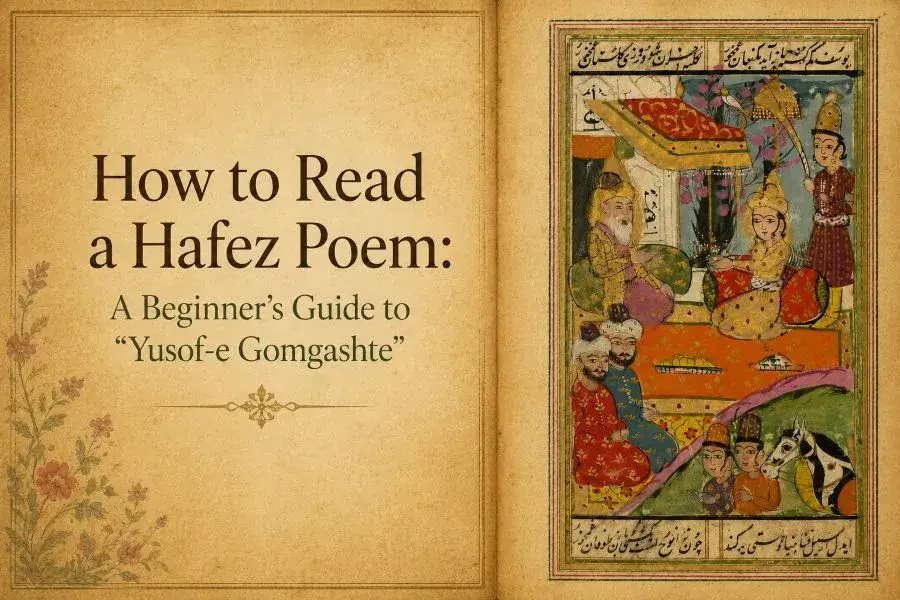
If you have ever wondered how to read a Hafez poem as a beginner, this guide is for you. We walk you through one of the best first Persian poems to read: Hafez’s ghazal beginning Yusof-e gomgashte baz āyad be Kan’ān (The lost Joseph will return to Canaan). You will get the Persian text, pronunciation, Yusof Gomgashte translation, and a step-by-step explanation of the poem’s imagery, sound, and meaning. No literary degree required. Just ten minutes and curiosity.
After a brief pause to recalibrate and reflect, Joy of Persian returns—with a renewed commitment to what we do best: guiding you into the heart of Persian language and literature.
Today, we begin with a threshold moment. Every Persian learner who has crossed from vocabulary lists into poetry remembers it: the first time a ghazal stopped feeling like homework and started feeling like home. For millions of Iranians across centuries, that threshold has a name. Hafez.
Before You Read: What You Need for This Persian Poetry Beginner’s Guide
This Persian poetry beginner’s guide is designed for learners who are not yet fluent in classical Persian. Here is what to expect:
- You do not need to know classical Persian grammar.
- You do not need to understand every word.
- Focus first on the refrain, imagery, and repeated symbols.
- Use the transliteration and translation together.
If you are not yet comfortable with Persian, start with our Persian language courses before diving into classical poetry.
Why This Is a Good Hafez Poem for Beginners
Hafez wrote roughly five hundred ghazals. We chose this one for three reasons that make it an ideal Hafez poem for beginners.
First, the refrain. Every couplet ends with the same two words: gham makhor (do not grieve). This repetition creates a musical structure you can feel even before you understand every word. It is the poet’s hand on your shoulder, again and again.
Second, the imagery. Hafez draws on stories most Persian speakers know from childhood: Joseph lost and found, Noah’s ark, the pilgrim’s journey to the Kaaba. These are not obscure references—they are the shared mythology of Persian culture. Understanding them opens a door.
Third, the accessibility. The grammar is within reach of an A2-B1 learner. The vocabulary is rich but not arcane. And the emotional message—resilience in the face of hardship—is universal.
In Iranian homes, reading Hafez is often a shared ritual—something you might encounter when meeting an Iranian family for the first time. Families gather, open the Divan at random, and read aloud. The poem that appears is interpreted as guidance, comfort, or prophecy. This practice, called fal-e Hafez, has continued for over six centuries.
Yusof Gomgashte Translation: Persian Text, Transliteration, and English Meaning
Below is the full text of Ghazal 255. We provide the original Persian, a simplified phonetic guide, and a line-by-line translation.
Listen along: We recommend reading while listening to the poem recited. The musicality of Persian poetry only fully reveals itself when heard. (Audio recording by Dr. Leila Seyed Ghasem available for Joy of Persian students.)
Couplet 1
| Persian | Phonetic | Translation |
|---|---|---|
| یوسفِ گُمگشته بازآید به کنعان، غم مخور | Yusof-e gom-gashte baz-āyad be Kan’ān, gham makhor | The lost Joseph will return to Canaan—do not grieve. |
| کلبهٔ احزان شَوَد روزی گلستان، غم مخور | Kolbe-ye ahzān shavad ruzi gols-tān, gham makhor | The house of sorrows will one day become a garden—do not grieve. |
Notes:
- Yusof = Joseph (of the Quranic/Biblical story, sold into slavery, reunited with his father)
- Kan’ān = Canaan, the homeland
- Kolbe = hut, humble dwelling; ahzān = sorrows
- Gols-tān = garden (literally “place of flowers”)
Couplet 2
| Persian | Phonetic | Translation |
|---|---|---|
| ای دل غمدیده، حالت به شود، دل بد مکن | Ey del-e gham-dide, hālat be shavad, del bad makon | O grief-stricken heart, your state will improve—do not despair. |
| وین سر شوریده باز آید به سامان، غم مخور | Vin sar-e shoride baz āyad be sāmān, gham makhor | This frenzied head will return to order—do not grieve. |
Notes:
- Gham-dide = sorrow-seen (one who has seen grief)
- Shoride = frenzied, scattered; sāmān = order, arrangement
Couplet 3
| Persian | Phonetic | Translation |
|---|---|---|
| گر بهار عمر باشد باز بر تخت چمن | Gar bahār-e omr bāshad baz bar takht-e chaman | If the spring of life remains, once more upon the throne of meadow, |
| چتر گل در سر کشی ای مرغ خوشخوان، غم مخور | Chatr-e gol dar sar kashi ey morgh-e khosh-khvān, gham makhor | You will hold a rose-parasol, O sweet-voiced bird—do not grieve. |
Notes:
- Bahār-e omr = spring of life (a common metaphor for youth/vitality)
- Takht-e chaman = throne of the meadow (poetic image of nature as kingdom)
- Chatr-e gol = umbrella/parasol of roses
Couplet 4
| Persian | Phonetic | Translation |
|---|---|---|
| دور گردون گر دو روزی بر مراد ما نرفت | Dowr-e gerdun gar do ruzi bar morād-e mā naraft | If the wheel of heaven for a day or two did not turn as we wished, |
| دائماً یکسان نباشد حال دوران، غم مخور | Dā’eman yeksān nabāshad hāl-e dowrān, gham makhor | The state of time is not forever the same—do not grieve. |
Notes:
- Dowr-e gerdun = the wheel of heaven (the celestial sphere, fate)
- Morād = wish, desire
Couplet 5
| Persian | Phonetic | Translation |
|---|---|---|
| هان مشو نومید چون واقف نهای از سر غیب | Hān masho nā-omid chon vāqef nahi az ser-e gheyb | Do not despair, for you are not aware of the hidden secret. |
| باشد اندر پرده بازیهای پنهان، غم مخور | Bāshad andar parda bāzi-hā-ye penhān, gham makhor | Behind the curtain, hidden plays unfold—do not grieve. |
Couplet 6
| Persian | Phonetic | Translation |
|---|---|---|
| ای دل ار سیل فنا بنیاد هستی برکند | Ey del ar sail-e fanā bonyād-e hasti bar-kanad | O heart, if the flood of annihilation uproots the foundation of being, |
| چون تو را نوح است کشتیبان ز طوفان، غم مخور | Chon torā Nuh ast kashti-bān ze tufān, gham makhor | Since Noah is your ship’s captain through the storm—do not grieve. |
Notes:
- Sail-e fanā = flood of annihilation/destruction
- Nuh = Noah; kashti-bān = ship’s captain/pilot
Couplet 7
| Persian | Phonetic | Translation |
|---|---|---|
| در بیابان گر به شوق کعبه خواهی زد قدم | Dar biābān gar be shouq-e Ka’beh khāhi zada qadam | If in the desert, longing for the Kaaba, you wish to set foot, |
| سرزنشها گر کند خار مغیلان، غم مخور | Sar-zanesh-hā gar konad khār-e moghilān, gham makhor | If the thorns of the moghil shrub rebuke you—do not grieve. |
Notes:
- Ka’beh = the Kaaba in Mecca
- Moghilān = a thorny shrub that grows in deserts
Couplet 8
| Persian | Phonetic | Translation |
|---|---|---|
| گر چه منزل بس خطرناک است و مقصد بس بعید | Gar che manzel bas khatarnāk ast va maqsad bas ba’id | Though the lodging is most dangerous and the destination most distant, |
| هیچ راهی نیست کآن را نیست پایان، غم مخور | Hich rāhi nist k-ān rā nist pāyān, gham makhor | There is no road that does not have an end—do not grieve. |
Couplet 9
| Persian | Phonetic | Translation |
|---|---|---|
| حال ما در فرقت جانان و ابرام رقیب | Hāl-e mā dar forqat-e jānān va ebrām-e raqib | Our state in separation from the beloved and the obstinacy of the rival, |
| جمله میداند خدای حال گردان، غم مخور | Jomle midānad Khodā-ye hāl-gardān, gham makhor | God, the changer of states, knows all—do not grieve. |
Notes:
- Forqat = separation; jānān = beloved (literally “life-giver”)
- Ebrām = obstinacy, stubbornness; raqib = rival
- Hāl-gardān = turner/changer of states (one of God’s attributes)
Couplet 10
| Persian | Phonetic | Translation |
|---|---|---|
| حافظا در کنج فقر و خلوت شبهای تار | Hāfezā dar konj-e faqr va khalvat-e shab-hā-ye tār | Hafez, in the corner of poverty and the solitude of dark nights, |
| تا بود وردت دعا و درس قرآن، غم مخور | Tā bud vard-at do’ā va dars-e Qor’ān, gham makhor | As long as your practice is prayer and the lesson of the Quran—do not grieve. |
Notes:
- Konj-e faqr = corner of poverty (humble circumstances)
- Vard = practice, routine; do’ā = prayer/supplication
How to Read This Hafez Poem Aloud
Persian poetry is meant to be heard, not just read. Before you analyze the meaning, listen to the music of the language.
The Refrain as Your Anchor Every couplet ends with the same two words: gham makhor (غم مخور). This is called the radif (ردیف)—the refrain that holds the poem together. When you listen to the recording, notice how gham makhor lands like a drumbeat at the end of each line. It creates a rhythm you can feel even if you do not understand every word.
Try this: read Couplet 1 aloud three times. Do not translate yet. Just feel the pause in the middle of each line, and the way gham makhor resolves the tension.
Reading with the Recording The best way to learn the rhythm is to shadow-read with Leila’s recording. Play one couplet. Pause. Read it aloud yourself, matching her pace. Notice where she breathes, where her voice rises, and where gham makhor settles.
For many Persian readers, Hafez is not approached word by word at first, but through recitation, repetition, and the music of the ghazal.
Key Images in This Hafez Poem for Beginners
Hafez does not lecture. He paints. Let us look at three key images in this Hafez poem for beginners and what they carry.
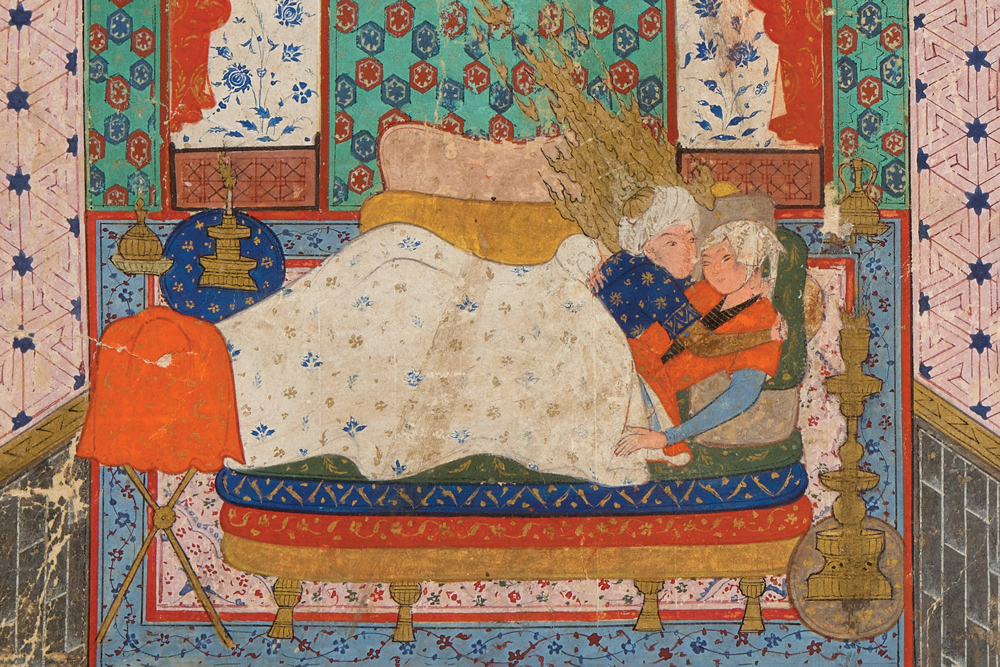
1. Joseph and Canaan
The story is familiar across Abrahamic traditions: Joseph, sold into slavery by his brothers, rises to power in Egypt, and is eventually reunited with his father Jacob in Canaan. For Persian readers, this is the ultimate narrative of return after loss. When Hafez says Yusof-e gom-gashte baz-āyad be Kan’ān, he is not just telling a Bible story. He is saying: what is lost will be found. What is broken will be mended.

Illustration via StockCake
2. The House of Sorrows / The Garden
Kolbe-ye ahzān (house of sorrows) vs. gols-tān (garden). This is one of the most powerful contrasts in Persian poetry. The kolbe is a hut, a poor dwelling. The gols-tān is abundance, color, life. Hafez promises transformation—not through effort, but through patience and faith.

Traditional Persian miniature of Noah’s Ark (Nuh’s ship) navigating the flood — Hafez’s image of divine protection even when existence itself is flooded.
3. Noah as Ship’s Captain
In the flood narrative, Noah saves humanity. Here, Hafez says: even if existence itself is flooded, you have a captain. The image is both terrifying (the flood) and comforting (the captain). This is classic Hafez: he acknowledges the darkness fully, then offers light.
Understanding the Meaning of Yusof Gomgashte
Now we move from image to idea. What is Hafez actually saying?
Layer 1: The Surface
On the surface, this is a poem of consolation. Bad times will pass. Things will get better. Do not despair.
Layer 2: The Philosophical
Hafez is a master of what scholars call the double register. Every image operates on two levels at once:
- Literal: Joseph, Noah, the Kaaba, the garden
- Metaphorical: The soul’s journey, divine protection, spiritual destination
The beloved (jānān) in Couplet 9 is not necessarily a human lover. In the Sufi tradition, the beloved is the Divine. The rival (raqib) is not a romantic competitor but the ego, or worldly distractions.
Layer 3: The Personal
In the final couplet, Hafez names himself: Hāfezā. This is not vanity. It is vulnerability. He places himself in the same konj-e faqr (corner of poverty) he asks us to endure. His comfort is not wealth or status, but do’ā va dars-e Qor’ān—prayer and the Quran.
This is why Iranians read Hafez in hard times. He does not preach from above. He sits beside you.
Common Mistakes When Reading a Hafez Poem for the First Time
Mistake 1: Reading too literally A beginner might ask: “Why is Hafez talking about Joseph and Noah? I just want to learn Persian.” The answer: these stories are the vocabulary of Persian emotional life. You would not ask why Shakespeare mentions Romeo. These references are not obstacles; they are keys.
Mistake 2: Ignoring the refrain Some readers skip the repeated gham makhor as redundant. It is not. In Persian music, the refrain (radif) is the structural spine. Each repetition deepens the meaning. By the tenth couplet, gham makhor is not advice—it is an incantation.
Your Turn: Practice Reading Your First Persian Poem
Here is a short exercise to lock in what you have learned.
Translate this couplet on your own:
“Gar che manzel bas khatarnāk ast va maqsad bas ba’id” “Hich rāhi nist k-ān rā nist pāyān, gham makhor”
Hints:
- Manzel = lodging, resting place
- Khatarnāk = dangerous
- Maqsad = destination
- Ba’id = distant
- Hich = none, nothing
- Pāyān = end
Check your translation against ours above.
Recap: What You Learned in This Persian Poetry Beginner’s Guide
In this guide, you learned how to read a Hafez poem through sound, imagery, and meaning. You discovered how gham makhor functions as a musical refrain, why Yusof-e gomgashte is such a good first Persian poem to read, and how to avoid the most common mistakes first-time readers make. If you would like to continue, the next step is to read another short ghazal with the same method—or to explore our Persian literature courses with expert guidance.
What Comes Next?
Not ready for classical poetry yet? Our “Selections from Persian Literature (1): Love, Mysticism, and Life” course is coming soon.
Join the Waitlist
Explore our Persian Literature courses: joyofpersian.com/courses/persian-literature
If you’re not yet comfortable with Persian, start with our language courses: joyofpersian.com/courses/persian-language
Did this guide help you read your first Persian poem? Let us know in the comments, or share which Hafez ghazal you would like us to explore next.
 Add as a preferred source on Google
(Click the link and check the box next to our name)