
The “Joy of Persian” Approach to Rapid Acquisition
If you’ve been following our guide to Learning Persian in 2026, you already know that fluency is a system, not a struggle. You’ve designed your PDCA cycle and committed to your Hamāse (حماسه). Now, it’s time for the first qiuck win.
Most learners look at the Persian script and see a fortress. We see a “paper tiger”, constructed of unfamiliar shapes rather than actual difficulty. The truth is, Persian is an Indo-European language, a distant cousin to English, French, and German, and it is teeming with open doors if you know where to look.
This Foundational Vocabulary Guide is not just a vocabulary list; it is a meticulously designed instructional roadmap. As instructional designers and language experts, we have analyzed thousands of words to curate the “First 100″—a strategic selection of words that bypass the usual hurdles of language learning. These words were chosen based on four specific criteria that lower the “cognitive load” (brain power) required to learn them:
- Cognates: Words you already know because they are borrowed from English or French.
- Non-Connecting Letters: Words that avoid cursive connections, making them look like printed letters.
- Phonetic Simplicity: Words that require no new muscle memory to pronounce (no throat-clearing sounds!).
- One-Syllable Essentials: Short, punchy words that form the atomic building blocks of the language.
Our philosophy at Joy of Persian is grounded in “comprehensible input” and the joy of discovery. We reject the “crutch” of transliteration (writing Persian in English letters, or “Finglish”). While it feels safe, transliteration actually slows down your brain’s ability to map sounds to the real script. Instead, we use these 100 “easy” words to prove to you that you can read and write the real script from day one. By the end of this article, you won’t just know 100 words; you will have dismantled the fear of the alphabet and replaced it with the confidence of a reader.
Note: At Joy of Persian, we do not use transliteration in our core Persian language courses (A1, A2, B1-1). We believe that long-term fluency comes from building a direct relationship between sound and the Persian script. This article, however, is different. It is written for a general audience—especially for learners who have just met the Persian alphabet. Here, transliteration is used deliberately and temporarily, liketraining wheels on a child’s bicycle: not as a crutch, but as a confidence-building aid. Our goal is not for you to rely on transliteration, but to outgrow it—and by the end of this list, to realize that you no longer need it.
Let’s embark on this journey—slow and steady, or as we say in Farsi, ahesteh ro peyvasteh ro.
Time to read:
Table of Contents
Part I: The Bridge of Cognates – Words You Already Know
The fastest way to build a vocabulary fortress is to use bricks you already own. For an English speaker, Persian is surprisingly generous. Due to shared Indo-European roots and a specific period of intense modernization in the 19th and 20th centuries, Persian absorbed a massive amount of vocabulary from French and, later, English.
These are not just random borrowings; they tell the story of modern Iran. When you use these words, you are tapping into a cultural history where Tehran was styled as the “Paris of the East,” and where modern technology entered the Iranian home through global channels.
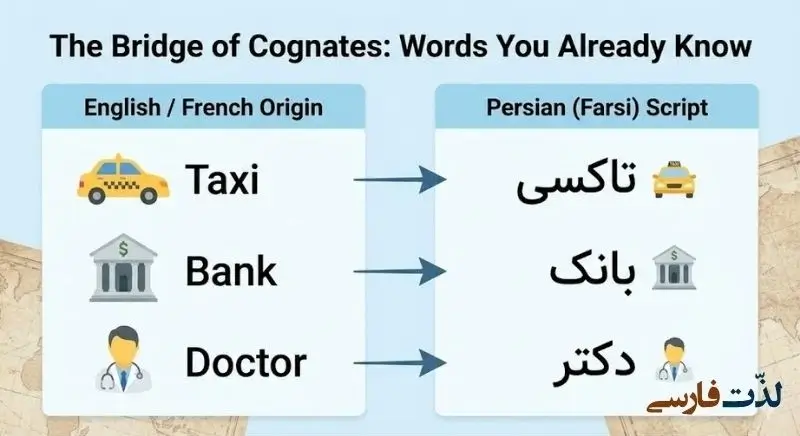
1.1 The French Connection: Domestic and Lifestyle Vocabulary
In the Qajar and Pahlavi eras, France was the model for Iranian education, law, and high culture. Consequently, a vast number of words related to the home, personal grooming, and social etiquette are direct imports from French.
For the beginner, this is a goldmine. The pronunciation is almost identical to the French original, often stripped of the nasal quality and given a crisp Persian articulation. This means you don’t need to learn the meaning—you only need to practice the spelling. This frees up 50% of your brain’s processing power to focus entirely on the script.
Table 1: Essential French Cognates (The “Free” Vocabulary)
| Persian Script | Transliteration | French Origin | English Meaning | Note |
| مرسی | mersi | Merci | Thank you | While mamnoon is the Arabic-root standard, mersi is universally used… |
| دوش | dush | Douche | Shower | Identical sound. Writing it teaches you the sh sound (ش) instantly. |
| آسانسور | āsānsor | Ascenseur | Elevator | |
| کادو | kādo | Cadeau | Gift | |
| مانتو | mānto | Manteau | Overcoat | In Iran, this refers to the long tunic/coat women wear in public. |
| بلوز | boluz | Blouse | Blouse | |
| ژاکت | zhāket | Jaquette | Jacket | Uses zh (ژ). |
| کراوات | kerāvāt | Cravate | Tie | |
| سالن | sālon | Salon | Lounge / Hall | Living room (sālon-e pazirāyi) or a beauty salon. |
| آژانس | āzhāns | Agence | Agency | Used for service/intermediary offices; historically also call-based taxis. |
| شامپو | shāmpu | Shampooing | Shampoo | Great for practicing p (پ), absent in Arabic. |
| پرو | poro | Preux / Prova | Fitting | Otāgh-e poro = fitting room. |
| مبل | mobl | Meuble | Sofa | Western-style furniture vs. floor cushions (poshti). |
| توالت | toālet | Toilette | Toilet / Restroom | Interchangeable with dastshuyi. |
| لوستر | luster | Lustre | Chandelier | |
| کمد | komod | Commode | Closet / Cabinet | French commode is still commonly used, but its meaning is narrower than Persian کمد. In French, it specifically means a chest of drawers or dresser, whereas کمد is a broader term covering wardrobes, cupboards, and storage cabinets. |
| سشوار | seshuār | Sèche-cheveux | Hairdryer | |
| بالکن | bālkon | Balcon | Balcony | |
| دسر | deser | Dessert | Dessert | |
| سوپ | sup | Soupe | Soup | |
| کتلت | kotlet | Côtelette | Cutlet | |
| سس | sos | Sauce | Sauce | Usually ketchup or mayonnaise. |
| ژامبون | zhāmbon | Jambon | Ham / Cold Cuts | Deli meats (often beef or chicken in Iran). |
| فامیل | fāmil | Famille | Family / Relative | Extended family / relatives. |
| کافه | kāfe | Café | Café |
Instructional Note: When practicing these words, focus on the vowels. Persian “O” is consistent (like “go”), and Persian “A” (Alef) is deep (like “ball”). French loanwords usually retain their original vowel qualities, making them excellent practice for vowel discrimination without the confusion of shifting pronunciations.
1.2 The Technological and Modern Layer (English Imports)
As the 20th century turned into the 21st, English became the primary donor for technical, medical, and global concepts. Because Persian phonology doesn’t like starting a word with a consonant cluster (like “Sc” in “Scanner” or “St” in “Stop”), these words often gain a “helper vowel” at the beginning, usually an “Eh” sound (Epenthesis).
For example, “Skeleton” becomes Es-ke-let. This predictable shift makes them easy to identify and spell.
Table 2: Tech, Travel, and Modern Life Cognates
| Persian Script | Transliteration | English Word | Orthographic/Phonetic Notes |
| بانک | bānk | Bank | Note the “Alef” (ا). Persian uses a long “ā” here, (like “a” in spa or father. |
| پست | post | Post (Mail) | Identical. Used for the post office (edāre-ye post). |
| تلفن | telefon | Telephone | Identical. |
| اینترنت | internet | Internet | Identical. |
| کامپیوتر | kāmpiyuter | Computer | Often pronounced “kām-pyu-ter.” |
| لپتاپ | laptāp | Laptop | Identical. |
| اسکنر | eskaner | Scanner | Note the initial vowel “e” added to break the “sc” cluster. |
| استادیوم | estādiyom | Stadium | “es-tā-diom.” Another example of the helper vowel. |
| پارک | pārk | Park | Very common. Iranians love picnicking in parks. |
| پلیس | polis | Police | Identical. |
| دکتر | doktor | Doctor | Identical. |
| هتل | hotel | Hotel | The “H” is fully aspirated (breathed out), never silent like in French. |
| اتوبوس | otobus | Bus | From “Autobus.” |
| تاکسی | tāksi | Taxi | Identical. |
| تراکتور | terāktor | Tractor | |
| هلیکوپتر | helikopter | Helicopter | Identical. |
| ترافیک | terāfik | Traffic | Unfortunately, a very common word in Tehran! |
| کلاس | kelās | Class | Used for school or distinct style (“High class”). |
| موزیک | muzik | Music | Often used for pop/western music; musighi is more formal/traditional. |
| فیلم | film | Film/Movie | Used for both camera film and movies. |
| سریال | seryāl | Serial (TV) | Refers to TV series. |
| سایز | sāyz | Size | Used in shopping: “sāyz-e man…” (My size…). |
| تیم | tim | Team | Used in sports: “tim-e melli” (National Team). |
| فوتبال | futbāl | Football | Note the “Alef” (ا). Persian uses a long “ā” here. |
| والیبال | vālibāl | Volleyball | Note the “Alef” (ا). Persian uses a long “ā” here. |
The “False Friend” Alert:
While navigating cognates, be aware of subtle shifts. A ماشین (Mashin) refers to a “Car” in general, not just a machine. ساندویچ (Sandevich) is a sandwich, but usually refers to a specific type of sub/hoagie, not sliced bread.7
Part II: The “Seven Rebellious Letters” – Script Hacking for Beginners
If the Persian script is a river, cursive connections are the currents that make it flow. But for a beginner, that flow can be drowning. The shapes change: a letter looks one way at the start of a word, another way in the middle, and a third way at the end.
But there is a “hack.”
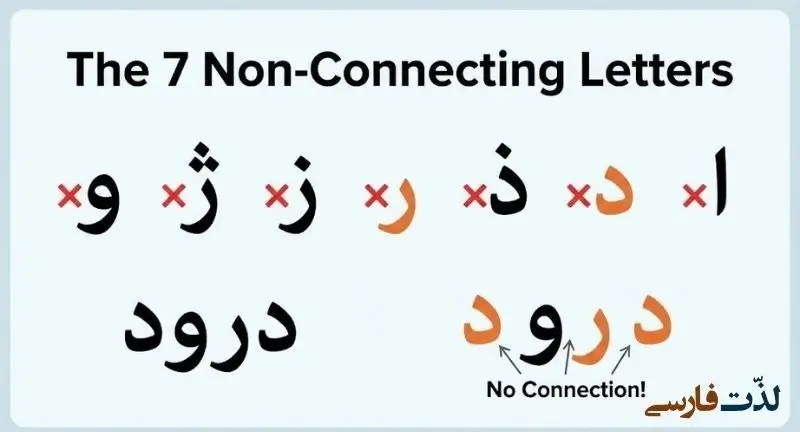
There are seven letters in the Persian alphabet that refuse to connect to the letter on their left (the letter that follows them). We call them the Non-Connecting Letters or the “Rebellious Seven”.
These letters are:
- Alef (ا)
- Dal (د)
- Zal (ذ)
- Re (ر)
- Ze (ز)
- Zhe (ژ)
- Vav (و)
Why is this the “Easiest” category?
When a word is made entirely of these letters, it behaves like English typing. The letters stand side-by-side with a tiny gap between them. They do not morph. They do not stack. They look exactly like they do on the keyboard. This makes them the perfect starting point for handwriting practice.
By combining these seven letters, we can generate a powerful list of words that require zero knowledge of cursive joining rules. These are the “training wheels” of Persian orthography.
Table 3: The “Disjoined” Word List (Spelling Made Simple)
| Persian Word | Transliteration | Meaning | Analysis & Mnemonic |
| درود | dorud | Greeting, Salutation, Hello | A formal or literary greeting |
| داد | dād | Gave | A palindrome in script! Looks identical forward and backward. |
| دود | dud | Smoke | The Vav (و) makes an “u” sound here, like “oo” in food or moon. |
| رود | rud | River | |
| روز | ruz | Day | Essential for “Ruz bekheyr” (Good day). |
| زود | zud | Quick/Early | “Zud bash!” means “Hurry up!” |
| درد | dard | Pain | |
| زرد | zard | Yellow | A primary color. No vowel written (short ‘a’ is implied). |
| آزاد | āzād | Free | |
| آزار | āzār | Hurt/Harm | |
| آرد | ārd | Flour | |
| اردو | ordu | Camp | Originally a Turkish/Mongol loan word. |
| دارو | dāru | Medicine | Easy to read on a pharmacy sign (darukhane). |
| داور | dāvar | Referee/Judge | Common in sports context. |
| راز | rāz | Secret | |
| آرزو | ārezu | Wish | Also a popular girl’s name. |
| دراز | derāz | Long | |
| زور | zur | Force/Power | |
| ارز | arz | Currency/Value | Seen in banks and exchange shops. |
| آواز | āvāz | Song/Singing | |
| آوار | āvār | Rubble, Debris | |
| زار | zār | Weeping | |
| دو | do | Two | |
| رادار | rādār | Radar | |
| ورود | vorud | Entry, Entrance, Access | Common on public and official signs (e.g. Entrance / No Entry). |
Handwriting Tip: When writing these words, ensure you lift your pen completely between each letter. This spacing is crucial. If you drag the pen, you might accidentally create a connection that turns a Dal (د) into a Re (ر) look-alike. Respect the gap!
Part III: Phonetic Simplicity – The “No Throat-Clearing” Zone
One of the biggest anxieties for new Persian learners is the reputation of “guttural” sounds. Yes, Persian has the خ (Khe – like the Scottish ‘Loch’) and the ق/غ (Ghayn/Qaf – a voiced uvular stop deep in the throat). While you will eventually master these, you don’t need them to start speaking.
This category focuses on Somatic Ease. These words use sounds made at the front of the mouth—the lips (Labial) and the teeth (Dental). They require no new muscle memory for an English speaker. They are physically relaxing to say.
3.1 The Body and Self
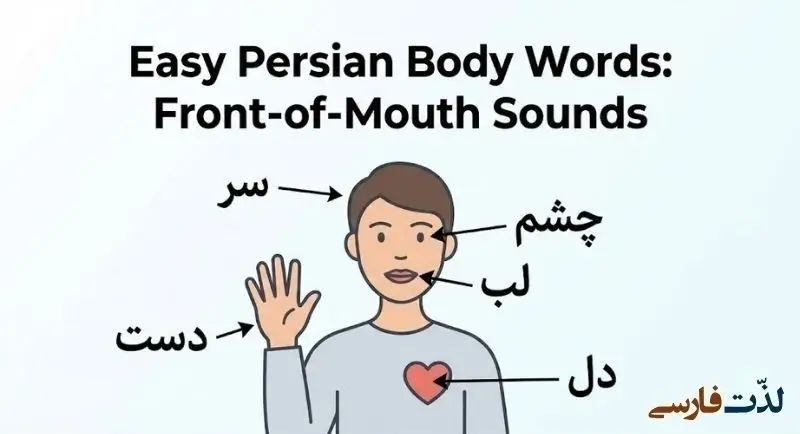
The words for basic body parts in Persian are remarkably simple and often cognate with English due to shared Indo-European roots.
Table 4: Front-of-Mouth Body Vocabulary
| Persian Word | Transliteration | Meaning | Why it’s Easy |
| سر | sar | Head | |
| پا | pā | Foot/Leg | Related to “pod” and “ped”. |
| دست | dast | Hand | |
| مو | mu | Hair | Like the sound a cow makes. “Moo.” |
| لب | lab | Lip | Cognate! |
| دل | del | Heart | Rhymes with “Bell.” The center of Persian emotions. |
| کمر | kamar | Waist/Back | Source of the English word “Cummerbund” (Kamar-band). |
| تن | tan | Body | |
| رگ | rag | Vein | |
| دندان | dandān | Tooth | Cognate with “Dental.” |
| ابرو | abru | Eyebrow | Cognate! |
Table 4b: The Self (Identity, Family, and Being)
| Persian Word | Transliteration | Meaning | Why it’s Easy |
| نام | nām | Name | Cognate! Essential for introductions: nām-e man … ast. |
| مادر | mādar | Mother | The Indo-European Ancestry Cognate. Shares the PIE root méh₂tēr. |
| پدر | pedar | Father | The Indo-European Ancestry Cognate. Preserves the hard ‘p’ from PIE ph₂tḗr. |
| برادر | barādar | Brother | The Indo-European Ancestry Cognate. A three-syllable archaic structure matching Sanskrit Bhratar. |
| دختر | dokhtar | Daughter, Girl | The Indo-European Ancestry Cognate. (Contains ‘Kh’ but the similarity overrides difficulty). |
| من | man | Me/I | |
| تو | to | You | Cognate with Latin/French “Tu.” |
| او | u | He/She | Just a single vowel sound! |
| ما | mā | We | |
| بد | bad | Bad | Cognate! |
| بهتر | behtar | Better | Cognate! “Better” = “Behtar.” |
| است | ast | Is | Cognate! German “Ist”, Latin “Est.” |
| نیست | nist | Is not | The ‘N’ acts as the negative prefix “Not.” |
| بود | bud | Was | Simple CVC pattern. |
3.2 Nature and Elements
Nature vocabulary often consists of primordial, short words, many of them monosyllabic. These words invoke the natural world with soft, flowing sounds (liquids and nasals).
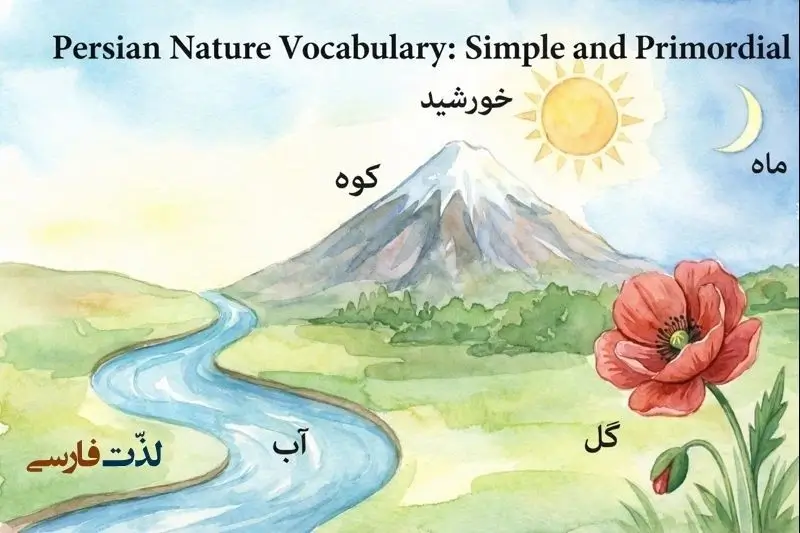
| Persian | Transliteration | English | Notes |
| آب | āb | Water | |
| باد | bād | Wind | Pronounced close to “bod” in body. |
| باران | bārān | Rain | |
| ابر | abr | Cloud | |
| گل | gol | Flower | Hard g as in go; essential in poetry. |
| برف | barf | Snow | Crisp sound; false friend with English slang. |
| دریا | daryā | Sea | |
| کوه | kuh | Mountain | |
| ماه | māh | Moon / Month | Soft, breathy h at the end; romantic tone. |
| ستاره | setāre | Star | Cognate with star (via Greek aster). |
| نور | nur | Light |
Joy of Persian Tip: Practice “Phonetic Anchoring.”
Touch your lip and say lab. Touch your head and say sar.
Connecting sound with physical sensation helps your brain form direct sound–meaning links, reducing the need for mental translation.
Part IV: One-Syllable Essentials – The Atomic Power of Persian
Persian is an agglutinative language, meaning it builds complex words by adding suffixes to simple roots. Often, the root word is a single syllable. Learning these “atomic” words gives you the highest return on investment because they appear inside thousands of other words.
4.1 The “Imperative” Verb Roots
In Persian, the shortest form of a verb is the command (Imperative). Even if you don’t want to command people, knowing these roots helps you spot the verb in a complex sentence.
| Persian (Root) | Imperative (Colloquial) | Transliteration | Core Meaning | Verb | Common Phrase (Persian) | Common Phrase (English) |
| کن | بکن / کن | bekon / kon | Do | kardan | یه کم صبر کن | Wait a bit. |
| گو | بگو | begu | Say | goftan | بگو ببینم | Go on, tell me. |
| ده | بده | bede | Give | dādan | بده به من | Give it to me. |
| آ | بیا | biyā | Come | āmadan | بیا اینجا | Come here. |
| رو | برو | boro | Go | raftan | برو جلو | Go ahead / Move forward. |
| بر | ببر | bebar | Carry / Take | bordan | ببرش اونجا | Take it over there. |
| زن | بزن | bezan | Hit / Strike | zadan | زنگ بزن | Call (me). |
| گیر | بگیر | begir | Take / Hold | gereftan | اینو بگیر | Take this. |
| بین | ببین | bebin | See | didan | اینو ببین | Look at this. |
| گذار | بگذار | begzār | Put | gozāshtan | اونو کنار بگذار | Put that aside. |
4.2 Short and Familiar Persian Words
This list mixes high-frequency core words with familiar everyday nouns chosen for their simplicity and sound patterns.
Table 5: Short and Common Persian Words
| Persian Word | Transliteration | Meaning | Note |
| میز | miz | Table | |
| در | dar | Door | Cognate! “Door” = “Dar.” |
| نان | nān | Bread | The most essential food item. “Nun” in colloquial speech. |
| پول | pul | Money | Sounds like “Pool.” Everyone needs “pul”! |
| زن | zan | Woman | Central to the phrase zan, zendegi, āzadi (Woman, Life, Freedom). |
| مرد | mard | Man | |
| بام | bām | Roof | “bām-e tehrān” is a famous roof-top park in Tehran. |
| شام | shām | Dinner | |
| چای | chāy | Tea | The lifeblood of Iran. |
| جا | jā | Place | “jā” or “jāy” jā-ye pārk (Parking spot). |
| کار | kār | Work | “Sar-e kar” (At work). |
| بار | bār | Load/Luggage | Also used for “Times” (yek bār – One time). |
| باز | bāz | Open | “dar bāze” (The door is open). |
| تار | tār | String/Dark | Also a traditional musical instrument. |
| مار | mār | Snake | |
| مور | mur | Ant | Tiny word for a tiny insect (Literary / classical form). |
| یا | yā | Or | A useful conjunction. |
| با | bā | With | “bā man biyā” (Come with me). |
| تا | tā | Until/Count | “tā fardā” (Until tomorrow). Also counts items (Do ta – Two of). |
| که | ke | That/Who | The most common connector word (relative pronoun). |
| چه | che | What | “Che” or “Chi.” |
Deep Dive: “nan” (Bread)
The word نان (nan) is deceptive. It looks simple—Nun, Alef, Nun. But it carries immense weight. In Iran, bread is not a side dish; it is the utensil, the plate, and the meal. It is sacred; if dropped, it is kissed and placed on a high ledge. Writing this word connects you to thousands of years of agriculture and hospitality. When you write Nan, you are writing civilization.
Part V: Instructional Strategy – How to Master the List
You have the categories. Now, how do you actually learn them without rote memorization? At Joy of Persian, we advocate for active, creative learning methods that engage your motor skills and your emotions.
5.1 The Bullet Journal (BuJo) Method
Bullet Journaling is a perfect companion for language learning because it is customizable and analog. Writing by hand helps encode the script into your brain better than typing.
Activity: Create a “First 100” Tracker
- The Spread: Open a fresh page. Title it “The Joy of Persian First 100.”
- The Grid: Draw a grid with 4 columns: Word (Persian), Pronunciation, Meaning, Mastery Check.
- The Daily 5: Do not try to learn all 100 at once. Pick 5 words per day.
- Write the word.
- Draw a tiny icon next to it (e.g., a drop for آب).
- Write a simple sentence using است (ast – is).
- Example: نان گرم است (nān garm ast – Bread is warm).
- The Migration: At the end of the week, migrate any words you didn’t master to the next week’s spread. This reduces the guilt of “falling behind”.
5.2 The “No Finglish” Rule
You will notice we provided transliteration (English letters) in the tables. Use this only to check your pronunciation. Do not write the English letters on your flashcards or in your journal.
Why? If you write “Nan” next to نان, your eye will naturally drift to the English letters because they are familiar. Your brain will skip the hard work of decoding the Persian script. This is the “crutch” that keeps students on the Intermediate Plateau for years. Force your brain to grapple with the script. It will be hard for 3 days, and then suddenly, it will be easy forever.
5.3 Musical Immersion
Many of the words in the “Nature” and “One-Syllable” categories appear frequently in Persian pop and traditional music.
- Activity: Listen to a classic song (like “Soltān-e Ghalbhā“).
- Task: Don’t try to understand the whole song. Just listen for your “First 100.” When you hear دل (Del – Heart) or یار (Yār – Friend/Lover), tally it in your journal. This is “active listening” and it trains your ear to pick out distinct words from the stream of speech.
Conclusion: Your “Quick Win” Roadmap
The perception of Persian as a “difficult” language is a myth. It is an Indo-European language dressed in different clothes. By stripping away the complex calligraphy and the guttural sounds in the early stages, we reveal a language that is welcoming, logical, and deeply connected to languages you already know.
These 100 words are your “Quick Win.” They are the keys to the city. With them, you can navigate a Tehran street (tāxi, bānk, hotel), express your basic needs (āb, nān, pul), and describe the world around you (garm, sard, khub).
Don’t wait for the “perfect” time to start. Grab a notebook. Write آب (Water). Then write نان (Bread). Congratulations—you are now a writer of Persian.
Happy Learning!
The Joy of Persian Team
 Add as a preferred source on Google
(Click the link and check the box next to our name)